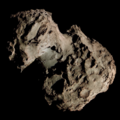
| 👁 Image The nucleus of Comet Borrelly as seen by NASA's Deep Space 1 mission in 22 September 2001. | |
| Discovery | |
|---|---|
| Discovered by | Alphonse Borrelly |
| Discovery site | Marseille, France |
| Discovery date | 28 December 1904 |
| Designations | |
| P/1904 Y2, P/1911 S1 | |
| |
| Orbital characteristics[2][3] | |
| Epoch | 9 August 2022 (JD 2459800.5) |
| Aphelion | 5.90 AU |
| Perihelion | 1.306 AU |
| Semi-major axis | 3.61 AU |
| Eccentricity | 0.6377 |
| Orbital period | 6.85 years |
| Inclination | 29.30° |
| Last perihelion | 1 February 2022 |
| Next perihelion | 11 December 2028[1] |
| Earth MOID | 0.36 AU |
| Physical characteristics[2] | |
| Dimensions | 8.0 × 4.0 × 4.0 km (5.0 × 2.5 × 2.5 mi)[4] |
| Mass | 2×10¹³ kg[a] |
Mean density | 0.3 g/cm3[5] |
| 0.022[6] | |
| Comet total magnitude (M1) | 9.8 |
| Comet nuclear magnitude (M2) | 13.2 |


| Perihelion distance at recent epochs[3] | |||||||
| Epoch | Perihelion (AU) | ||||||
|---|---|---|---|---|---|---|---|
| 2028 | 1.310[1] | ||||||
| 2022 | 1.306 | ||||||
| 2015 | 1.349 | ||||||
| 2008 | 1.355 | ||||||
Comet Borrelly /bɒˈrɛli/ or Borrelly's Comet (official designation: 19P/Borrelly) is a comet with a period of 6.85 years that was visited by the Deep Space 1 spacecraft in 2001. The comet last came to perihelion (closest approach to the Sun) on 1 February 2022[3][7] and will next come to perihelion on 11 December 2028.[1]
| Date & time of closest approach |
Earth distance (AU) |
Sun distance (AU) |
Velocity wrt Earth (km/s) |
Velocity wrt Sun (km/s) |
Uncertainty region (3-sigma) |
Reference |
|---|---|---|---|---|---|---|
| 2028-Dec-05 19:12 ± 6 min | 0.413 AU (61.8 million km; 38.4 million mi; 161 LD) | 1.31 AU (196 million km; 122 million mi; 510 LD) | 17.3 | 33.3 | ± 35 thousand km | Horizons |
Deep Space 1 returned images of the comet's nucleus from 3400 kilometers away. At 45 meters per pixel, it was the highest resolution view ever seen of a comet up until that time.[8]
Discovery
[edit]The comet was discovered by Alphonse Borrelly during a routine search for comets at Marseille, France on 28 December 1904.[citation needed]
Exploration
[edit]Deep Space 1 flyby
[edit]

Deep Space 1 · 9969 Braille · Earth · 19P/Borrelly
On 21 September 2001 the spacecraft Deep Space 1, which was launched to test new equipment in space, performed a flyby of Borrelly. It was steered toward the comet during the extended mission of the craft, and presented an unexpected bonus for the mission scientists. Despite the failure of a system that helped determine its orientation, Deep Space 1 managed to send back to Earth what were, at the time, the best images and other science data from a comet.


Notes
[edit]- ^ Using the volume of an ellipsoid of 8x4x4 km * a rubble pile density of 0.3 g/cm3 yields a mass (m=d*v) of 2.0×10¹³ kg
References
[edit]- ^ a b c "Horizons Batch for 19P/Borrelly (90000305) on 2028-Dec-11" (Perihelion occurs when rdot flips from negative to positive). JPL Horizons. Archived from the original on 11 February 2023. Retrieved 6 July 2023. (JPL#K222/14 Soln.date: 2023-May-25)
- ^ a b "19P/Borrelly – JPL Small-Body Database Lookup". ssd.jpl.nasa.gov. Jet Propulsion Laboratory. Retrieved 20 December 2025.
- ^ a b c MPC
- ^ H. A. Weaver; S. A. Stern; J. W. Parker (2003). "Hubble Space Telescope STIS Observations of Comet 19P/Borrelly during the Deep Space 1 Encounter". The Astronomical Journal. 126 (1). The American Astronomical Society: 444–451. Bibcode:2003AJ....126..444W. doi:10.1086/375752.
- ^ D. T. Britt; G. J. Consol-magno; W. J. Merline (13–17 March 2006). Small Body Density and Porosity: New Data, New Insights (PDF). 37th Annual Lunar and Planetary Science Conference. League City, Texas. Bibcode:2006LPI....37.2214B.
- ^ Robert Roy Britt (29 November 2001). "Comet Borrelly Puzzle: Darkest Object in the Solar System". Space.com. Archived from the original on 22 January 2009. Retrieved 16 December 2008.
- ^ Seiichi Yoshida (3 April 2021). "19P/Borrelly". Seiichi Yoshida's Comet Catalog. Retrieved 15 June 2022.
- ^ Beatty, Kelly (25 June 2004). "Meet Comet Borrelly". Sky & Telescope. Retrieved 27 January 2021.
External links
[edit]- 19P/Borrelly at the JPL Small-Body Database
- 19P/Borrelly at Gary W. Kronk's Cometography
- 19P/Borrelly at Kazuo Kinoshita's website
- Elements and Ephemeris for 19P/Borrelly – Minor Planet Center

.png)