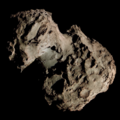
| 👁 Image Infrared image of Comet Clark taken by NEOWISE on 9 September 2017 | |
| Discovery | |
|---|---|
| Discovered by | Michael Clark |
| Discovery date | 9 June 1973 |
| Designations | |
| P/1973 L1, P/1978 G1 | |
| |
| Orbital characteristics | |
| Epoch | March 6, 2006 |
| Aphelion | 4.685 AU |
| Perihelion | 1.562 AU |
| Semi-major axis | 3.124 AU |
| Eccentricity | 0.4999 |
| Orbital period | 5.521 a |
| Inclination | 9.4883° |
| Last perihelion | 21 January 2023[1] |
| Next perihelion | 28 September 2028[2] |
| Physical characteristics | |
Mean radius | 0.83 km (0.52 mi)[3] |
| 0.035 (assumed) | |
| (V–R) = 0.64±0.07[4] | |
| Comet total magnitude (M1) | 11.1 |
| Comet nuclear magnitude (M2) | 14.6 |


71P/Clark is a periodic comet in the Solar System with an orbital period of 5.5 years.
It was discovered by Michael Clark at Mount John University Observatory, New Zealand on 9 June 1973 with a brightness of apparent magnitude 13. Subsequently it has been observed in 1978, 1984, 1989, 1995, 2000, 2006, 2011[5] and 2017.[6]
Physical characteristics
[edit]The nucleus of the comet has a radius of 0.68 ± 0.04 km (0.423 ± 0.025 mi), assuming a geometric albedo of 0.04, based on observations by Hubble Space Telescope,[4] while observations by Keck indicate a radius of 1.305 km (0.811 mi).[7] Another study in 2006 places the nuclear radius around 0.83 km (0.52 mi) assuming that it has a geometric albedo of 0.035±0.012.[3]
References
[edit]- ^ MPC
- ^ "Horizons Batch for 71P/Clark (90000724) on 2028-Sep-28" (Perihelion occurs when rdot flips from negative to positive). JPL Horizons. Retrieved 2023-07-06. (Soln.date: 2023-Jul-05)
- ^ a b G. Tancredi; J. A. Fernández; H. Rickman; J. Licandro (2006). "Nuclear magnitudes and the size distribution of Jupiter family comets". Icarus. 182 (2): 527–549. Bibcode:2006Icar..182..527T. doi:10.1016/j.icarus.2006.01.007.
- ^ a b P. L. Lamy; I. Toth; H. A. Weaver; M. F. A'Hearn; L. Jorda (2009). "Properties of the nuclei and comae of 13 ecliptic comets from Hubble Space Telescope snapshot observations" (PDF). Astronomy & Astrophysics. 508 (2): 1045–1056. Bibcode:2009A&A...508.1045L. doi:10.1051/0004-6361/200811462. S2CID 125249770.
- ^ "71P/Clark". Cometography. Retrieved 25 February 2015.
- ^ "APOD 2017, May 27 - Comet Clark is near the Edge". Retrieved 27 May 2017.
- ^ K. J. Meech; O. R. Hainaut; B. G. Marsden (2004). "Comet nucleus size distributions from HST and Keck telescopes". Icarus. 170 (2): 463–491. Bibcode:2004Icar..170..463M. doi:10.1016/j.icarus.2004.03.014.
External links
[edit]- 71P/Clark at the JPL Small-Body Database
- 71P/Clark – Seiichi Yoshida @ aerith.net

.png)