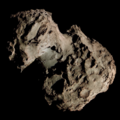
| Discovery | |
|---|---|
| Discovered by | Clement J. Taylor |
| Discovery site | Cape Town, South Africa |
| Discovery date | 24 November 1915 |
| Designations | |
| D/1915 W1 P/1976 X1 | |
| |
| Orbital characteristics[2][3] | |
| Epoch | 21 November 2025 (JD 2461000.5) |
| Observation arc | 103.28 years |
| Number of observations | 854 |
| Aphelion | 5.489 AU |
| Perihelion | 2.271 AU |
| Semi-major axis | 3.879 AU |
| Eccentricity | 0.41469 |
| Orbital period | 7.641 years |
| Inclination | 22.061° |
| 104.81° | |
| Argument of periapsis | 343.53° |
| Mean anomaly | 314.03° |
| Last perihelion | 18 March 2019[1] |
| Next perihelion | 12 November 2026 |
| TJupiter | 2.797 |
| Earth MOID | 1.306 AU |
| Jupiter MOID | 0.134 AU |
| Physical characteristics[2] | |
Mean radius | 0.83 km (0.52 mi)[4] |
| Comet total magnitude (M1) | 17.3 |
Comet Taylor, also known as 69P/Taylor, is a Jupiter-family comet with a 7.64-year orbit around the Sun. It is the only comet discovered by South African astronomer, Clement Jennings Taylor.
Observational history
[edit]Discovery
[edit]The comet was first discovered by Clement J. Taylor from Cape Town, South Africa on 24 November 1915. It was first recognized as a periodic comet after Hamilton Jeffers and Ferdinand J. Neubauer calculated its orbit on February 1916.[5] Around the same time, George van Biesbroeck and Edward Emerson Barnard observed the comet from the Yerkes Observatory, and reported that the comet split into two distinct nuclei, A and B.[6] Barnard initially identified the brighter Fragment A as the main component of Comet Taylor, however he later determined that it was Fragment B the actual main body instead, after orbital calculations of the latter fragment matched that of the pre-breakup nucleus, indicating that Fragment A was undergoing an outburst at the time.[7] The comet was last seen on May 1917.
Loss and recovery
[edit]The comet was predicted to return in 1922,[5] but was not recovered. After a close encounter with Jupiter in 1925, of which the comet approached the planet at a distance of 0.24 AU (36 million km), the comet was declared lost.[8]
In 1928, the discovery of 30P/Reinmuth was originally assumed to be Comet Taylor, and again in 1951 the same assumption was made with 49P/Arend-Rigaux.
The 1976 return was predicted by N. A. Belyaev and V. V. Emelʹyanenko and on 25 January 1977, Charles Kowal announced that he recovered the comet on photographic plates taken from the Palomar Observatory on 13 December 1976.[9]
Follow-up observations
[edit]The comet was recovered for the returns in 1984 and 1990, and in January 1998 was observed as magnitude 12 when it was 1.0 AU (150 million km) from Earth.[10]
There were 6 recovery images of 69P in October 2018 when the comet had a magnitude of about 20.5.[3] Due to the lack of observations, when the comet is at perihelion on 18 March 2019 and 2.45 AU (367 million km) from Earth, the 3-sigma uncertainty in the comet's Earth distance will be ±6000 km.
Physical characteristics
[edit]Between 2006 and 2007, infrared observations from the Spitzer Space Telescope revealed that the nucleus of 69P/Taylor has an effective radius of around 0.83 km (0.52 mi).[4]
References
[edit]- ^ S. Nakano (4 February 2012). "69P/Taylor (NK 2167)". OAA Computing and Minor Planet Sections. Retrieved 18 February 2012.
- ^ a b "69P/Taylor – JPL Small-Body Database Lookup". ssd.jpl.nasa.gov. Jet Propulsion Laboratory. Retrieved 4 February 2026.
- ^ a b "69P/Taylor Orbit". Minor Planet Center. Retrieved 26 February 2019.
- ^ a b Y. R. Fernández; M. S. P. Kelley; P. L. Lamy; et al. (2013). "Thermal properties, sizes, and size distribution of Jupiter-family cometary nuclei". Icarus. 226 (1): 1138–1170. arXiv:1307.6191. Bibcode:2013Icar..226.1138F. doi:10.1016/j.icarus.2013.07.021.
- ^ a b H. M. Jeffers; F. J. Neubauer (1916). "Note on Comet e 1915 (Taylor)" (PDF). Publications of the Astronomical Society of the Pacific. 28 (162): 35–36. Bibcode:1916PASP...28...35J. doi:10.1086/122478. JSTOR 40691907.
- ^ E. E. Barnard (1916). "Observations of the double comets 1915e and 1915a". The Astronomical Journal. 29 (689): 138. Bibcode:1916AJ.....29..138B. doi:10.1086/104141.
- ^ Z. Sekanina (1977). "Relative Motions of Fragments of the Split Comets I: A New Approach". Icarus. 30 (3): 574–594. Bibcode:1977Icar...30..574S. doi:10.1016/0019-1035(77)90111-7.
- ^ G. van Biesbroeck (October 1928). "Comet Notes". Popular Astronomy. 36: 547. Bibcode:1928PA.....36..547V.
- ^ C. T. Kowal (28 January 1977). B. G. Marsden (ed.). "Periodic Comet Taylor (1916 I = 1977a)". IAU Circular. 3033 (1). Bibcode:1977IAUC.3033....1K.
- ^ G. W. Kronk. "69P/Taylor". Cometography.com. Retrieved 26 February 2019.
External links
[edit]- 69P/Taylor at the JPL Small-Body Database
- 69P/Taylor – Seiichi Yoshida @ aerith.net
- 69P/Taylor at Gary W. Kronk's Cometography
- 69P/Taylor at Kazuo Kinoshita's website
- 69P/Taylor at Seiichi Yoshida's website

.png)