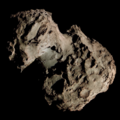
| 👁 Image Infrared image of Comet Johnson taken by the Spitzer Space Telescope on 18 July 2005 | |
| Discovery[1] | |
|---|---|
| Discovered by | Ernest Leonard Johnson |
| Discovery date | 25 August 1949 |
| Designations | |
| P/1949 Q1, P/1956 P1 | |
| |
| Orbital characteristics[3][4] | |
| Epoch | 28 April 2016 (JD 2457506.5) |
| Observation arc | 5,220 days (14.29 years) |
| Number of observations | 1,612 |
| Aphelion | 5.021 AU |
| Perihelion | 2.006 AU |
| Semi-major axis | 3.514 AU |
| Eccentricity | 0.42897 |
| Orbital period | 6.587 years |
| Inclination | 12.283° |
| 111.46° | |
| Argument of periapsis | 214.69° |
| Mean anomaly | 235.39° |
| Last perihelion | 2 March 2025 |
| Next perihelion | 2031-Sep-29[2] |
| TJupiter | 2.931 |
| Earth MOID | 1.007 AU |
| Jupiter MOID | 0.513 AU |
| Physical characteristics[5][6] | |
| Dimensions | 6.0 × 4.4 km (3.7 × 2.7 mi) |
Mean diameter | 5.74 km (3.57 mi) |
| 29 hours | |
| Comet total magnitude (M1) | 8.9 |
| Comet nuclear magnitude (M2) | 13.4 |


48P/Johnson is a periodic comet in the Solar System.
The comet's nucleus is estimated to be approximately 5.74 km (3.57 mi) in diameter, according to Lamy, Fernandez, and Weaver.[7] David C. Jewitt and Scott S. Sheppard, however, estimate the nucleus to have dimensions of 6.0 × 4.4 km (3.7 × 2.7 mi).[5]
References
[edit]- ^ E. L. Johnson (29 August 1949). J. M. Vinter Hansen (ed.). "Comet Johnson (1949d)". IAU Circular. 1228 (1).
- ^ "Horizons Batch for 48P/Johnson (90000568) on 2031-Sep-29" (Perihelion occurs when rdot flips from negative to positive). JPL Horizons. Archived from the original on 2025-09-28. Retrieved 2025-09-28. (JPL#K253/21 Soln.date: 2025-Sep-22)
- ^ "48P/Johnson – JPL Small-Body Database Lookup". ssd.jpl.nasa.gov. Jet Propulsion Laboratory. Retrieved 1 March 2010.
- ^ "48P/Johnson Orbit". Minor Planet Center. Retrieved 22 July 2025.
- ^ a b D. C. Jewitt; S. S. Sheppard (2004). "The nucleus of comet 48P/Johnson". The Astronomical Journal. 127 (3): 1784–1790. Bibcode:2004AJ....127.1784J. doi:10.1086/382097.
- ^ B. E. A. Mueller; N. H. Samarasinha (2018). "Further Investigation of Changes in Cometary Rotation". The Astronomical Journal. 156 (3): 107–114. arXiv:1806.11158. Bibcode:2018AJ....156..107M. doi:10.3847/1538-3881/aad0a1.
- ^ P. L. Lamy; I. Toth; Y. R. Fernández; H. A. Weaver (2004). "The Sizes, Shapes, Albedos, and Colors of Cometary Nuclei" (PDF). Comets II. pp. 223–264. JSTOR j.ctv1v7zdq5.22.

External links
[edit]- 48P/Johnson at the JPL Small-Body Database
- 48P at Kronk's Cometography
- 48P/Johnson – Seiichi Yoshida @ aerith.net
- Lightcurve (Artyom Novichonok)


.png)