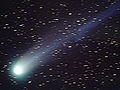
| 👁 Image Comet Kushida photographed by Hunter Wilson on 16 January 2009 | |
| Discovery | |
|---|---|
| Discovered by | Yoshio Kushida |
| Discovery site | Yatsugatake, Japan |
| Discovery date | 8 January 1994 |
| Designations | |
| P/1994 A1, P/2000 O2 | |
| 1993 XX, 1994a | |
| Orbital characteristics[1][2] | |
| Epoch | 21 November 2025 (JD 2461000.5) |
| Observation arc | 30.41 years |
| Earliest precovery date | 7 January 1994 |
| Number of observations | 5,919 |
| Aphelion | 6.269 AU |
| Perihelion | 1.399 AU |
| Semi-major axis | 3.834 AU |
| Eccentricity | 0.63495 |
| Orbital period | 7.509 years |
| Inclination | 3.931° |
| 242.92° | |
| Argument of periapsis | 216.37° |
| Mean anomaly | 87.308° |
| Last perihelion | 25 January 2024 |
| Next perihelion | 2 August 2031 |
| TJupiter | 2.681 |
| Earth MOID | 0.417 AU |
| Jupiter MOID | 0.011 AU |
| Physical characteristics[1] | |
Mean radius | 1.2 km (0.75 mi)[3] |
| Comet total magnitude (M1) | 12.9 |
| Comet nuclear magnitude (M2) | 16.1 |


144P/Kushida is a Jupiter-family comet discovered by Yoshio Kushida in January 1994. This was the first comet discovery of 1994 and his second discovery within a month. It last came to perihelion on 25 January 2024, and brightened to about magnitude 10.[4]
| Date & time of closest approach |
Mars distance (AU) |
Sun distance (AU) |
Velocity wrt Mars (km/s) |
Velocity wrt Sun (km/s) |
Uncertainty region (3-sigma) |
Reference |
|---|---|---|---|---|---|---|
| 2119-May-17 11:19 ± 13 minutes | 0.049 AU (7.3 million km; 4.6 million mi; 19 LD) | 1.68 AU (251 million km; 156 million mi) | 13.6 | 28.6 | ± 13 thousand km | Horizons |
Based on data gathered during the period of January 9–11, 1994 Syuichi Nakano calculated the date of perihelion to be 1993 December 5.33 and the distance of perihelion as 1.36 AU. The low inclination to the ecliptic suggested to Nakano that the comet could be a short period type. On January 14, 1994, Daniel W. E. Green confirmed Nakano's suggestion and published a short-period orbit on IAU Circular 5922. Based on 29 positions obtained during the period of January 9–13, Green determined a perihelion date of 1993 December 12.99, a perihelion distance of 1.37 AU, and an orbital period of 7.20 years.
Using over 300 positions obtained between January 7 and July 9, 1994, Patrick Rocher refined the calculations and determined the perihelion distance as 1.367 AU, the perihelion date as 1993 December 12.862, and the orbital period as 7.366 years.
See also
[edit]References
[edit]- ^ a b c "144P/Kushida – JPL Small-Body Database Lookup". ssd.jpl.nasa.gov. Jet Propulsion Laboratory. Retrieved 27 August 2023.
- ^ "144P/Kushida Orbit". Minor Planet Center. Retrieved 7 April 2017.
- ^ P. L. Lamy; I. Toth; Y. R. Fernández; H. A. Weaver (2004). "The Sizes, Shapes, Albedos, and Colors of Cometary Nuclei" (PDF). Comets II. University of Arizona Press. pp. 223–264. Bibcode:2004come.book..223L. doi:10.2307/j.ctv1v7zdq5.22. ISBN 978-0-8165-2450-1. JSTOR j.ctv1v7zdq5.22.
- ^ S. Yoshida (4 December 2018). "144P/Kushida". www.aerith.net. Retrieved 31 July 2023.
External links
[edit]- 144P/Kushida at the JPL Small-Body Database
- 144P/Kushida at Gary W. Kronk's Cometography
- 144P/Kushida at Seiichi Yoshida's website

.png)