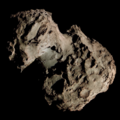
| 👁 Image Comet Finlay photographed from the US Naval Observatory on 26 September 1960[1] | |
| Discovery | |
|---|---|
| Discovered by | William Henry Finlay |
| Discovery site | Royal Observatory, South Africa |
| Discovery date | 26 September 1886 |
| Designations | |
| P/1886 S1, P/1893 K1 | |
| |
| Orbital characteristics[3][4] | |
| Epoch | 21 November 2025 (JD 2461000.5) |
| Observation arc | 135.43 years |
| Number of observations | 2,062 |
| Aphelion | 6.025 AU |
| Perihelion | 0.997 AU |
| Semi-major axis | 3.511 AU |
| Eccentricity | 0.71595 |
| Orbital period | 6.58 years |
| Inclination | 6.786° |
| 13.734° | |
| Argument of periapsis | 347.87° |
| Mean anomaly | 238.54° |
| Last perihelion | 13 July 2021 |
| Next perihelion | 9 February 2028[2] |
| TJupiter | 2.619 |
| Earth MOID | 0.009 AU |
| Jupiter MOID | 0.162 AU |
| Physical characteristics[5] | |
Mean radius | 1.21 km (0.75 mi) |
| 0.035±0.012 (assumed) | |
| Comet total magnitude (M1) | 14.9 |


Comet Finlay, also known as 15P/Finlay, is a Jupiter-family comet with an orbital period of 6.58 years. It discovered by William Henry Finlay from the Royal Observatory at Cape of Good Hope, South Africa on 26 September 1886. Of the known numbered periodic comets, the orbit of 15P/Finlay has one of the smallest minimum orbit intersection distances with Earth's orbit (E-MOID).[3] In October 2060, the comet will pass about 5 million km (3.1 million mi) from Earth.[6]
Observational history
[edit]| Perihelion distance at different epochs[4] | |||||||
| Epoch | Perihelion (AU) | ||||||
|---|---|---|---|---|---|---|---|
| 1866 | 1.0 | ||||||
| 1906 | 0.96 | ||||||
| 1919 | 1.0 | ||||||
| 1981 | 1.1 | ||||||
| 2008 | 0.97 | ||||||
| 2021 | 0.99 | ||||||
| 2028 | 1.0[2] | ||||||
When the first orbit calculations were made in 1886, there was a similarity between this orbit and that of Francesco de Vico's lost comet of 1844.[a] Lewis Boss noted large discrepancies between the orbits and after further observations concluded that de Vico's comet could not be the same as Finlay's.[7]
During the 1906 apparition, the comet brightened to magnitude 6. In 1910 a close pass with Jupiter increased the orbital period, in 1919 the path was off predictions and a new comet discovered by Sasaki (Kyoto Observatory, Japan) on 25 October 1919, was discovered to be Finlay's.
The magnitude of the comet declined after 1926, and it was not until 1953 that it has been observed on every return.
2014–2015
[edit]During the 2014 perihelion passage the comet outburst on 16 December 2014 from magnitude 11 to magnitude 9 becoming bright enough to be seen in common binoculars with a 50 mm objective lens.[8] On December 23, 2014, 15P and Mars were only 1/6 of a degree apart in the sky after sunset.[8] But by December 23, 2014, the comet had dimmed considerably since the outburst. On 16 January 2015, the comet outburst to magnitude 8.[9]
2060
[edit]15P/Finlay currently has an Earth-MOID of 0.009 AU (1.3 million km; 0.84 million mi).[3] The comet will come to perihelion six more times and then on October 22, 2060, the comet will pass roughly 0.0334 AU (5.00 million km; 3.10 million mi) from Earth with an uncertainty region of about ±2300 km.[3][6] This will be one of the closest comet approaches to Earth.[10]
Physical characteristics
[edit]In 2004, Jakub Cerny estimated that the nucleus of 15P/Finlay has an upper limit of about 1.5 km (0.93 mi) using non-gravitational forces to determine it.[11] However this was uncertain as it assumed a nearly 10% active surface fraction upon perihelion.[11] Photometric data in 2000 obtained an absolute magnitude of 17.2, which corresponds to a much larger nucleus at 2.42 km (1.50 mi) assuming its geometric albedo is around 0.035.[5]
Arids meteor shower
[edit]Debris ejected during the 1995 perihelion passage generated a meteor shower on 29–30 September 2021 radiating from the southern constellation of Ara.[12][13] More outbursts are expected on 7 October 2021 from the 2008 and 2014 streams.[14]
A 2026 study confirmed that this meteor shower was successfully detected at the Mauna Kea Observatory in Hawaii, where the source was attributed to have originated from dust ejected during the 2014 apparition of Finlay.[15] However the study also noted that the 2008 apparition was exceptionally quiet, making it unlikely to have produced high-velocity dust that could have contributed to the 2021 meteor shower as the 2014 apparition did.[15]
Notes
[edit]- ^ This comet was later known to be 54P/de Vico–Swift–NEAT in 1965 and 2002, respectively
References
[edit]- ^ E. Roemer (1960). "Comet Notes". Publications of the Astronomical Society of the Pacific. 72 (429): 512–515. Bibcode:1960PASP...72..512R. doi:10.1086/127598. JSTOR 40676950.
- ^ a b "Horizons Batch for 15P/Finlay (90000258) on 2028-Feb-09" (Perihelion occurs when rdot flips from negative to positive). JPL Horizons. Retrieved 16 June 2022. (JPL#K213/16 Soln.date: 2022-Mar-09)
- ^ a b c d "15P/Finlay – JPL Small-Body Database Lookup". ssd.jpl.nasa.gov. Jet Propulsion Laboratory. Retrieved 20 February 2017.
- ^ a b "15P/Finlay Orbit". Minor Planet Center. Retrieved 21 June 2014.
- ^ a b G. Tancredi; J. A. Fernández; H. Rickman; J. Licandro (2006). "Nuclear magnitudes and the size distribution of Jupiter family comets". Icarus. 182 (2): 527–549. Bibcode:2006Icar..182..527T. doi:10.1016/j.icarus.2006.01.007.
- ^ a b "Horizons Batch for 2060-Oct-22 Earth approach". JPL Horizons. Archived from the original on 16 June 2022. Retrieved 16 June 2022.
- ^ G. W. Kronk. "15P/Finlay". Cometography.com. Retrieved 31 January 2007.
- ^ a b Bob King (18 December 2014). "Comet Finlay in Bright Outburst, Visible in Small Telescopes". Universe Today. Retrieved 20 December 2014.
- ^ Michael Mattiazzo. "24324Re: [comets-ml] Re: Possible another outburst of 15P/Finlay?". Yahoo: comet-ml. Retrieved 17 January 2015.
{{cite web}}: CS1 maint: deprecated archival service (link) - ^ Comet Close Approaches to the Earth
- ^ a b P. L. Lamy; I. Toth; Y. R. Fernández; H. A. Weaver (2004). "The Sizes, Shapes, Albedos, and Colors of Cometary Nuclei" (PDF). Comets II. University of Arizona Press. pp. 223–264. Bibcode:2004come.book..223L. doi:10.2307/j.ctv1v7zdq5.22. ISBN 978-0-8165-2450-1. JSTOR j.ctv1v7zdq5.22.
- ^ P. Jenniskens; T. Cooper; D. Lauretta; et al. (1 October 2021). D. W. Green (ed.). "Arid Meteors 2021". Central Bureau for Astronomical Telegrams. 5046: 1. Bibcode:2021CBET.5046....1J.
- ^ Q. Z. Ye; J. Vaubaillon; M. Sato; et al. (4 October 2021). D. W. Green (ed.). "Arid Meteors 2021". Central Bureau for Astronomical Telegrams. 5049: 1. Bibcode:2021CBET.5049....1Y.
- ^ P. Jenniskens; S. Heathcote; E. Jehin; et al. (9 October 2021). D. W. Green (ed.). "Arid Meteors 2021". Central Bureau for Astronomical Telegrams. 5055: 1. Bibcode:2021CBET.5055....1J.
- ^ a b I. Tanaka; H. Hasegawa; T. Uda; et al. (2026). "Detection of the 2021 Arid meteor shower on Maunakea, Hawai'i" (PDF). Publications of the Astronomical Society of Japan. 78 (1): 11–19. arXiv:2601.05412. Bibcode:2026PASJ...78...11T. doi:10.1093/pasj/psaf126.
External links
[edit]- 15P/Finlay at the JPL Small-Body Database
- Elements and Ephemeris for 15P/Finlay – Minor Planet Center
- 15P at Kronk's Cometography
- 15P at Kazuo Kinoshita's Comets
- 15P at Seiichi Yoshida's Comet Catalog
- 15P at CometBase database
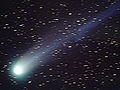
- 15P/Finlay on 18 Dec 2014 (200mm lens F5.6 / Rob Kaufman of Australia)


.png)