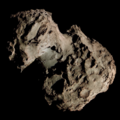
| 👁 Image Infrared image of Comet Forbes taken by the NEOWISE spacecraft on 27 May 2018 | |
| Discovery | |
|---|---|
| Discovered by | Alexander F. I. Forbes |
| Discovery site | Rosebank, South Africa |
| Discovery date | 1 August 1929 |
| Designations | |
| P/1929 P1, P/1942 L1 | |
| |
| Orbital characteristics[2][3] | |
| Epoch | 21 November 2025 (JD 2461000.5) |
| Observation arc | 96.28 years |
| Number of observations | 2,487 |
| Aphelion | 5.305 AU |
| Perihelion | 1.618 AU |
| Semi-major axis | 3.462 AU |
| Eccentricity | 0.53255 |
| Orbital period | 6.44 years |
| Inclination | 8.948° |
| 314.55° | |
| Argument of periapsis | 330.07° |
| Mean anomaly | 62.099° |
| Last perihelion | 11 October 2024 |
| Next perihelion | 19 March 2031[1] |
| TJupiter | 2.866 |
| Earth MOID | 0.602 AU |
| Jupiter MOID | 0.228 AU |
| Physical characteristics[2] | |
Mean radius | 0.81 km (0.50 mi)[4] |
| Comet total magnitude (M1) | 9.6 |
| Comet nuclear magnitude (M2) | 15.4 |


37P/Forbes is a periodic comet in the Solar System. The orbit of this comet passes close to the planet Jupiter however it orbit changes frequently. It was discovered on August 1, 1929, by Alexander F. I. Forbes in South Africa.[5] The comet nucleus is estimated to be 1.62 km (1.01 mi) in diameter.[4]
A close approach to Jupiter in the year 2001 has changes its perihelion to 1.57 AU. Despite the small change, the comet brightness went down by a magnitude of 2.[6]
References
[edit]- ^ "Horizons Batch for 37P/Forbes (90000465) on 2031-Mar-19" (Perihelion occurs when rdot flips from negative to positive). JPL Horizons. Archived from the original on 28 September 2025. Retrieved 28 September 2025. (JPL#K243/29 Soln.date: 2025-Apr-11)
- ^ a b "37P/Forbes – JPL Small-Body Database Lookup". ssd.jpl.nasa.gov. Jet Propulsion Laboratory. Retrieved 28 February 2010.
- ^ "37P/Forbes Orbit". Minor Planet Center. Retrieved 23 February 2019.
- ^ a b c d P. L. Lamy; I. Toth; H. A. Weaver; M. F. A'Hearn; L. Jorda (2009). "Properties of the nuclei and comae of 13 ecliptic comets from Hubble Space Telescope snapshot observations" (PDF). Astronomy & Astrophysics. 508 (2): 1045–1056. Bibcode:2009A&A...508.1045L. doi:10.1051/0004-6361/200811462. S2CID 125249770.
- ^ "C&M: 37P/Forbes" Cometrography.com. Retrieved 2012-04-18
- ^ "37P/Forbes". www.aerith.net. Retrieved 7 April 2025.
External links
[edit]- 37P/Forbes at the JPL Small-Body Database
- 37P/Forbes at Gary W. Kronk's Cometography
- 37P/Forbes at Seiichi Yoshida's website
- 37P/Forbes at Syuichi Nakano's website
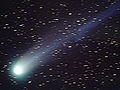
- 37P/Forbes 2011 05 29, 2:55:09 UT; mag 18.0 N; C. Bell H47

.png)