


|
A star is a luminous spheroid of plasma held together by self-gravity. The nearest star to Earth is the Sun. Many other stars are visible to the naked eye at night; their immense distances from Earth make them appear as fixed points of light. The most prominent stars have been categorised into constellations and asterisms, and many of the brightest stars have proper names. Astronomers have assembled star catalogues that identify the known stars and provide standardized stellar designations. The observable universe contains an estimated 1022 to 1024 stars. Only about 4,000 of these stars are visible to the naked eye—all within the Milky Way galaxy. A star's life begins with the gravitational collapse of a gaseous nebula of material largely comprising hydrogen, helium, and traces of heavier elements. Its total mass mainly determines its evolution and eventual fate. A star shines for most of its active life due to the thermonuclear fusion of hydrogen into helium in its core. This process releases energy that traverses the star's interior and radiates into outer space. At the end of a star's lifetime, fusion ceases and its core becomes a stellar remnant: a white dwarf, a neutron star, or—if it is sufficiently massive—a black hole. Stellar nucleosynthesis in stars or their remnants creates almost all naturally occurring chemical elements heavier than lithium. Stellar mass loss or supernova explosions return chemically enriched material to the interstellar medium. These elements are then recycled into new stars. Astronomers can determine stellar properties—including mass, age, metallicity (chemical composition), variability, distance, and motion through space—by carrying out observations of a star's apparent brightness, spectrum, and changes in its position in the sky over time. Stars can form orbital systems with other astronomical objects, as in planetary systems and star systems with two or more stars. When two such stars orbit closely, their gravitational interaction can significantly impact their evolution. Stars often form part of much larger gravitationally bound structures, such as star clusters and galaxies. (Full article...) Selected star - show anotherPhoto credit: NASA
Canopus (/kəˈnoʊpəs/; α Car, α Carinae, Alpha Carinae) is the brightest star in the southern constellation of Carina, and the second brightest star in the night-time sky, after Sirius. Canopus's visual magnitude is −0.72, and it has an absolute magnitude of −5.65. Canopus is a supergiant of spectral type F. Canopus is essentially white when seen with the naked eye (although F-type stars are sometimes listed as "yellowish-white"). It is located in the far southern sky, at a declination of −52° 42' (2000) and a right ascension of 06h24.0m. Its name comes from the mythological Canopus, who was a navigator for Menelaus, king of Sparta. Canopus is the most intrinsically bright star within approximately 700 light years, and it has been the brightest star in Earth's sky during three different epochs over the past four million years. Other stars appear brighter only during relatively temporary periods, during which they are passing the Solar System at a much closer distance than Canopus. About 90,000 years ago, Sirius moved close enough that it became brighter than Canopus, and that will remain the case for another 210,000 years. But in 480,000 years, Canopus will once again be the brightest, and will remain so for a period of about 510,000 years. Selected article - show anotherPhoto credit: User:Mysid and User:Jm smits
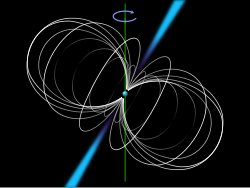
Pulsars are highly magnetized, rotating neutron stars that emit a beam of electromagnetic radiation. The observed periods of their pulses range from 1.4 milliseconds to 8.5 seconds. The radiation can only be observed when the beam of emission is pointing towards the Earth. This is called the lighthouse effect and gives rise to the pulsed nature that gives pulsars their name. Because neutron stars are very dense objects, the rotation period and thus the interval between observed pulses is very regular. For some pulsars, the regularity of pulsation is as precise as an atomic clock. A few pulsars are known to have planets orbiting them, such as PSR B1257+12. Werner Becker of the Max Planck Institute for Extraterrestrial Physics said in 2006, "The theory of how pulsars emit their radiation is still in its infancy, even after nearly forty years of work. The events leading to the formation of a pulsar begin when the core of a massive star is compressed during a supernova, which collapses into a neutron star. The neutron star retains most of its angular momentum, and since it has only a tiny fraction of its progenitor's radius (and therefore its moment of inertia is sharply reduced), it is formed with very high rotation speed. A beam of radiation is emitted along the magnetic axis of the pulsar, which spins along with the rotation of the neutron star. The magnetic axis of the pulsar determines the direction of the electromagnetic beam, with the magnetic axis not necessarily being the same as its rotational axis. This misalignment causes the beam to be seen once for every rotation of the neutron star, which leads to the "pulsed" nature of its appearance. The beam originates from the rotational energy of the neutron star, which generates an electrical field from the movement of the very strong magnetic field, resulting in the acceleration of protons and electrons on the star surface and the creation of an electromagnetic beam emanating from the poles of the magnetic field. This rotation slows down over time as electromagnetic power is emitted. When a pulsar's spin period slows down sufficiently, the radio pulsar mechanism is believed to turn off (the so-called "death line"). As this seems to take place after ~10-100 million years, but neutron stars have been formed throughout the ~13.6 billion year age of the universe, more than 99% of neutron stars are thought to no longer be pulsars. To date, the slowest observed pulsar has a period of 8 seconds. Selected image - show anotherPhoto credit: NASA
This stellar swarm is Messier 80 (NGC 6093), one of the densest of the 147 known globular star clusters in the Milky Way galaxy, located about 28,000 light-years from Earth. Every star visible in this image is either more highly evolved than, or in a few rare cases more massive than, our own Sun. Especially obvious are the bright red giants, which are stars similar to the Sun in mass that are nearing the ends of their lives. Did you know?
SubcategoriesTo display all subcategories click on the ►
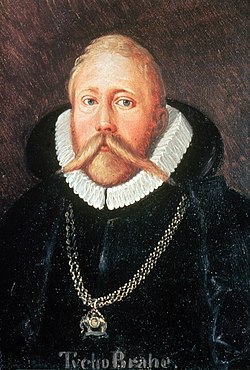
Selected biography - show anotherPhoto credit: Eduard Ender
Tycho Brahe, born Tyge Ottesen Brahe (de Knudstrup) (14 December 1546 – 24 October 1601), was a Danish nobleman known for his accurate and comprehensive astronomical and planetary observations. Coming from Scania, then part of Denmark, now part of modern-day Sweden, Tycho was well known in his lifetime as an astronomer and alchemist. His Danish name "Tyge Ottesen Brahe" is pronounced in Modern Standard Danish as [ˈtsʰyːəˈʌtəsn̩ˈpʁɑːə]. He adopted the Latinized name "Tycho Brahe" (usually /ˈtaɪkoʊˈbrɑː/ or /ˈbrɑːhiː/ in English) from Tycho (sometimes written Tÿcho) at around age fifteen, and he is now generally referred to as "Tycho", as was common in Scandinavia in his time, rather than by his surname "Brahe". (The incorrect form of his name, Tycho de Brahe, appeared only much later. Tycho Brahe was granted an estate on the island of Hven and the funding to build the Uraniborg, an early research institute, where he built large astronomical instruments and took many careful measurements. After disagreements with the new king in 1597, he was invited by the Bohemian king and Holy Roman emperor Rudolph II to Prague, where he became the official imperial astronomer. He built the new observatory at Benátky nad Jizerou. Here, from 1600 until his death in 1601, he was assisted by Johannes Kepler. Kepler later used Tycho's astronomical information to develop his own theories of astronomy.
TopicsWikiProjectsThings to do
Related portalsAssociated WikimediaThe following Wikimedia Foundation sister projects provide more on this subject:
Discover Wikipedia using portals |








- Portals with triaged subpages from June 2018
- All portals with triaged subpages
- Portals with no named maintainer
- Random portal component with 11–15 available subpages
- Random portal component with more available subpages than specified max
- Random portal component with 21–25 available subpages
- Random portal component with fewer available subpages than specified max
- Random portal component with 16–20 available image subpages
- Pages with Danish IPA
- Pages with plain IPA
- Random portal component with 6–10 available subpages