Outer space does not begin at a definite altitude above Earth's surface. The Kármán line, an altitude of 100 km (62 mi) above sea level, is conventionally used as the start of outer space in space treaties and for aerospace records keeping. Certain portions of the upper stratosphere and the mesosphere are sometimes referred to as "near space". The framework for international space law was established by the Outer Space Treaty, which entered into force on 10 October 1967. This treaty precludes any claims of national sovereignty and permits all states to freely explore outer space. Despite the drafting of UN resolutions for the peaceful uses of outer space, anti-satellite weapons have been tested in Earth orbit.
The concept that the space between the Earth and the Moon must be a vacuum was first proposed in the 17th century after scientists discovered that air pressure decreased with altitude. The immense scale of outer space was grasped in the 20th century when the distance to the Andromeda Galaxy was first measured. Humans began the physical exploration of space later in the same century with the advent of high-altitude balloon flights. This was followed by crewed rocket flights and, then, crewed Earth orbit, first achieved by Yuri Gagarin of the Soviet Union in 1961. The economic cost of putting objects, including humans, into space is very high, limiting human spaceflight to low Earth orbit and the Moon. On the other hand, uncrewed spacecraft have reached all of the known planets in the Solar System. Outer space represents a challenging environment for human exploration because of the hazards of vacuum and radiation. Microgravity has a negative effect on human physiology that causes both muscle atrophy and bone loss. (Full article...)
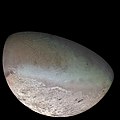
Triton is the largest moon of the planetNeptune, discovered on October 10, 1846, by William Lassell. It is the only large moon in the Solar System with a retrograde orbit, which is an orbit in the opposite direction to its planet's rotation. At 2,700 km (1,700 mi) in diameter, it is the seventh-largest moon in the Solar System. Because of its retrograde orbit and composition similar to Pluto's, Triton is thought to have been captured from the Kuiper belt. Triton consists of a crust of frozen nitrogen over an icy mantle believed to cover a substantial core of rock and metal. The core makes up two-thirds of its total mass. Triton has a mean density of 2.061 g/cm3 (1.191 oz/cu in) and is composed of approximately 15–35% water ice. Triton is one of the few moons in the Solar System known to be geologically active. As a consequence, its surface is relatively young, with a complex geological history revealed in intricate and mysterious cryovolcanic and tectonic terrains. Part of its crust is dotted with geysers believed to erupt nitrogen.
The launch of Space ShuttleAtlantis on STS-98, February 72001, at sunset. The sun is behind the camera, and the shape of the plume is cast across the vault of the sky, intersecting the rising full moon. The top portion of the plume is bright because it is illuminated directly by the sun; the lower portions are in the Earth's shadow. After launch, the shuttle must engage in a pitch and roll program so that the vehicle is below the external tank and SRBs, as evidenced in the plume trail. The vehicle climbs in a progressively flattening arc, because achieving low orbit requires much more horizontal than vertical acceleration.
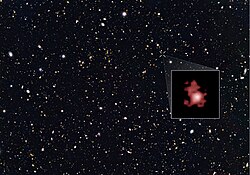
Credit: NASA, ESA, AURA/Caltech, Palomar Observatory
The Pleiades (also known as M45 or the Seven Sisters) is an open cluster in the constellation of Taurus. It is among the nearest to the Earth of all open clusters, probably the best known and certainly the most striking to the naked eye.
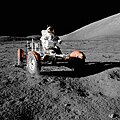
Astronaut Eugene Cernan makes a short test drive of the lunar rover (officially, Lunar Roving Vehicle or LRV) during the early part of the first Apollo 17extravehicular activity. The LRV was only used in the last three Apollo missions, but it performed without any major problems and allowed the astronauts to cover far more ground than in previous missions. All three LRVs were abandoned on the Moon.
"Earthrise," the first occasion in which humans saw the Earth seemingly rising above the surface of the Moon, taken during the Apollo 8 mission on December 24, 1968. This view was seen by the crew at the beginning of its fourth orbit around the Moon, although the very first photograph taken was in black-and-white. Note that the Earth is in shadow here. A photo of a fully lit Earth would not be taken until the Apollo 17 mission.
Photograph: NASA, ESA, and the Hubble Heritage Team
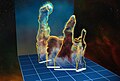
The Pillars of Creation, a series of elephant trunks of interstellar gas and dust in the Eagle Nebula, are the subject of a famous Hubble Space Telescope photograph taken in 1995. They are so named because the depicted gas and dust, while being eroded by the light from nearby stars, are in the process of creating new stars. Shown here is a 2014 rephotograph, which was unveiled in 2015 as part of the telescope's 25th anniversary celebrations.
Ignace-Gaston Pardies (1636–1673) was a French Catholic priest and scientist. His celestial atlas, entitled Globi coelestis in tabulas planas redacti descriptio, comprised six charts of the night sky and was first published in 1674. The atlas uses a gnomonic projection so that the plates make up a cube of the celestial sphere. The constellation figures are drawn from Uranometria, but were carefully reworked and adapted to a broader view of the sky. This is the second plate from a 1693 edition of Pardies's atlas, featuring constellations including Pegasus and Andromeda, visible in the northern sky.
"The Blue Marble" is a famous photograph of Earth. NASA officially credits the image to the entire Apollo 17 crew — Eugene Cernan, Ronald Evans and Jack Schmitt — all of whom took photographic images during the mission. Apollo 17 passed over Africa during daylight hours and Antarctica is also illuminated. The photograph was taken approximately five hours after the spacecraft's launch, while en route to the Moon. Apollo 17, notably, was the last manned lunar mission; no humans since have been at a range where taking a "whole-Earth" photograph such as "The Blue Marble" would be possible.
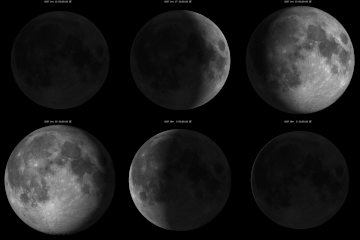
An animation of the phases of the Moon. As the Moon revolves around the Earth, the Sun lights the Moon from a different side, creating the different phases. In the image, the Moon appears to get bigger as well as "wobble" slightly. Tidal locking synchronizes the Moon's rotation period on its axis to match its orbital period around the earth. These two periods nearly cancel each other out, except that the Moon's orbit is elliptical. This causes its orbital motion to speed up when closer to the Earth, and slow down when farther away, causing the Moon's apparent diameter to change, as well as the wobbling motion observed.
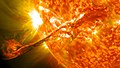
A solar flare, a sudden flash of brightness observed over the Sun's surface or the solar limb which is interpreted as a large energy release, recorded on August 31, 2012. Such flares are often, but not always, followed by a colossal coronal mass ejection; in this instance, the ejection traveled at over 900 miles (1,400 km) per second.
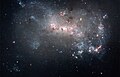
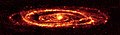
The Andromeda Galaxy is a spiral galaxy approximately 2.5 million light-years away. The image, created using a hydrogen-alpha filter, also shows Messier objects32 and 110, as well as NGC 206 and the star Nu Andromedae. On December 15, 1612, German astronomer Simon Marius became the first person to describe the galaxy using a telescope.
This natural-color mosaic image, combining thirty photographs, was taken by the Cassini orbiter over the course of approximately two hours on 23 July 2008 as it panned its wide-angle camera across Saturn and its ring system as the planet approached equinox. Six moons are pictured in the panorama, with the largest, Titan, visible at the bottom left.
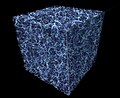
Image 5Distribution of Matter in a cubic section of the universe. The blue fiber-like structures represent matter, while the empty regions show the cosmic voids (from Outer space)
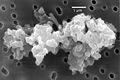
Image 10Astronomers used the James Webb Space Telescope to image the warm dust around a nearby young star, Fomalhaut, in order to study the first asteroid belt ever seen outside of the Solar System in infrared light. (from Cosmic dust)
Image 11Collision on Launch Avoidance lead to delayed spacecraft launches to avoid potential conjunctions/collisions during launch. Seen here is a Collision Avoidance analysis that mandated a four-minute delay for the launch of SPADEX in 2024. (from Space debris)
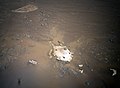
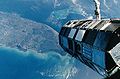
Image 18Debris impacts on Mir's solar panels degraded their performance. The damage is most noticeable on the panel on the right, which is facing the camera with a high degree of contrast. Extensive damage to the smaller panel below is due to impact with a Progress spacecraft rather than space debris. (from Space debris)
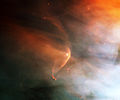
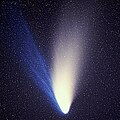
Image 35The sparse plasma (blue) and dust (white) in the tail of comet Hale–Bopp are being shaped by pressure from solar radiation and the solar wind, respectively.
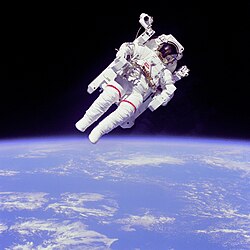
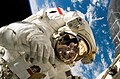
Image 36Astronaut Piers Sellers during the third spacewalk of STS-121, a demonstration of orbiter heat shield repair techniques (from Outline of space science)
Image 37A wide field view of outer space as seen from Earth's surface at night. The interplanetary dust cloud is visible as the horizontal band of zodiacal light, including the false dawn (edges) and gegenschein (center), which is visually crossed by the Milky Way (from Outer space)
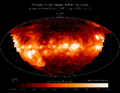
Image 39The distribution of ionized hydrogen (known by astronomers as H II from old spectroscopic terminology) in the parts of the Galactic interstellar medium visible from the Earth's northern hemisphere as observed with the Wisconsin Hα Mapper (Haffner et al. 2003) harv error: no target: CITEREFHaffnerReynoldsTufteMadsen2003 (help). (from Interstellar medium)
Image 43For the first time, the NASA / ESA / Canadian Space Agency / James Webb Space Telescope has observed the chemical signature of carbon-rich dust grains at redshift z ≈ 7, which is roughly equivalent to one billion years after the birth of the Universe, this observation suggests exciting avenues of investigation into both the production of cosmic dust and the earliest stellar populations in our Universe. (from Cosmic dust)
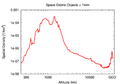
Image 58Spatial density of space debris by altitude according to ESA MASTER-2001, without debris from the Chinese ASAT and 2009 collision events (from Space debris)
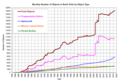
Image 59Growth of tracked objects in orbit and related events; efforts to manage outer space global commons have so far not reduced the total amount of debris or the growth of objects in orbit. (from Space debris)
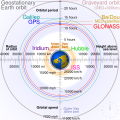
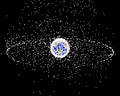
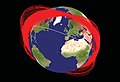
Image 64Near-Earth space showing the low-Earth (blue), medium Earth (green), and high Earth (red) orbits. The last extends beyond the radius of geosynchronous orbits (from Outer space)
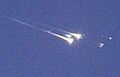
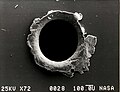
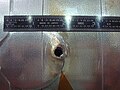
Image 66Space ShuttleEndeavour had a major impact on its radiator during STS-118. The entry hole is about 5.5 mm (0.22 in), and the exit hole is twice as large. (from Space debris)
Image 67Timeline of the expansion of the universe, where space is represented schematically at each time by circular sections. On the left, the dramatic expansion of inflation; at the center, the expansion accelerates (artist's concept; neither time nor size are to scale) (from Outer space)
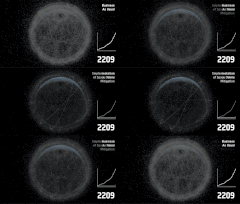
Image 68A computer-generated animation by the European Space Agency representing space debris in low earth orbit at the current rate of growth compared to mitigation measures being taken (from Space debris)
Image 79Atmospheric attenuation in dB/km as a function of frequency over the EHF band. Peaks in absorption at specific frequencies are a problem, due to atmosphere constituents such as water vapor (H2O) and carbon dioxide (CO2). (from Interstellar medium)
Image 80The diversity found in the different types and scales of astronomical objects make the field of study increasingly specialized. (from Outline of space science)
Image 82Gabbard diagram of almost 300 pieces of debris from the disintegration of the five-month-old third stage of the Chinese Long March 4 booster on 11 March 2000 (from Space debris)


.jpg)




.jpg)
.jpg)


.jpg)



.gif)



.jpg)






.jpg)




.jpg)


















.jpg)



.jpg)






_(53057957393).jpg)


.jpg)







.png)

















_on_Jul_14_2020_aligned_to_stars.jpg)







.png)