

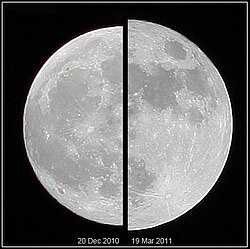
A supermoon is a full moon or a new moon that nearly coincides with perigee—the closest that the Moon comes to the Earth in its orbit—resulting in a slightly larger-than-usual apparent size of the lunardisk as viewed from Earth.[1] The technical name is a perigee syzygy (of the Earth–Moon–Sun system) or a full (ornew) Moon around perigee.[a] Because the term supermoon is astrological in origin, it has no precise astronomical definition.[2][contradictory]
The association of the Moon with both oceanic and crustal tides has led to claims that the supermoon phenomenon may be associated with increased risk of events like earthquakes and volcanic eruptions, but no such link has been found.[3]
The opposite phenomenon, an apogee syzygy or a full (ornew) Moon around apogee, has been called a micromoon.[4]
Definitions
[edit]The name supermoon was coined by astrologer Richard Nolle in1979, in DellHoroscope magazine arbitrarily defined as:
... a new or full moon which occurs with the Moon at or near (within 90%of) its closest approach to Earth in a given orbit (perigee). In short, Earth, Moon and Sun are all in a line, with Moon in its nearest approach to Earth.
— Richard Nolle[5]


He came up with the name while reading Strategic Role Of Perigean Spring Tides in Nautical History and Coastal Flooding, published in1976 by FergusWood, a hydrologist withNOAA.[6][7] Nolle explained in2011 that he based calculations on 90% of the difference in lunar apsis extremes for the solaryear. In other words, a full or newmoon is considered a supermoon if 👁 {\displaystyle ld_{s}\leq ld_{p}+0.1*(ld_{a}-ld_{p})}
, where 👁 {\displaystyle ld_{s}}
is the lunar distance at syzygy, 👁 {\displaystyle ld_{a}}
is the lunar distance at the greatest apogee of the year, and 👁 {\displaystyle ld_{p}}
is the lunar distance at the smallest perigee of the year.[8][9]
In practice, there is no official or even consistent definition of how near perigee the fullMoon must occur to receive the supermoon label, and newmoons rarely receive a supermoon label. Different sources give different definitions.[10][11]
The term perigee-syzygy or perigee full/newmoon is preferred in the scientific community.[12] Perigee is the point at which the Moon is closest in its orbit to the Earth, and syzygy is when the Earth, the Moon and the Sun are aligned, which happens at every full or newmoon. Astrophysicist FredEspenak uses Nolle's definition but preferring the label of fullMoon at perigee, and using the apogee and perigee nearest in time rather than the greatest and least of the year.[13] Woodused the definition of a full or new moon occurring within 24hours of perigee and also used the label perigee-syzygy.[7]
Wood also coined the less-used term proxigee where perigee and the full or newmoon are separated by 10hours or less.[7] Nolle has also added the concept of extreme supermoon in2000 describing the concept as any new or fullmoons that are at "100% or greater of the meanperigee".[14]
Occurrence
[edit]Of the possible 12 or 13 full (ornew) moons each year, usually three or four may be classified as supermoons, as commonly defined.
The full moon occurred Thursday December 4, 2025 at 3:14 PST, following an occurrence on November 5, 2025. Due to the event occurring in December it is usually called the "cold moon". The full moon rises on the 4th and 5th of December, Thursday and Friday Evening.[15]
The supermoon of November 14, 2016, was the closest full occurrence since January26, 1948, and will not be surpassed until November25, 2034.[16]
The closest full supermoon of the 21stcentury will occur on December6, 2052.[17]


The oscillating nature of the distance to the full or new moon is due to the difference between the synodicmonth[b] and anomalisticmonths.[13][c] The period of this oscillation is about 14synodic months, which is close to 15anomalistic months. Thus every 14lunations there is a fullmoon nearest to perigee.
Occasionally, a supermoon coincides with a total lunar eclipse. The most recent occurrence of this by any definition was in May2022, and the next occurrence will be in October2033.[13]
In the Islamic calendar (a lunar calendar), the occurrence of full supermoons follows a seven-year cycle. In the firstyear, the fullmoon is near perigee in month1 or 2, the next year in month3 or 4, and so on. In the seventhyear of the cycle the fullmoons are never very near to perigee. Approximately every 20years the occurrences move to onemonth earlier. As of Gregorianyear 2025[update] such a transition is occurring, so fullsupermoons occur twice in succession. For example in Hijri year1446, they occur both in month3 (Rabīʿ al-ʾAwwal, on September18, 2024) and in month4 (Rabīʿ ath-Thānī, on October17, 2024).
Appearance
[edit].jpg)

A full moon at perigee appears roughly 14%larger in diameter than at apogee.[18] Many observers insist that the Moon looks bigger to them. This is likely due to observations shortly after sunset when the Moon appears near the horizon and the Moonillusion is at its most apparent.[19]
While the Moon's surface luminance remains the same, because it is closer to the Earth the illuminance is about 30%brighter than at its farthest point, or apogee. This is due to the inverse squarelaw of light, which changes the amount of light received on Earth in inverse proportion to the distance from the Moon. But, the perceived brightness will be the same; the Moon will just be smaller in one's field of view. That change in size is exactly proportional to the change in the amount of light.[20] A supermoon directly overhead could provide up to 0.36 lux.[21]
Effects on Earth
[edit]Claims that supermoons can cause natural disasters, and the claim of Nolle that supermoons cause "geophysical stress", have been refuted by scientists.[2][22][23][24]
Despite lack of scientific evidence, there has been media speculation that natural disasters, such as the 2011Tōhoku earthquake and tsunami and the 2004 Indian Ocean earthquake and tsunami, are causally linked with the 1–2-week period surrounding a supermoon.[25] The 7.5 magnitude 2016Kaikōura earthquake in NewZealand also coincided with a supermoon.[26][27] Tehran earthquake on May8, 2020, also coincided with a supermoon.
Scientists have confirmed that the combined effect of the Sun and Moon on the Earth's oceans, the tide,[28] is greatest when the Moon is either new or full.[29] and that during lunar perigee, the tidal force is somewhat stronger,[30] resulting in perigean spring tides. While this increased tidal force is relatively weak[31][32][d] in a global geophysical context, it can induce measurable local effects. For example, research based on 25years of daily observations on a sandy beach has shown that the larger tidal ranges produced by supermoons, known as kingtides, make beach erosion in the upper swashzone more likely.[34] These long-term data indicate that beach morphology fluctuates in cycles related to the supermoon, and that erosion during highwaves can be more severe when coincident with a supermoon.
Super Blood Moon
[edit]
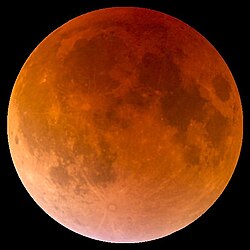
Total lunar eclipses which fall on supermoon and micromoon days are relatively rare. In the 21stcentury, there are 87total lunar eclipses, of which 28 are supermoons and 6 are micromoons. Almost all total lunar eclipses in Lunar Saros129 are micromoon eclipses.
The Super Blood Moon is an astronomical event that combines two phenomena: a supermoon and a total lunar eclipse, resulting in a larger, brighter, and reddish-colored Moon. A total lunar eclipse takes place when the Earth aligns between the Sun and the Moon, causing Earth's shadow to fall on the Moon. As the shadow covers the Moon, sunlight passing through Earth's atmosphere scatters, filtering out most bluelight and casting a reddish hue on the Moon. This phenomenon is often called a bloodmoon because of its striking red or orange color.
When these two events coincide, the Moon appears both larger and redder than usual, leading to the term Super BloodMoon. This unique alignment creates a visually impressive and rare sight that has inspired folklore and intrigue for centuries. Super Blood Moons are relatively infrequent, occurring about once every few years, making them a notable event for astronomers and skywatchers alike.
Annular solar eclipses
[edit]Annular solar eclipses occur when the Moon's apparent diameter is smaller than the Sun's. Almost all annular solar eclipses between 1880 and2060 in Solar Saros144 and almost all annular solar eclipses between 1940 and2120 in Solar Saros128 are micromoon annular solar eclipses.[35]
See also
[edit]- Apsis – Either of two extreme points in a celestial object's orbit
- Moon illusion – Perceived variation in the Moon's size
- Syzygy (astronomy) – Alignment of celestial bodies
- Wet moon – Horizontal (bowl appearance) crescent
Notes
[edit]- ^ See perigee and syzygy
- ^ The time it takes for the Moon to complete a full progression through its phases: one lunation.
- ^ The time it takes for the Moon to return to either of its orbital apses (perigee or apogee). This differs slightly from a lunation because the Moon's orbit gradually precesses around Earth. If the synodic and anomalistic months were identical, the Moon would always be the same distance from Earth for a given lunar phase.
- ^ As an average of 1000 earthquakes of magnitude 5 or greater (18 >= magn. 7),[33] and multiple "supermoons", occur yearly, the law of truly large numbers guarantees that over a sufficiently-long interval, numerous "large" earthquakes will occur around the time of supermoons. Refuting the null hypothesis ("there is no relation between the variables") would entail demonstrating evidence for an alternative hypothesis, such as a statistically significant increase in earthquake frequency around the time of certain events. The inverse—formulating a hypothesis, then looking back through already-gathered data to find support (and disregarding unsupportive data)—is known as data dredging (see also Texas sharpshooter fallacy, apophenia).
References
[edit]- ^ Staff (September 7, 2014). "Revisiting the Moon". New York Times. Retrieved September 8, 2014.
- ^ a b Plait, Phil. "Kryptonite for the supermoon". Bad Astronomy. Discover. Archived from the original on October 22, 2019. Retrieved August 29, 2015.
- ^ Rice, Rachel. "No Link Between 'Super Moon' and Earthquakes". Discovery News. Archived from the original on June 13, 2011. Retrieved March 20, 2015.
- ^ "What Is a Micromoon?". TimeAndDate.com. Stavanger, Norway. Retrieved August 6, 2018.
- ^ Nolle, Richard (March 10, 2011). "Supermoon". Astropro. Retrieved March 14, 2011.
- ^ "What is a Super Moon". Act For Libraries. Archived from the original on January 11, 2018. Retrieved January 10, 2018.
- ^ a b c Fergus, Wood (1976). The Strategic Role of Perigean Spring Tides in Nautical History and Coastal Flooding, 1635-1976. Washington DC: US National Oceanic and Atmospheric Administration.
- ^ "November 2017 full moon a supermoon?". EarthSky. Retrieved January 8, 2018.
- ^ Nolle, Richard. "SuperMoon: What It Is, What It Means". Astropro. Retrieved January 8, 2018.
- ^ "November 2017 full moon a supermoon?". EarthSky.org. Retrieved January 8, 2018.
- ^ Nolle, Richard. "Astrologer Richard Nolle's Century 21 CE SuperMoon Table". Astropro. Retrieved January 8, 2018.
- ^ Phillips, Tony (May 2, 2012). "Perigee "Super Moon" On May 5–6". NASA Science News. Retrieved May 6, 2012.
- ^ a b c Espenak, Fred. "Full Moon at Perigee (Super Moon): 2001 to 2100". Astropixels. Archived from the original on February 10, 2020. Retrieved March 12, 2020.
- ^ "Astrologer Richard Nolle's Century 21 CE SuperMoon Table". Astropro. 2000. Retrieved March 8, 2020.
- ^ iain.todd@ourmedia.co.uk (December 4, 2025). "Tonight's full Moon is your last chance to see a supermoon in 2025. Here's how to make the most of it". BBC Sky at Night Magazine. Retrieved December 4, 2025.
- ^ "What is a supermoon?". EarthSky. Retrieved November 14, 2016.
- ^ "Closest supermoon since 1948!". EarthSky. November 12, 2016. Retrieved November 14, 2016.
- ^ "Supermoon 2018: When and How to See January's Two Full Moons". Space.com. Retrieved January 10, 2018.
- ^ "What Is A Supermoon? Facts vs. Fiction". Sky & Telescope. November 8, 2016. Retrieved January 10, 2018.
- ^ Phillips, Tony (March 16, 2011). "Super Full Moon". Science@NASA Headline News. Archived from the original on May 7, 2012. Retrieved June 22, 2013.
- ^ Kyba, Christopher C M; Mohar, Andrej; Posch, Thomas (February 1, 2017). "How bright is moonlight?" (PDF). Astronomy & Geophysics. 58 (1). Oxford University Press: 1.31 – 1.32. doi:10.1093/astrogeo/atx025. ISSN 1468-4004. OCLC 46686009.
- ^ UC Berkeley Seismological Laboratory (n.d.) [First published 1999]. "Earthquake FAQ". self-published. Can the position of the moon or planets affect seismicity?. Archived from the original on October 3, 2025.
- ^ Fuis, Gary (n.d.). "Can the position of the moon or the planets affect seismicity?". USGS Earthquake Hazards Program. Archived from the original on May 7, 2011. Retrieved March 14, 2011.
- ^ Wolchover, Natalie (March 9, 2011). "Will the March 19 "SuperMoon" Trigger Natural Disasters?". Life's Little Mysteries. Archived from the original on March 15, 2011. Retrieved March 15, 2011.
- ^ Paquette, Mark (March 4, 2011) [First published March 1, 2011]. "Extreme Super (Full) Moon to Cause Chaos?". Astronomy Weather Blog. AccuWeather. Archived from the original on March 10, 2020. Retrieved March 14, 2011.
- ^ "GeoNet – Quakes". Retrieved November 13, 2016.
- ^ Griffin, Andrew. "Supermoon: Biggest in living memory to appear in the sky, as 2016 ends with three huge full moons in a row". The Independent. Archived from the original on May 25, 2022.
- ^ Plait, Phil (March 5, 2011) [First published 2008]. "Tides, the Earth, the Moon, and why our days are getting longer". Bad Astronomy. Retrieved March 14, 2011.
- ^ United States National Oceanic and Atmospheric Administration (June 16, 2024) [First published August 1, 2014]. "What are spring and neap tides?". self-published. Archived from the original on August 19, 2025.
- ^ "Apogee and Perigee of the Moon". Moon Connection. n.d. Archived from the original on April 3, 2025. Retrieved March 14, 2011.
- ^ Plait, Phil (March 11, 2011). "No, the 'supermoon' didn't cause the Japanese earthquake". Discover Magazine. Archived from the original on October 22, 2019. Retrieved March 14, 2011.
- ^ Rice, Tony (May 4, 2012). "Super moon looms Saturday". WRAL-TV. Raleigh, NC: Capitol Broadcasting Company. Archived from the original on November 30, 2024. Retrieved May 5, 2012.
- ^ "Earthquakes". California Geological Survey. n.d. Archived from the original on September 27, 2024. Retrieved October 16, 2024.
- ^ Masayuki, Banno; Yoshiaki, Kuriyama (November 5, 2020). "Supermoon Drives Beach Morphological Changes in the Swash Zone". Geophysical Research Letters. 47 (22) e2020GL089745. American Geophysical Union. doi:10.1029/2020GL089745. ISSN 1944-8007. LCCN 74646541. OCLC 1795290. CODEN GPRLAJ.
- ^ "Moon at Perigee and Apogee: 2001 to 2100". Astropixels. Retrieved November 19, 2018.
External links
[edit]

- Lunar Apogee/Perigee Calculator at Fourmilab
- Richard Nolle's definition
- Richard Nolle's list of supermoons in the 21stcentury
- Full Moon at Perigee (Super Moon): 2001 to 2100 by FredEspenak
- Super Blue Blood Moon 2018 | Check123 1 Minute Video (archived 20 March 2022)
- Supermoons and Micromoons
- Next Supermoons


- CS1: unfit URL
- Articles with short description
- Short description is different from Wikidata
- Use mdy dates from September 2022
- All self-contradictory articles
- Self-contradictory articles from August 2024
- Wikipedia articles scheduled for update tagging
- Articles containing potentially dated statements from 2025
- All articles containing potentially dated statements
- Articles containing Arabic-language text
- Articles containing video clips