When was the first general election held in independent India?
The first general election was conducted over four months in 1951-52, initiating the democratic process by which the reins of the country were put in the hands of its people.
What is the minimum voting age for Indian citizens in general elections?
The minimum voting age for Indian citizens in the general elections in 18 years. Hence, any person of age 18 years or above are eligible to exercise their franchise.
How often are general elections typically held in India?
Typically, general elections in India are held every 5 years – which is the tenure of an elected government in the country.
Which Indian state has the highest number of parliamentary constituencies?
The state of Uttar Pradesh has the highest number of parliamentary constituencies at 80, followed by Maharashtra (48) and West Bengal (42).
What is the significance of the Election Commission of India in overseeing general elections?
The Election Commission of India (ECI) is a constitutional body empowered to conduct free and fair polls across India, and hence is significantly instrumental in upholding democracy in the country. In India, the world's largest democracy, the electoral process starts right from the announcement of dates to declaration of the results -- and the ECI regulates it all. Ensuring smooth functioning of the whole process -- that includes electoral roll management, implementation of election code of conduct, voter awareness programmes, regulation of political parties, conducting elections, addressing electoral disputes among others --remains the top priority of the ECI.
Who is the longest serving Prime Minister of India?
India’s longest serving Prime Minister is Jawaharlal Nehru who held the post for 16 years, 286 days, from 1947 to 1964. Nehru took oath as the first Prime Minister of independent India on August 15, 1947, and died on May 27, 1964, while serving his fourth term as the PM.
What is the process for electing the Prime Minister of India after general elections?
The Prime Minister of India is not elected by the voters directly but is appointed by the President. After the general elections, the leader of the winning party or alliance with an absolute majority in the Lok Sabha becomes the Prime Minister.
However, certain criteria need to be fulfilled to be the Prime Minister of India.
i) The candidate should be a citizen of India.
ii) The person should be a member of the Lok Sabha or the Rajya Sabha or should be elected within six months from the start of their tenure as PM.
iii) If a member of Lok Sabha, the person should be at least 25 years in age. If a member of Rajya Sabha, the person should be at least 30 years old.
iv) The candidate should not hold any office or profit under the state or Central government of India.
v) Once elected as PM, the person must leave any post they might have been holding in government or private institutions.
vi) The candidate should not have any criminal charges proved against them in any court of justice in India.
Which political party won the highest number of seats in the Lok Sabha in the last general elections?
The Bharatiya Janata Party (BJP) won the maximum number of seats in the last Lok Sabha elections. The party clinched 303 out of 543 seats that went to the polls in 2019, becoming the single largest party in the House. The BJP-led National Democratic Alliance (NDA) secured a total of 353 seats in the Lok Sabha.
What is the term length for members of the Lok Sabha following a general election?
The term length for members of Lok Sabha after being elected through general elections is 5 years.
A grassroots Maratha leader, he has been a strategic figure in the ongoing Maratha reservation movement. As chief minister from June 2022 to November 2024, he oversaw major infrastructure projects, including the Samruddhi Mahamarg and Atal Setu
The BJP’s successes over the past year come on the back of its ability to keep tight control of the political narrative, and repeatedly push the opposition into uncomfortable corners
2024 was considered to be a crucial election year globally, with political parties in India ramping up their digital ad spending ahead of the Lok Sabha polls.
Gandhi said that after the 2024 LS elections, PM Modi had announced the “Employment Linked Incentive” scheme with much fanfare, promising to provide employment to our youth.
Opposition has approached the EC earlier to complain about the PM violating code of conduct with such televised appearances either on voting day or after the end of canvassing
As in the recent Lok Sabha elections, opposition parties will be fighting each other besides the Congress-I in most constituencies in the March state Assembly elections in 10 states and the Union Territory of Pondicherry.
In India’s electoral history, two seats have been won by a vote-share margin exceeding 90%, one of them being Anantnag; the late P A Sangma holds record for most such results
Commentators described the BJP-led government as a ‘minority’ government that will force Mr Modi to be more circumspect and restrained. I did not share that view. They thought that Mr Modi will be more deferent to Parliament, but that too was belied by the Winter session.
Highest enrolment of overseas electors in 2024 was recorded in five southern states – Kerala (89,839), Andhra Pradesh (7,927), Telangana (3,470), Tamil Nadu (3,432) and Karnataka (3,148).
'We will take appropriate steps at the appropriate time to realise the people's desire not to be ruled by the BJP govt,' said Congress President Mallikarjun Kharge.
The BJP is facing resentment among farmers in Haryana and the party is defending it saying the protests are being staged by their opponents to create a wave against the ruling party.
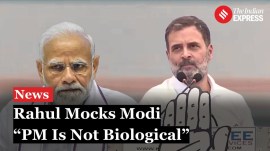
Lok Sabha Election 2024: Rahul Gandhi mentioned that Narendra Modi keeps distracting people with nonsensical comments whenever he is asked about his government's shortcomings.
All-round India-A beat Afghanistan-A to enter Tri-series final
Sports10 min ago
India A secure their spot in the final of the tri-series in Dambulla with a 101-run win over Afghanistan A. Priyansh Arya, Tilak Varma, and Kumar Kushagra all scored half-centuries, while Nishant Sindhu took four wickets to lead the bowling attack.