

Buffon's Needle Problem


Buffon's needle problem asks to find the probability that a needle of length 👁 l
will land on a line, given a floor with
equally spaced parallel lines
a distance 👁 d
apart. The problem was first posed by the French naturalist Buffon in 1733 (Buffon
1733, pp. 43-45), and reproduced with solution by Buffon in 1777 (Buffon 1777,
pp. 100-104).


Define the size parameter 👁 x
by

| 👁 x=l/d. |
(1)
|

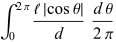
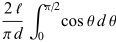
For a short needle (i.e., one shorter than the distance between two lines, so that 👁 x=l/d<1
),
the probability 👁 P(x)
that the needle falls on a line is


| 👁 P(x) | 👁 = | 👁 int_0^(2pi)(l|costheta|)/d(dtheta)/(2pi) |
(2)
|
| 👁 Image | 👁 = | 👁 (2l)/(pid)int_0^(pi/2)costhetadtheta |
(3)
|
| 👁 Image | 👁 = | 👁 (2l)/(pid) |
(4)
|
| 👁 Image | 👁 = | 👁 (2x)/pi. |
(5)
|






For 👁 x=l/d=1
,
this therefore becomes


(OEIS A060294).
For a long needle (i.e., one longer than the distance between two lines so that 👁 x=l/d>1
), the probability that it intersects at least one line is the slightly more complicated
expression


where (Uspensky 1937, pp. 252 and 258; Kunkel).

Writing
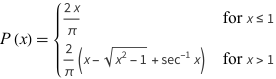
then gives the plot illustrated above. The above can be derived by noting that
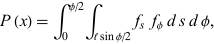
where


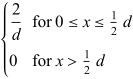


are the probability functions for the distance 👁 s
of the needle's midpoint 👁 s
from the nearest line and the angle 👁 phi
formed by the needle and the lines, intersection takes place
when 👁 0<=s<=(lsinphi)/2
,
and 👁 phi
can be restricted to 👁 [0,pi/2]
by symmetry.




![👁 [0,pi/2]](https://mathworld.wolfram.com/images/equations/BuffonsNeedleProblem/Inline31.svg)
Let 👁 N
be the number of line crossings by 👁 n
tosses of a short needle with size parameter 👁 x
. Then 👁 N
has a binomial distribution
with parameters 👁 n
and 👁 2x/pi
.
A point estimator for 👁 theta=1/pi
is given by


| 👁 theta^^=N/(2xn), |
(12)
|

which is both a uniformly minimum variance unbiased estimator and a maximum likelihood estimator (Perlman and Wishura 1975) with variance
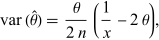
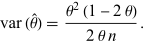
which, in the case 👁 x=1
, gives

The estimator 👁 pi^^=1/theta^^
for 👁 pi
is known as Buffon's estimator and is an asymptotically unbiased estimator given
by


| 👁 pi^^=(2xn)/N, |
(15)
|

where 👁 x=l/d
,
👁 n
is the number of throws, and 👁 N
is the number of line crossings. It has asymptotic variance


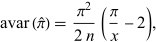
which, for the case 👁 x=1
, becomes


(OEIS A114598; Mantel 1953; Solomon 1978, p. 7).

The above figure shows the result of 500 tosses of a needle of length parameter 👁 x=1/3
, where needles crossing a line are
shown in red and those missing are shown in green. 107 of the tosses cross a line,
giving 👁 pi^^=3.116+/-0.073
.



Several attempts have been made to experimentally determine 👁 pi
by needle-tossing. 👁 pi
calculated from five independent series of tosses of a (short)
needle are illustrated above for one million tosses in each trial 👁 x=1/3
. For a discussion of the relevant statistics and a critical
analysis of one of the more accurate (and least believable) needle-tossings, see
Badger (1994). Uspensky (1937, pp. 112-113) discusses experiments conducted
with 2520, 3204, and 5000 trials.


The problem can be extended to a "needle" in the shape of a convex polygon with generalized diameter less
than 👁 d
.
The probability that the boundary of the polygon will intersect
one of the lines is given by

| 👁 P=p/(pid), |
(19)
|

where 👁 p
is the perimeter of the polygon (Uspensky 1937, p. 253;
Solomon 1978, p. 18).

A further generalization obtained by throwing a needle on a board ruled with two sets of perpendicular lines is called the Buffon-Laplace needle problem.
See also
Buffon-Laplace Needle Problem, Clean Tile ProblemExplore with Wolfram|Alpha

More things to try:
References
Badger, L. "Lazzarini's Lucky Approximation of 👁 pi
." Math. Mag. 67, 83-91, 1994.Bogomolny, A. "Buffon's Noodle." http://www.cut-the-knot.org/Curriculum/Probability/Buffon.shtml.Borwein, J. and Bailey, D. Mathematics by Experiment: Plausible Reasoning in the 21st Century. Wellesley, MA: A K Peters, p. 139, 2003.Buffon, G. Editor's note concerning a lecture given 1733 by Mr. Le Clerc de Buffon to the Royal Academy of Sciences in Paris. Histoire de l'Acad. Roy. des Sci., pp. 43-45, 1733.Buffon, G. "Essai d'arithmétique morale." Histoire naturelle, générale er particulière, Supplément 4, 46-123, 1777.Diaconis, P. "Buffon's Needle Problem with a Long Needle." J. Appl. Prob. 13, 614-618, 1976.Dörrie, H. "Buffon's Needle Problem." §18 in 100 Great Problems of Elementary Mathematics: Their History and Solutions. New York: Dover, pp. 73-77, 1965.Edelman, A. and Kostlan, E. "How Many Zeros of a Random Polynomial are Real?" Bull. Amer. Math. Soc. 32, 1-37, 1995.Hoffman, P. The Man Who Loved Only Numbers: The Story of Paul Erdős and the Search for Mathematical Truth. New York: Hyperion, p. 209, 1998.Isaac, R. The Pleasures of Probability. New York: Springer-Verlag, 1995.Kendall, M. G. and Moran, P. A. P. Geometrical Probability. New York: Hafner, 1963.Klain, Daniel A. and Rota, G.-C. Introduction to Geometric Probability. New York: Cambridge University Press, 1997.Kraitchik, M. "The Needle Problem." §6.14 in Mathematical Recreations. New York: W. W. Norton, p. 132, 1942.Kunkel, P. "Buffon's Needle." http://whistleralley.com/buffon/buffon.htm.Mantel, L. "An Extension of the Buffon Needle Problem." Ann. Math. Stat. 24, 674-677, 1953.Morton, R. A. "The Expected Number and Angle of Intersections Between Random Curves in a Plane." J. Appl. Prob. 3, 559-562, 1966.Perlman, M. and Wichura, M. "Sharpening Buffon's Needle." Amer. Stat. 20, 157-163, 1975.Santaló, L. A. Integral Geometry and Geometric Probability. Reading, MA: Addison-Wesley, 1976.Schuster, E. F. "Buffon's Needle Experiment." Amer. Math. Monthly 81, 26-29, 1974.Sloane, N. J. A. Sequences A060294 and A114598 in "The On-Line Encyclopedia of Integer Sequences."Solomon, H. "Buffon Needle Problem, Extensions, and Estimation of 👁 pi

." Ch. 1 in Geometric Probability. Philadelphia, PA: SIAM, pp. 1-24, 1978.Stoka, M. "Problems of Buffon Type for Convex Test Bodies." Conf. Semin. Mat. Univ. Bari, No. 268, 1-17, 1998.Uspensky, J. V. "Buffon's Needle Problem," "Extension of Buffon's Problem," and "Second Solution of Buffon's Problem." §12.14-12.16 in Introduction to Mathematical Probability. New York: McGraw-Hill, pp. 112-115, 251-255, and 258, 1937.Wegert, E. and Trefethen, L. N. "From the Buffon Needle Problem to the Kreiss Matrix Theorem." Amer. Math. Monthly 101, 132-139, 1994.Wells, D. The Penguin Dictionary of Curious and Interesting Numbers. Middlesex, England: Penguin Books, p. 53, 1986.Wood, G. R. and Robertson, J. M. "Buffon Got It Straight." Stat. Prob. Lett. 37, 415-421, 1998.
Referenced on Wolfram|Alpha
Buffon's Needle ProblemCite this as:
Weisstein, Eric W. "Buffon's Needle Problem." From MathWorld--A Wolfram Resource. https://mathworld.wolfram.com/BuffonsNeedleProblem.html