

Clean Tile Problem

Clean tile is a game investigated by Buffon (1777) in which players bet on the number of different tiles a thrown coin will partially cover on a floor that is regularly
tiled. Buffon investigated the probabilities on a triangular
grid, square grid, hexagonal
grid, and grid composed of rhombi. Assume that the
side length of the tile 👁 l
is greater than the coin diameter 👁 d
. Then, on a square grid, it is possible for a coin to land
so that it partially covers 1, 2, 3, or 4 tiles. On a triangular grid, it can land
on 1, 2, 3, 4, or 6 tiles. On a hexagonal grid, it can land on 1, 2, or 3 tiles.


Special cases of this game give the Buffon-Laplace needle problem (for a square grid) and Buffon's needle problem (for infinite equally spaced parallel lines).

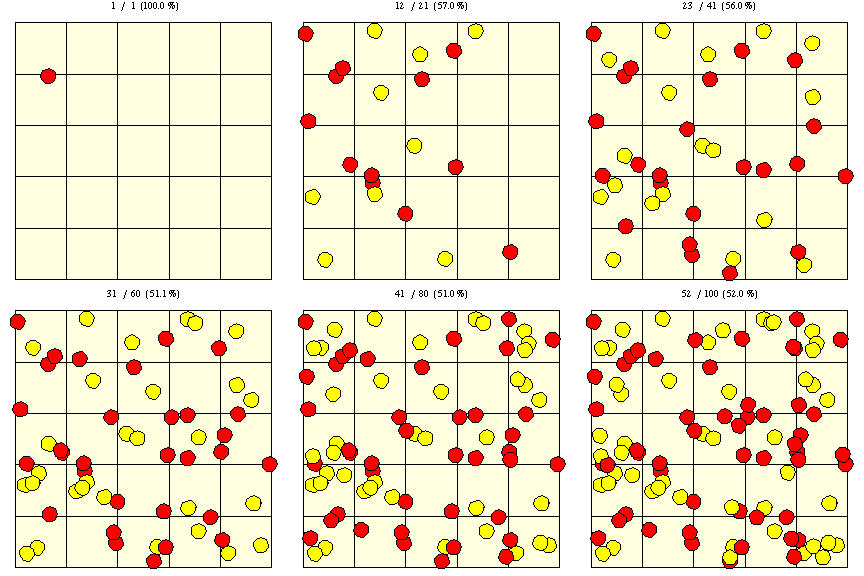
As shown in the figure above, on a square grid with tile edge length 👁 l
,
the probability that a coin of diameter 👁 d
will lie entirely on a single tile (indicated by yellow disks
in the figure) is given by


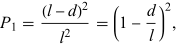
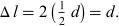
since the shortening of the side of a square obtained by insetting from a square of side length 👁 l
by the radius of the coin 👁 d/2
is given by


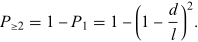
The probability that it will lie on two or more (indicated by red disks) is just
For the game to be fair with two players betting on (1) a single tile or (2) two or more tiles, these quantities must be equal, which gives


The probability of landing on exactly two tiles is the ratio of shaded area in the above figure to the tile size, namely


On a square grid, the probability of a coin landing on exactly three tiles is the fraction of a tile covered by the region illustrated in the figure above,
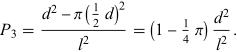

Similarly, the probability of a coin landing on four tiles is the fraction of a tile covered by a disk, as illustrated in the figure above,
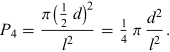

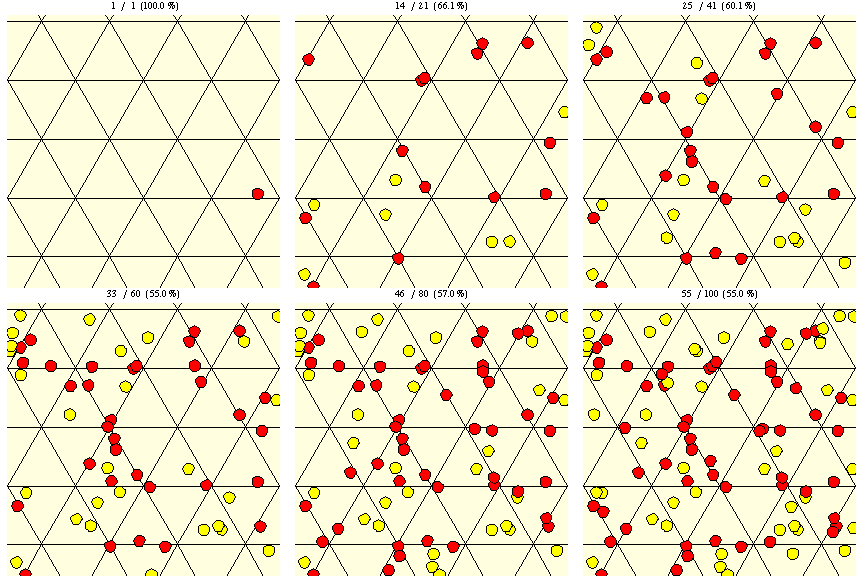
As shown in the figure above, on a triangular grid with tile edge length 👁 l
, the probability that a coin of diameter 👁 d
will lie entirely on a single tile is given by


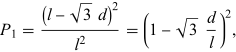
since the shortening of the side of an equilateral triangle obtained by insetting from a triangle of side length 👁 l
by the radius of the coin 👁 d/2
is



The probability that it will lie on two or more is just

For the game to be fair with two players betting on (1) a single tile or (2) two or more tiles, these quantities must be equal, which gives


As shown in the figure above, on a hexagonal grid with tile edge length 👁 l
, the probability that a coin of diameter 👁 d
will lie entirely on a single tile is given by



since the shortening of the side of a regular hexagon obtained by insetting from a triangle of side length 👁 l
by the radius of the coin 👁 d/2
is



The probability that it will lie on two or more is just

For the game to be fair with two players betting on (1) a single tile or (2) two or more tiles, these quantities must be equal, which gives


In a quadrilateral tiling formed by rhombi with opening angle 👁 theta
,
insetting from a rhombus of side length 👁 l
gives


so

Therefore, the probability that a coin will lie on a single tile is


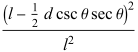


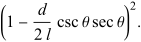
The probability that it will lie on two or more is just

For the game to be fair with two players betting on (1) a single tile or (2) two or more tiles, these quantities must be equal, which gives

As expected, this reduces to the square case for 👁 theta=pi/4
.

See also
Buffon-Laplace Needle Problem, Buffon's Needle ProblemExplore with Wolfram|Alpha

More things to try:
References
Buffon, G. "Essai d'arithmétique morale." Histoire naturelle, générale er particulière, Supplément 4, 46-123, 1777.Mathai, A. M. "The Clean Tile Problem." §1.1.1 in An Introduction to Geometrical Probability: Distributional Aspects with Applications. Taylor & Francis: pp. 2-5, 1999.Solomon, H. Geometric Probability. Philadelphia, PA: SIAM, 1978.Referenced on Wolfram|Alpha
Clean Tile ProblemCite this as:
Weisstein, Eric W. "Clean Tile Problem." From MathWorld--A Wolfram Resource. https://mathworld.wolfram.com/CleanTileProblem.html