

Circumsphere

The circumsphere of given set of points, commonly the vertices of a solid, is a sphere that passes through all the points. A circumsphere
does not always exist, but when it does, its radius 👁 R
is called the circumradius
and its center the circumcenter. The circumsphere
is the 3-dimensional generalization of the circumcircle.


The figures above depict the circumspheres of the Platonic solids.
The circumsphere is implemented in the Wolfram Language as [pts], where pts is a list of points, or [poly], where poly is a (giving a two-dimensional circumcircle) or (giving a three-dimensional circumsphere) object.
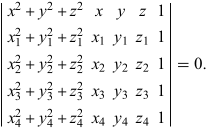
By analogy with the equation of the circumcircle, the equation for the circumsphere of the tetrahedron
with polygon vertices 👁 (x_i,y_i,z_i)
for 👁 i=1
, ..., 4 is


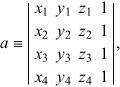
Expanding the determinant,

where
👁 D_x
is the determinant obtained from the
matrix

![👁 D=[x_1^2+y_1^2+z_1^2 x_1 y_1 z_1 1; x_2^2+y_2^2+z_2^2 x_2 y_2 z_2 1; x_3^2+y_3^2+z_3^2 x_3 y_3 z_3 1; x_4^2+y_4^2+z_4^2 x_4 y_4 z_4 1]](https://mathworld.wolfram.com/images/equations/Circumsphere/NumberedEquation4.svg)
by discarding the 👁 x_i
column (and taking a plus sign) and similarly for 👁 D_y
(this time taking the minus sign) and 👁 D_z
(again taking the plus sign)


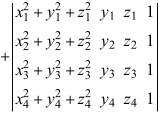


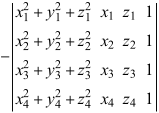


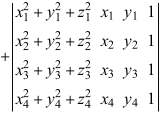
and 👁 c
is given by

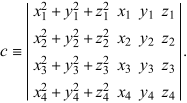
Completing the square gives

which is a sphere of the form

with circumcenter
| 👁 x_0 | 👁 = | 👁 (D_x)/(2a) |
(11)
|
| 👁 y_0 | 👁 = | 👁 (D_y)/(2a) |
(12)
|
| 👁 z_0 | 👁 = | 👁 (D_z)/(2a) |
(13)
|


and circumradius
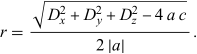
See also
Circumcenter, Circumcircle, Circumradius, Insphere, MidsphereExplore with Wolfram|Alpha

More things to try:
Cite this as:
Weisstein, Eric W. "Circumsphere." From MathWorld--A Wolfram Resource. https://mathworld.wolfram.com/Circumsphere.html