

Platonic Solid


The Platonic solids, also called the regular solids or regular polyhedra, are convex polyhedra with equivalent faces composed of congruent convex regular polygons. There are exactly five such solids (Steinhaus 1999, pp. 252-256): the cube, dodecahedron, icosahedron, octahedron, and tetrahedron, as was proved by Euclid in the last proposition of the Elements. The Platonic solids are sometimes also called "cosmic figures" (Cromwell 1997), although this term is sometimes used to refer collectively to both the Platonic solids and Kepler-Poinsot polyhedra (Coxeter 1973).
The Platonic solids were known to the ancient Greeks, and were described by Plato in his Timaeus ca. 350 BC. In this work, Plato equated the tetrahedron with the "element" fire, the cube with earth, the icosahedron with water, the octahedron with air, and the dodecahedron with the stuff of which the constellations and heavens were made (Cromwell 1997). Predating Plato, the neolithic people of Scotland developed the five solids a thousand years earlier. The stone models are kept in the Ashmolean Museum in Oxford (Atiyah and Sutcliffe 2003).
Schläfli (1852) proved that there are exactly six regular bodies with Platonic properties (i.e., regular polytopes) in four dimensions, three in five dimensions, and three in all higher dimensions. However, his work (which contained no illustrations) remained practically unknown until it was partially published in English by Cayley (Schläfli 1858, 1860). Other mathematicians such as Stringham subsequently discovered similar results independently in 1880 and Schläfli's work was published posthumously in its entirety in 1901.
If 👁 P
is a polyhedron
with congruent (convex) regular polygonal faces, then Cromwell (1997, pp. 77-78)
shows that the following statements are equivalent.

1. The vertices of 👁 P
all lie on a sphere.

2. All the dihedral angles are equal.
3. All the vertex figures are regular polygons.
4. All the solid angles are equivalent.
5. All the vertices are surrounded by the same number of faces.
Let 👁 v
(sometimes denoted 👁 N_0
)
be the number of polyhedron vertices, 👁 e
(or 👁 N_1
) the number of graph edges,
and 👁 f
(or 👁 N_2
)
the number of faces. The following table gives the Schläfli
symbol, Wythoff symbol, and C&R symbol,
the number of vertices 👁 v
,
edges 👁 e
,
and faces 👁 f
,
and the point groups for the Platonic solids (Wenninger
1989). The ordered number of faces for the Platonic solids are 4, 6, 8, 12, 20 (OEIS
A053016; in the order tetrahedron, cube, octahedron,
dodecahedron, icosahedron), which is also the ordered number of vertices (in the
order tetrahedron, octahedron, cube, icosahedron, dodecahedron). The ordered number
of edges are 6, 12, 12, 30, 30 (OEIS A063722;
in the order tetrahedron, octahedron = cube, dodecahedron = icosahedron).


| solid | Schläfli symbol | Wythoff symbol | C&R symbol | 👁 v | 👁 e | 👁 f | group |
| cube | 👁 {4,3} | 3 👁 | 2 4 | 👁 4^3 | 8 | 12 | 6 | 👁 O_h |
| dodecahedron | 👁 {5,3} | 3 👁 | 2 5 | 👁 5^3 | 20 | 30 | 12 | 👁 I_h |
| icosahedron | 👁 {3,5} | 5 👁 | 2 3 | 👁 3^5 | 12 | 30 | 20 | 👁 I_h |
| octahedron | 👁 {3,4} | 4 👁 | 2 3 | 👁 3^4 | 6 | 12 | 8 | 👁 O_h |
| tetrahedron | 👁 {3,3} | 3 👁 | 2 3 | 👁 3^3 | 4 | 6 | 4 | 👁 T_d |


The duals of Platonic solids are other Platonic solids and, in fact, the dual of the tetrahedron is another tetrahedron.
Let 👁 r_d
be the inradius of the dual polyhedron (corresponding
to the insphere, which touches the faces of the dual
solid), 👁 rho
be the midradius of both the polyhedron and its dual
(corresponding to the midsphere, which touches the
edges of both the polyhedron and its duals), 👁 R
the circumradius (corresponding
to the circumsphere of the solid which touches the
vertices of the solid) of the Platonic solid, and 👁 a
the edge length of the solid. Since the circumsphere
and insphere are dual to each other, they obey the relationship


| 👁 Rr_d=rho^2 |
(1)
|

(Cundy and Rollett 1989, Table II following p. 144). In addition,


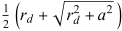





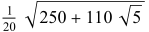
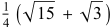
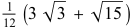
The following two tables give the analytic and numerical values of these distances for Platonic solids with unit side length.






| solid | 👁 r | 👁 rho | 👁 R |
| cube | 0.5 | 0.70711 | 0.86603 |
| dodecahedron | 1.11352 | 1.30902 | 1.40126 |
| icosahedron | 0.75576 | 0.80902 | 0.95106 |
| octahedron | 0.40825 | 0.5 | 0.70711 |
| tetrahedron | 0.20412 | 0.35355 | 0.61237 |


Finally, let 👁 A
be the area of a single face, 👁 V
be the volume
of the solid, and the polyhedron edges be of unit
length on a side. The following table summarizes these quantities for the Platonic
solids.


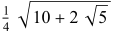
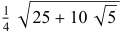
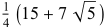
| solid | 👁 A | 👁 V |
| cube | 1 | 1 |
| dodecahedron | 👁 1/4sqrt(25+10sqrt(5)) | 👁 1/4(15+7sqrt(5)) |
| icosahedron | 👁 1/4sqrt(3) | 👁 5/(12)(3+sqrt(5)) |
| octahedron | 👁 1/4sqrt(3) | 👁 1/3sqrt(2) |
| tetrahedron | 👁 1/4sqrt(3) | 👁 1/(12)sqrt(2) |




The following table gives the dihedral angles 👁 alpha
and angles 👁 beta
subtended by an edge from the center for the Platonic solids
(Cundy and Rollett 1989, Table II following p. 144).


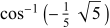
| solid | 👁 alpha (rad) | 👁 alpha (👁 degrees ) | 👁 beta | 👁 beta (👁 degrees ) |
| cube | 👁 1/2pi | 90.000 | 👁 cos^(-1)(1/3) | 70.529 |
| dodecahedron | 👁 cos^(-1)(-1/5sqrt(5)) | 116.565 | 👁 cos^(-1)(1/3sqrt(5)) | 41.810 |
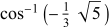
| icosahedron | 👁 cos^(-1)(-1/3sqrt(5)) | 138.190 | 👁 cos^(-1)(1/5sqrt(5)) | 63.435 |
| octahedron | 👁 cos^(-1)(-1/3) | 109.471 | 👁 1/2pi | 90.000 |
| tetrahedron | 👁 cos^(-1)(1/3) | 70.529 | 👁 cos^(-1)(-1/3) | 109.471 |





The number of polyhedron edges meeting at a polyhedron vertex is 👁 2e/v
. The Schläfli symbol
can be used to specify a Platonic solid. For the solid whose faces are 👁 p
-gons (denoted 👁 {p}
), with 👁 q
touching at each polyhedron
vertex, the symbol is 👁 {p,q}
. Given 👁 p
and 👁 q
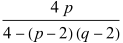
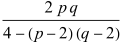
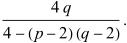
, the number of polyhedron
vertices, polyhedron edges, and faces are
given by


| 👁 N_0 | 👁 = | 👁 (4p)/(4-(p-2)(q-2)) |
(8)
|
| 👁 N_1 | 👁 = | 👁 (2pq)/(4-(p-2)(q-2)) |
(9)
|
| 👁 N_2 | 👁 = | 👁 (4q)/(4-(p-2)(q-2)). |
(10)
|







The plots above show scaled duals of the Platonic solid embedded in an augmented form of the original solid, where the scaling is chosen so that the dual vertices lie at the incenters of the original faces (Wenninger 1983, pp. 8-9).
Since the Platonic solids are convex, the convex hull of each Platonic solid is the solid itself. Minimal surfaces for Platonic solid frames are illustrated in Isenberg (1992, pp. 82-83).
See also
Archimedean Solid, Catalan Solid, Johnson Solid, Kepler-Poinsot Polyhedron, Quasiregular Polyhedron, Uniform Polyhedron Explore this topic in the MathWorld classroomExplore with Wolfram|Alpha

More things to try:
References
Artmann, B. "Symmetry Through the Ages: Highlights from the History of Regular Polyhedra." In In Eves' Circles (Ed. J. M. Anthony). Washington, DC: Math. Assoc. Amer., pp. 139-148, 1994.Atiyah, M. and Sutcliffe, P. "Polyhedra in Physics, Chemistry and Geometry." Milan J. Math. 71, 33-58, 2003.Ball, W. W. R. and Coxeter, H. S. M. "Polyhedra." Ch. 5 in Mathematical Recreations and Essays, 13th ed. New York: Dover, pp. 131-136, 1987.Behnke, H.; Bachman, F.; Fladt, K.; and Kunle, H. (Eds.). Fundamentals of Mathematics, Vol. 2: Geometry. Cambridge, MA: MIT Press, p. 272, 1974.Beyer, W. H. (Ed.). CRC Standard Mathematical Tables, 28th ed. Boca Raton, FL: CRC Press, pp. 128-129, 1987.Bogomolny, A. "Regular Polyhedra." http://www.cut-the-knot.org/do_you_know/polyhedra.shtml.Bourke, P. "Platonic Solids (Regular Polytopes in 3D)." http://www.swin.edu.au/astronomy/pbourke/geometry/platonic/.Coxeter, H. S. M. Regular Polytopes, 3rd ed. New York: Dover, pp. 1-17, 93, and 107-112, 1973.Critchlow, K. Order in Space: A Design Source Book. New York: Viking Press, 1970.Cromwell, P. R. Polyhedra. New York: Cambridge University Press, pp. 51-57, 66-70, and 77-78, 1997.Cundy, H. and Rollett, A. Mathematical Models, 3rd ed. Stradbroke, England: Tarquin Pub., Table II after p. 144, 1989.Dunham, W. Journey through Genius: The Great Theorems of Mathematics. New York: Wiley, pp. 78-81, 1990.Euclid. Book XIII in The Thirteen Books of the Elements, 2nd ed. unabridged, Vol. 3: Books X-XIII. New York: Dover, 1956.Gardner, M. "The Five Platonic Solids." Ch. 1 in The Second Scientific American Book of Mathematical Puzzles & Diversions: A New Selection. New York: Simon and Schuster, pp. 13-23, 1961.Geometry Technologies. "The 5 Platonic Solids and the 13 Archimedean Solids." http://www.scienceu.com/geometry/facts/solids/.Harris, J. W. and Stocker, H. "Regular Polyhedron." §4.4 in Handbook of Mathematics and Computational Science. New York: Springer-Verlag, pp. 99-101, 1998.Heath, T. A History of Greek Mathematics, Vol. 1: From Thales to Euclid. New York: Dover, p. 162, 1981.Hovinga, S. "Regular and Semi-Regular Convex Polytopes: A Short Historical Overview." http://presh.com/hovinga/regularandsemiregularconvexpolytopesashorthistoricaloverview.html.Hume, A. "Exact Descriptions of Regular and Semi-Regular Polyhedra and Their Duals." Computing Science Tech. Rep., No. 130. Murray Hill, NJ: AT&T Bell Laboratories, 1986.Isenberg, C. The Science of Soap Films and Soap Bubbles. New York: Dover, 1992.Kepler, J. Opera Omnia, Vol. 5. Frankfort, p. 121, 1864.Kern, W. F. and Bland, J. R. "Regular Polyhedrons." In Solid Mensuration with Proofs, 2nd ed. New York: Wiley, pp. 116-119, 1948.Meserve, B. E. Fundamental Concepts of Geometry. New York: Dover, 1983.Nooshin, H.; Disney, P. L.; and Champion, O. C. "Properties of Platonic and Archimedean Polyhedra." Table 12.1 in "Computer-Aided Processing of Polyhedric Configurations." Ch. 12 in Beyond the Cube: The Architecture of Space Frames and Polyhedra (Ed. J. F. Gabriel). New York: Wiley, pp. 360-361, 1997.Ogilvy, C. S. Excursions in Geometry. New York: Dover, pp. 129-131, 1990.Pappas, T. "The Five Platonic Solids." The Joy of Mathematics. San Carlos, CA: Wide World Publ./Tetra, pp. 39 and 110-111, 1989.Pedagoguery Software. . http://www.peda.com/poly/.Steinhaus, H. Mathematical Snapshots, 3rd ed. New York: Dover, pp. 191-201, 1999.Rawles, B. A. "Platonic and Archimedean Solids--Faces, Edges, Areas, Vertices, Angles, Volumes, Sphere Ratios." http://www.intent.com/sg/polyhedra.html.Robertson, S. A. and Carter, S. "On the Platonic and Archimedean Solids." J. London Math. Soc. 2, 125-132, 1970.Schläfli, L. "Theorie der vielfachen Kontinuität." Unpublished manuscript. 1852. Published in Denkschriften der Schweizerischen naturforschenden Gessel. 38, 1-237, 1901.Schläfli, L. "On The Multiple Integral 👁 intndxdy...dz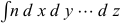
whose Limits Are 👁 p_1=a_1x+b_1y+...+h_1z>0

, 👁 p_2>0

, ..., 👁 p_n>0

and 👁 x^2+y^2+...+z^2<1

." Quart. J. Pure Appl. Math. 2, 269-301, 1858.Schläfli, L. "On The Multiple Integral 👁 intndxdy...dz
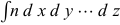
whose Limits Are 👁 p_1=a_1x+b_1y+...+h_1z>0

, 👁 p_2>0

, ..., 👁 p_n>0

and 👁 x^2+y^2+...+z^2<1

." Quart. J. Pure Appl. Math. 3, 54-68 and 97-108, 1860.Sharp, A. Geometry Improv'd: 1. By a Large and Accurate Table of Segments of Circles, with Compendious Tables for Finding a True Proportional Part, Exemplify'd in Making out Logarithms from them, there Being a Table of them for all Primes to 1100, True to 61 Figures. 2. A Concise Treatise of Polyhedra, or Solid Bodies, of Many Bases. London: R. Mount, p. 87, 1717.Steinhaus, H. "Platonic Solids, Crystals, Bees' Heads, and Soap." Ch. 8 in Mathematical Snapshots, 3rd ed. New York: Dover, pp. 199-201 and 252-256, 1983.Plato. Timaeus. In Gorgias and Timaeus. New York: Dover, 2003.Sloane, N. J. A. Sequences A053016 and A063722 in "The On-Line Encyclopedia of Integer Sequences."Waterhouse, W. "The Discovery of the Regular Solids." Arch. Hist. Exact Sci. 9, 212-221, 1972-1973.Webb, R. "Platonic Solids." http://www.software3d.com/Platonic.html.Wells, D. The Penguin Dictionary of Curious and Interesting Numbers. Middlesex, England: Penguin Books, pp. 60-61, 1986.Wells, D. The Penguin Dictionary of Curious and Interesting Geometry. London: Penguin, pp. 187-188, 1991.Wenninger, M. "The Five Regular Convex Polyhedra and Their Duals." Ch. 1 in Dual Models. Cambridge, England: Cambridge University Press, pp. 7-13, 1983.Wenninger, M. J. Polyhedron Models. New York: Cambridge University Press, 1989.
Referenced on Wolfram|Alpha
Platonic SolidCite this as:
Weisstein, Eric W. "Platonic Solid." From MathWorld--A Wolfram Resource. https://mathworld.wolfram.com/PlatonicSolid.html