

Cube


The cube, illustrated above together with a wireframe version and a net that can be used for its construction, is the Platonic
solid composed of six square faces that meet each
other at right angles and has eight vertices and 12
edges. It is also the uniform polyhedron with
Maeder index 6 (Maeder 1997), Wenninger index 3 (Wenninger 1989), Coxeter index 18
(Coxeter et al. 1954), and Har'El index 11 (Har'El 1993). It is described
by the Schläfli symbol 👁 {4,3}
and Wythoff symbol 👁 3|24
.


Three symmetric projections of the cube are illustrated above.
The cube is the unique regular convex hexahedron. The topologically distinct pentagonal wedge is the only other convex hexahedron that shares the same number of vertices, edges, and faces as the cube (though of course with different face shapes; the pentagonal wedge consists of triangles, 2 quadrilaterals, and 2 pentagons).
The cube is implemented in the Wolfram Language as [] or []. Precomputed properties are available as [, prop].
The cube is a space-filling polyhedron and therefore has Dehn invariant 0.

It is the convex hull of the endododecahedron and stella octangula.

There are a total of 11 distinct nets for the cube (Turney 1984-85, Buekenhout and Parker 1998, Malkevitch), illustrated above, the same number as the octahedron. Questions of polyhedron coloring of the cube can be addressed using the Pólya enumeration theorem.
A cube with unit edge lengths is called a unit cube.
The surface area and volume of a cube with edge length 👁 a
are


Because the volume of a cube of edge length 👁 a
is given by 👁 a^3
, a number of the form 👁 a^3
is called a cubic
number (or sometimes simply "a cube"). Similarly, the operation of
taking a number to the third power is called cubing.


A unit cube has inradius, midradius, and circumradius of
| 👁 r | 👁 = | 👁 1/2 |
(3)
|
| 👁 rho | 👁 = | 👁 1/2sqrt(2) |
(4)
|
| 👁 R | 👁 = | 👁 1/2sqrt(3). |
(5)
|


The cube has a dihedral angle of
| 👁 alpha=1/2pi. |
(6)
|

In terms of the inradius 👁 r
of a cube, its surface area 👁 S
and volume 👁 V
are given by


so the volume, inradius, and surface area are related by
| 👁 (dV)/(dr)=S, |
(9)
|

where 👁 h=r
is the harmonic
parameter (Dorff and Hall 2003, Fjelstad and Ginchev 2003).

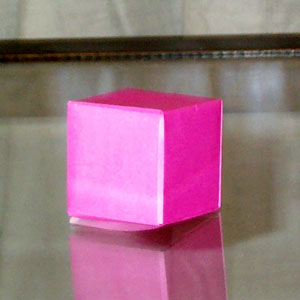
The illustration above shows an origami cube constructed from a single sheet of paper (Kasahara and Takahama 1987, pp. 58-59).
Sodium chloride (NaCl; common table salt) naturally forms cubic crystals.
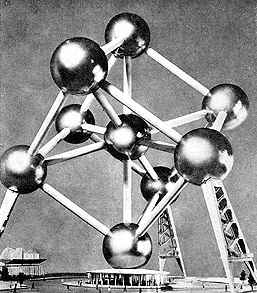
The world's largest cube is the Atomium, a structure built for the 1958 Brussels World's Fair, illustrated above (© 2006 Art Creation (ASBL); Artists Rights Society (ARS), New York; SABAM, Belgium). The Atomium is 334.6 feet high, and the nine spheres at the vertices and center have diameters of 59.0 feet. The distance between the spheres along the edge of the cube is 95.1 feet, and the diameter of the tubes connecting the spheres is 9.8 feet.

The dual polyhedron of a unit cube is an octahedron with edge lengths 👁 sqrt(2)
.

The cube has the octahedral group 👁 O_h
of symmetries, and is an equilateral
zonohedron and a rhombohedron. It has 13 axes
of symmetry: 👁 6C_2
(axes joining midpoints of opposite edges), 👁 4C_3
(space diagonals), and 👁 3C_4
(axes joining opposite face centroids).


The connectivity of the vertices of the cube is given by the cubical graph.
Using so-called "wallet hinges," a ring of six cubes can be rotated continuously (Wells 1975; Wells 1991, pp. 218-219).

The illustrations above show the cross sections obtained by cutting a unit cube centered at the origin with various planes. The following table summarizes the metrical properties of these slices.
| cutting plane | face shape | edge lengths | surface area | volume of pieces |
| 👁 z=0 | square | 1 | 1 | 👁 1/2 , 👁 1/2 |
| 👁 x+z=0 | rectangle | 1, 👁 sqrt(2) | 👁 sqrt(2) | 👁 1/2 , 👁 1/2 |
| 👁 x+y+z=0 | hexagon | 👁 1/2sqrt(2) | 👁 3/4sqrt(3) | 👁 1/2 , 👁 1/2 |
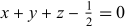
| 👁 x+y+z-1/2=0 | equilateral triangle | 👁 sqrt(2) | 👁 1/2sqrt(3) | 👁 1/6 , 👁 5/6 |




As shown above, a plane passing through the midpoints of opposite edges (perpendicular to a 👁 C_3
axis) cuts the cube in a regular hexagonal cross section (Gardner 1960; Steinhaus 1999, p. 170;
Kasahara 1988, p. 118; Cundy and Rollett 1989, p. 157; Holden 1991, pp. 22-23).
Since there are four such axes, there are four possible hexagonal cross sections. If the vertices of the cube are 👁 (+/-1,+/-1+/-1)
, then the vertices of
the inscribed hexagon are 👁 (0,-1,-1)
, 👁 (1,0,-1)
,
👁 (1,1,0)
, 👁 (0,1,1)
, 👁 (-1,0,1)
,
and 👁 (-1,-1,0)
. A hexagon
is also obtained when the cube is viewed from above a corner along the extension
of a space diagonal (Steinhaus 1999, p. 170).


The maximal cross sectional area that can be obtained by cutting a unit cube with a plane passing through its center is 👁 sqrt(2)
, corresponding to a rectangular section intersecting
the cube in two diagonally opposite edges and along two opposite face diagonals.
The area obtained as a function of normal to the plane 👁 (a,b,1)
is illustrated above (Hidekazu).


A hyperboloid of one sheet is obtained as the envelope of a cube rotated about a space diagonal (Steinhaus 1999, pp. 171-172; Kabai
2002, p. 11). The resulting volume for a cube with edge length 👁 a
is

| 👁 V=1/3sqrt(3)pia^3 |
(10)
|
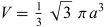
(Cardot and Wolinski 2004).

More generally, consider the solid of revolution obtained for revolution axis passing through the center and the point 👁 (x,y,1)
, several examples of which are shown above.


As shown by Hidekazu, the solid with maximum volume is obtained for parameters of approximately 👁 (a,b)=(0.529307,0.237593)
.
This corresponds to the rightmost plot above.



The centers of the faces of an octahedron form a cube, and the centers of the faces of a cube form an octahedron
(Steinhaus 1999, pp. 194-195). The largest square
which will fit inside a cube of edge length 👁 a
has each corner a distance 1/4 from a corner of a cube. The
resulting square has edge length 👁 3sqrt(2)a/4
, and the cube containing that edge is called Prince Rupert's cube.


The solid formed by the faces having the edges of the stella octangula (left figure) as polygon diagonals is a cube (right figure; Ball and Coxeter 1987). Affixing a square pyramid of height 1/2 on each face of a cube having unit edge length results in a rhombic dodecahedron (Brückner 1900, p. 130; Steinhaus 1999, p. 185).
Since its eight faces are mutually perpendicular or parallel, the cube cannot be stellated.
The cube can be constructed by augmentation of a unit edge-length tetrahedron by a pyramid with height
👁 1/6sqrt(6)
. The following table gives
polyhedra which can be constructed by augmentation
of a cube by pyramids of given heights 👁 h
.


| 👁 h | result |
| 👁 1/6 | tetrakis hexahedron |
| 👁 1/2 | rhombic dodecahedron |
| 👁 1/2sqrt(2) | star equilateral 24-deltahedron |


The polyhedron vertices of a cube of edge length 2 with face-centered axes are given by 👁 (+/-1,+/-1,+/-1)
. If the cube is oriented with a space diagonal
along the z-axis, the coordinates are (0, 0, 👁 sqrt(3)
), (0, 👁 2sqrt(2/3)
, 👁 1/sqrt(3)
),
(👁 sqrt(2)
, 👁 sqrt(2/3)
, 👁 -1/sqrt(3)
),
(👁 sqrt(2)
, 👁 -sqrt(2/3)
, 👁 1/sqrt(3)
),
(0, 👁 -2sqrt(2/3)
, 👁 -1/sqrt(3)
), (👁 -sqrt(2)
, 👁 -sqrt(2/3)
,
👁 1/sqrt(3)
), (👁 -sqrt(2)
, 👁 sqrt(2/3)
,
👁 -1/sqrt(3)
), and the negatives of these
vectors. A faceted version is the great
cubicuboctahedron.


See also
Augmented Truncated Cube, Biaugmented Truncated Cube, Bidiakis Cube, Bislit Cube, Browkin's Theorem, Cube Dissection, Cube Dovetailing Problem, Cube Duplication, Cubic Number, Cubical Graph, Cuboid, Goursat's Surface, Hadwiger Problem, Hypercube, Keller's Conjecture, Pentagonal Wedge, Platonic Solid, Polyhedron Coloring, Prince Rupert's Cube, Prism, Rubik's Cube, Soma Cube, Stella Octangula, Tesseract, Unit Cube Explore this topic in the MathWorld classroomExplore with Wolfram|Alpha

More things to try:
References
Atomium. "Atomium: The Most Astonishing Building in the World." http://www.atomium.be/.Ball, W. W. R. and Coxeter, H. S. M. Mathematical Recreations and Essays, 13th ed. New York: Dover, 1987.Beyer, W. H. (Ed.). CRC Standard Mathematical Tables, 28th ed. Boca Raton, FL: CRC Press, pp. 127 and 228, 1987.Brückner, M. Vielecke under Vielflache. Leipzig, Germany: Teubner, 1900.Buekenhout, F. and Parker, M. "The Number of Nets of the Regular Convex Polytopes in Dimension 👁 <=4
." Disc. Math. 186, 69-94, 1998.Cardot C. and Wolinski F. "Récréations scientifiques." La jaune et la rouge, No. 594, 41-46, 2004.Coxeter, H. S. M.; Longuet-Higgins, M. S.; and Miller, J. C. P. "Uniform Polyhedra." Phil. Trans. Roy. Soc. London Ser. A 246, 401-450, 1954.Cundy, H. and Rollett, A. "Cube. 👁 4^3

" and "Hexagonal Section of a Cube." §3.5.2 and 3.15.1 in Mathematical Models, 3rd ed. Stradbroke, England: Tarquin Pub., pp. 85 and 157, 1989.Davie, T. "The Cube (Hexahedron)." http://www.dcs.st-and.ac.uk/~ad/mathrecs/polyhedra/cube.html.Dorff, M. and Hall, L. "Solids in 👁 R^n

Whose Area is the Derivative of the Volume." College Math. J. 34, 350-358, 2003.Eppstein, D. "Rectilinear Geometry." http://www.ics.uci.edu/~eppstein/junkyard/rect.html.Fischer, G. (Ed.). Plate 2 in Mathematische Modelle aus den Sammlungen von Universitäten und Museen, Bildband. Braunschweig, Germany: Vieweg, p. 3, 1986.Fjelstad, P. and Ginchev, I. "Volume, Surface Area, and the Harmonic Mean." Math. Mag. 76, 126-129, 2003.Gardner, M. "Mathematical Games: More about the Shapes That Can Be Made with Complex Dominoes." Sci. Amer. 203, 186-198, Nov. 1960.Geometry Technologies. "Cube." http://www.scienceu.com/geometry/facts/solids/cube.html.Har'El, Z. "Uniform Solution for Uniform Polyhedra." Geometriae Dedicata 47, 57-110, 1993.Harris, J. W. and Stocker, H. "Cube" and "Cube (Hexahedron)." §4.2.4 and 4.4.3 in Handbook of Mathematics and Computational Science. New York: Springer-Verlag, pp. 97-98 and 100, 1998.👁 Update a link

Hidekazu, T. "Research on a Cube." http://www.biwako.ne.jp/~hidekazu/materials/cubee.htmHolden, A. Shapes, Space, and Symmetry. New York: Dover, 1991.Kabai, S. Mathematical Graphics I: Lessons in Computer Graphics Using Mathematica. Püspökladány, Hungary: Uniconstant, p. 231, 2002.Kasahara, K. "Cube A--Bisecting I," "Cube B--Bisecting II," "Cube C--Bisecting Horizontally," "Cube D--Bisecting on the Diagonal," "Cube E--Bisecting III," "Making a Cube from a Cube with a Single Cut," and "Module Cube." Origami Omnibus: Paper-Folding for Everyone. Tokyo: Japan Publications, pp. 104-108, 112, and 118-120, and 208, 1988.Kasahara, K. and Takahama, T. Origami for the Connoisseur. Tokyo: Japan Publications, 1987.Kern, W. F. and Bland, J. R. "Cube." §9 in Solid Mensuration with Proofs, 2nd ed. New York: Wiley, pp. 19-20, 1948.Maeder, R. E. "06: Cube." 1997. https://www.mathconsult.ch/static/unipoly/06.html.Malkevitch, J. "Nets: A Tool for Representing Polyhedra in Two Dimensions." http://www.ams.org/new-in-math/cover/nets.html.Malkevitch, J. "Unfolding Polyhedra." http://www.york.cuny.edu/~malk/unfolding.html.Steinhaus, H. Mathematical Snapshots, 3rd ed. New York: Dover, 1999.Turney, P. D. "Unfolding the Tesseract." J. Recr. Math. 17, No. 1, 1-16, 1984-85.Wells, D. "Puzzle Page." Games and Puzzles. Sep. 1975.Wells, D. The Penguin Dictionary of Curious and Interesting Geometry. London: Penguin, pp. 41-42 and 218-219, 1991.Wenninger, M. J. "The Hexahedron (Cube)." Model 3 in Polyhedron Models. Cambridge, England: Cambridge University Press, p. 16, 1989.
Referenced on Wolfram|Alpha
CubeCite this as:
Weisstein, Eric W. "Cube." From MathWorld--A Wolfram Resource. https://mathworld.wolfram.com/Cube.html