

Complex Residue

The constant 👁 a_(-1)
in the Laurent series

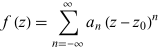
of 👁 f(z)
about a point 👁 z_0
is called the residue of 👁 f(z)
. If 👁 f
is analytic at 👁 z_0
, its residue is zero, but the converse is not always true
(for example, 👁 1/z^2
has residue of 0 at 👁 z=0
but is not analytic at 👁 z=0
).
The residue of a function 👁 f
at a point 👁 z_0
may be denoted 👁 Res_(z=z_0)(f(z))
. The residue is implemented in the Wolfram
Language as [f,
👁 {
z, z0👁 }
].


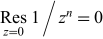
Two basic examples of residues are given by 👁 Res_(z=0)1/z=1
and 👁 Res_(z=0)1/z^n=0
for 👁 n>1
.



The residue of a function 👁 f
around a point 👁 z_0
is also defined by


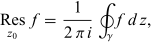
where 👁 gamma
is counterclockwise simple closed contour, small enough
to avoid any other poles of 👁 f
. In fact, any counterclockwise path with contour
winding number 1 which does not contain any other poles
gives the same result by the Cauchy integral
formula. The above diagram shows a suitable contour
for which to define the residue of function, where the poles are indicated as black
dots.


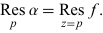
It is more natural to consider the residue of a meromorphic one-form because it is independent of the choice of coordinate. On a Riemann
surface, the residue is defined for a meromorphic one-form 👁 alpha
at a point 👁 p
by writing 👁 alpha=fdz
in a coordinate 👁 z
around 👁 p
. Then


The sum of the residues of 👁 intfdz
is zero on the Riemann
sphere. More generally, the sum of the residues of a meromorphic one-form on
a compact Riemann surface must be zero.

The residues of a function 👁 f(z)
may be found without explicitly expanding into a Laurent
series as follows. If 👁 f(z)
has a pole of order 👁 m
at 👁 z_0
, then 👁 a_n=0
for 👁 n<-m
and 👁 a_(-m)!=0
. Therefore,


| 👁 f(z) | 👁 = | 👁 sum_(n=-m)^(infty)a_n(z-z_0)^n |
(4)
|
| 👁 Image | 👁 = | 👁 sum_(n=0)^(infty)a_(-m+n)(z-z_0)^(-m+n). |
(5)
|


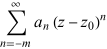


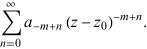
Multiplying both sides by 👁 (z-z_0)^m
gives

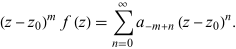
Take the first derivative and reindex,
| 👁 d/(dz)[(z-z_0)^mf(z)] | 👁 = | 👁 sum_(n=0)^(infty)na_(-m+n)(z-z_0)^(n-1) |
(7)
|
| 👁 Image | 👁 = | 👁 sum_(n=1)^(infty)na_(-m+n)(z-z_0)^(n-1) |
(8)
|
| 👁 Image | 👁 = | 👁 sum_(n=0)^(infty)(n+1)a_(-m+n+1)(z-z_0)^n. |
(9)
|
![👁 d/(dz)[(z-z_0)^mf(z)]](https://mathworld.wolfram.com/images/equations/ComplexResidue/Inline42.svg)

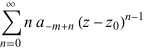


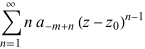


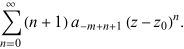
Take the second derivative and reindex,
![👁 (d^2)/(dz^2)[(z-z_0)^mf(z)]](https://mathworld.wolfram.com/images/equations/ComplexResidue/Inline51.svg)

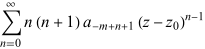


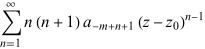


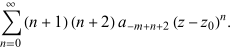
Iterating then gives
| 👁 (d^(m-1))/(dz^(m-1))[(z-z_0)^mf(z)] | 👁 = | 👁 sum_(n=0)^(infty)(n+1)(n+2)...(n+m-1)a_(n-1)(z-z_0)^n |
(13)
|
| 👁 Image | 👁 = | 👁 (m-1)!a_(-1)+sum_(n=1)^(infty)(n+1)(n+2)...(n+m-1)a_(n-1)(z-z_0)^n. |
(14)
|
![👁 (d^(m-1))/(dz^(m-1))[(z-z_0)^mf(z)]](https://mathworld.wolfram.com/images/equations/ComplexResidue/Inline60.svg)





So
| 👁 lim_(z->z_0)(d^(m-1))/(dz^(m-1))[(z-z_0)^mf(z)] | 👁 = | 👁 lim_(z->z_0)(m-1)!a_(-1)+0 |
(15)
|
| 👁 Image | 👁 = | 👁 (m-1)!a_(-1) |
(16)
|
![👁 lim_(z->z_0)(d^(m-1))/(dz^(m-1))[(z-z_0)^mf(z)]](https://mathworld.wolfram.com/images/equations/ComplexResidue/Inline66.svg)

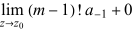


since 👁 lim_(z->z_0)(z-z_0)^n=0
,
and the residue is

![👁 a_(-1)=1/((m-1)!)(d^(m-1))/(dz^(m-1))[(z-z_0)^mf(z)]_(z=z_0).](https://mathworld.wolfram.com/images/equations/ComplexResidue/NumberedEquation5.svg)
The residues of a holomorphic function at its poles characterize a great deal of the structure of a function, appearing for example in the amazing residue theorem of contour integration.
See also
Cauchy Integral Formula, Cauchy Integral Theorem, Contour Integration, Contour Winding Number, Laurent Series, Pole, Residue TheoremPortions of this entry contributed by Todd Rowland
Explore with Wolfram|Alpha

More things to try:
Cite this as:
Rowland, Todd and Weisstein, Eric W. "Complex Residue." From MathWorld--A Wolfram Resource. https://mathworld.wolfram.com/ComplexResidue.html