

Residue Theorem
An analytic function 👁 f(z)
whose Laurent series
is given by

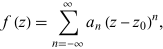
can be integrated term by term using a closed contour 👁 gamma
encircling 👁 z_0
,


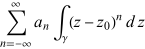



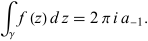
The Cauchy integral theorem requires that the first and last terms vanish, so we have
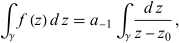
where 👁 a_(-1)
is the complex residue. Using the contour 👁 z=gamma(t)=e^(it)+z_0
gives


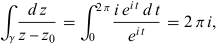
so we have
If the contour 👁 gamma
encloses multiple poles, then the theorem gives the general result

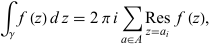
where 👁 A
is the set of poles contained inside the contour. This amazing theorem therefore
says that the value of a contour integral for
any contour in the complex plane depends
only on the properties of a few very special points inside the contour.


The diagram above shows an example of the residue theorem applied to the illustrated contour 👁 gamma
and the function


Only the poles at 1 and 👁 i
are contained in the contour, which have residues of 0 and
2, respectively. The values of the contour integral
is therefore given by


See also
Cauchy Integral Formula, Cauchy Integral Theorem, Complex Residue, Contour, Contour Integral, Contour Integration, Group Residue Theorem, Laurent Series, PoleExplore with Wolfram|Alpha

More things to try:
References
Knopp, K. "The Residue Theorem." §33 in Theory of Functions Parts I and II, Two Volumes Bound as One, Part I. New York: Dover, pp. 129-134, 1996.Krantz, S. G. "The Residue Theorem." §4.4.2 in Handbook of Complex Variables. Boston, MA: Birkhäuser, pp. 48-49, 1999.Referenced on Wolfram|Alpha
Residue TheoremCite this as:
Weisstein, Eric W. "Residue Theorem." From MathWorld--A Wolfram Resource. https://mathworld.wolfram.com/ResidueTheorem.html