

Digamma Function


The digamma function is a special function which is given by the logarithmic derivative of the gamma function (or, depending on the definition, the logarithmic derivative of the factorial).
Because of this ambiguity, two different notations are sometimes (but not always) used, with
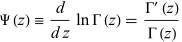
defined as the logarithmic derivative of the gamma function 👁 Gamma(z)
, and

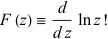
defined as the logarithmic derivative of the factorial function. The two are connected by the relationship
| 👁 F(z)=Psi(z+1). |
(3)
|

The 👁 n
th
derivative of 👁 Psi(z)
is called the polygamma
function, denoted 👁 psi_n(z)
.
The notation


is therefore frequently used for the digamma function itself, and Erdélyi et al. (1981) use the notation 👁 psi(z)
for 👁 Psi(z)
. The digamma function 👁 psi_0(z)
is returned by the function [z]
or [0,
z] in the Wolfram Language,
and typeset using the notation 👁 psi^((0))(z)
.


The digamma function arises in simple sums such as
| 👁 sum_(k=0)^(infty)((-1)^k)/(zk+1) | 👁 = | 👁 (Phi(-1,1,z^(-1)))/z |
(5)
|
| 👁 Image | 👁 = | 👁 1/(2z)[psi_0((z+1)/(2z))-psi_0(1/(2z))], |
(6)
|


![👁 1/(2z)[psi_0((z+1)/(2z))-psi_0(1/(2z))],](https://mathworld.wolfram.com/images/equations/DigammaFunction/Inline14.svg)
where 👁 Phi(z,s,a)
is a Lerch transcendent.

Special cases are given by


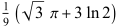


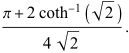
Gauss's digamma theorem states that
![👁 (Gamma^'(p/q))/(Gamma(p/q))=-gamma-ln(2q)-1/2picot((pip)/q)+2sum_(0<n<q/2)cos((2pipn)/q)ln[sin((pin)/q)]](https://mathworld.wolfram.com/images/equations/DigammaFunction/NumberedEquation5.svg)
(Allouche 1992, Knuth 1997, p. 94).
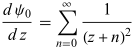
An asymptotic series for the digamma function is given by


![👁 d/(dz)lim_(n->infty)[lnn!+zlnn-ln(z+1)-ln(z+2)-...-ln(z+n)]](https://mathworld.wolfram.com/images/equations/DigammaFunction/Inline30.svg)





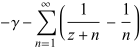


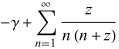


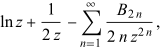
where 👁 gamma
is the Euler-Mascheroni constant and
👁 B_(2n)
are Bernoulli
numbers.


The digamma function satisfies

For integer 👁 z=n
,

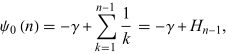
where 👁 gamma
is the Euler-Mascheroni constant and
👁 H_n
is a harmonic
number.


Other identities include

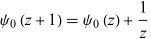

Special values are


At integer values,


(Derbyshire 2004, p. 58), and at half-integral values,


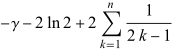


where 👁 H_n
is a harmonic number.

It is given by the unit square integral

for 👁 u>0
(Guillera and Sondow 2005). Plugging in 👁 u=1
gives a special case involving the Euler-Mascheroni
constant.


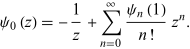
The series for 👁 psi_0(z)
is given by

A logarithmic series is given by

(Guillera and Sondow 2005).
A surprising identity that arises from the FoxTrot series is given by

See also
Barnes G-Function, G-Function, Gamma Function, Gauss's Digamma Theorem, Harmonic Number, Hurwitz Zeta Function, Logarithmic Derivative, Mellin's Formula, Polygamma Function, Ramanujan phi-Function, Trigamma FunctionRelated Wolfram sites
http://functions.wolfram.com/GammaBetaErf/PolyGamma/Explore with Wolfram|Alpha

More things to try:
References
Abramowitz, M. and Stegun, I. A. (Eds.). "Psi (Digamma) Function." §6.3 in Handbook of Mathematical Functions with Formulas, Graphs, and Mathematical Tables, 9th printing. New York: Dover, pp. 258-259, 1972.Allouche, J.-P. "Series and Infinite Products related to Binary Expansions of Integers." 1992. http://algo.inria.fr/seminars/sem92-93/allouche.ps.Arfken, G. "Digamma and Polygamma Functions." §10.2 in Mathematical Methods for Physicists, 3rd ed. Orlando, FL: Academic Press, pp. 549-555, 1985.Boros, G. and Moll, V. "The Psi Function." §10.11 in Irresistible Integrals: Symbolics, Analysis and Experiments in the Evaluation of Integrals. Cambridge, England: Cambridge University Press, pp. 212-215, 2004.Derbyshire, J. Prime Obsession: Bernhard Riemann and the Greatest Unsolved Problem in Mathematics. New York: Penguin, 2004.Erdélyi, A.; Magnus, W.; Oberhettinger, F.; and Tricomi, F. G. "The 👁 psi
Function." §1.7 in Higher Transcendental Functions, Vol. 1. New York: Krieger, pp. 15-20, 1981.Guillera, J. and Sondow, J. "Double Integrals and Infinite Products for Some Classical Constants Via Analytic Continuations of Lerch's Transcendent." 16 June 2005 http://arxiv.org/abs/math.NT/0506319.Havil, J. Gamma: Exploring Euler's Constant. Princeton, NJ: Princeton University Press, 2003.Jeffreys, H. and Jeffreys, B. S. "The Digamma (👁 F

) and Trigamma (👁 F^'

) Functions." Methods of Mathematical Physics, 3rd ed. Cambridge, England: Cambridge University Press, pp. 465-466, 1988.Knuth, D. E. The Art of Computer Programming, Vol. 1: Fundamental Algorithms, 3rd ed. Reading, MA: Addison-Wesley, 1997.Spanier, J. and Oldham, K. B. "The Digamma Function 👁 psi(x)

." Ch. 44 in An Atlas of Functions. Washington, DC: Hemisphere, pp. 423-434, 1987.
Referenced on Wolfram|Alpha
Digamma FunctionCite this as:
Weisstein, Eric W. "Digamma Function." From MathWorld--A Wolfram Resource. https://mathworld.wolfram.com/DigammaFunction.html