

Harmonic Number


A harmonic number is a number of the form

arising from truncation of the harmonic series. A harmonic number can be expressed analytically as

where 👁 gamma
is the Euler-Mascheroni constant and
👁 Psi(x)=psi_0(x)
is the digamma
function.


The first few harmonic numbers 👁 H_n
are 1, 👁 3/2
, 👁 11/6
, 👁 25/12
, 👁 137/60
, ... (OEIS A001008
and A002805). The numbers of digits in the
numerator of 👁 H_(10^n)
for 👁 n=0
,
1, ... are 1, 4, 41, 434, 4346, 43451, 434111, 4342303, 43428680, ... (OEIS A114467),
with the corresponding number of digits in the denominator given by 1, 4, 40, 433,
4345, 43450, 434110, 4342302, 43428678, ... (OEIS A114468).
These digits converge to what appears to be the decimal digits of 👁 log_(10)e=0.43429448...
(OEIS A002285).




The first few indices 👁 n
such that the numerator of 👁 H_n
is prime are given by 2, 3, 5, 8, 9, 21, 26, 41, 56, 62,
69, ... (OEIS A056903). The search for prime
numerators has been completed up to 👁 81780
by E. W. Weisstein (May 13, 2009), and the following
table summarizes the largest known values.


| 👁 n | decimal digits | discoverer |
| 63942 | 27795 | E. W. Weisstein (Feb. 14, 2007) |
| 69294 | 30067 | E. W. Weisstein (Feb. 1, 2008) |
| 69927 | 30301 | E. W. Weisstein (Mar. 11, 2008) |
| 77449 | 33616 | E. W. Weisstein (Apr. 4, 2009) |
| 78128 | 33928 | E. W. Weisstein (Apr. 9, 2009) |
| 78993 | 34296 | E. W. Weisstein (Apr. 17, 2009) |
| 81658 | 35479 | E. W. Weisstein (May. 12, 2009) |

The denominators of 👁 H_n
appear never to be prime except for the case 👁 H_2=3/2
. Furthermore, the denominator is never a prime
power (except for this case) since the denominator is always divisible by the
largest power of 2 less than or equal to 👁 n
, and also by any prime 👁 p
with 👁 n/2<p<=n
.


The harmonic numbers are implemented as [n].
The values of 👁 n
such that 👁 H_n
equals or exceeds 1, 2, 3, ... are given by 1, 4, 11, 31, 83, 227, 616, 1674, ...
(OEIS A004080). Another interesting sequence
is the number of terms in the simple continued
fraction of 👁 H_(10^n)
for 👁 n=0
,
1, 2, ..., given by 1, 8, 68, 834, 8356, 84548, 841817, 8425934, 84277586, ... (OEIS
A091590), which is conjectured to approach
👁 12ln2/pi^2=0.8427659...
(OEIS A089729).





The definition of harmonic numbers can also be extended to the complex plane, as illustrated above.
Based on their definition, harmonic numbers satisfy the obvious recurrence equation
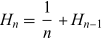
with 👁 H_1=1
.

The number formed by taking alternate signs in the sum also has an explicit analytic form
| 👁 H_n^' | 👁 = | 👁 sum_(k=1)^(n)((-1)^(k+1))/k |
(4)
|
| 👁 Image | 👁 = | 👁 ln2+1/2(-1)^n[psi_0(1/2n+1/2)-psi_0(1/2n+1)] |
(5)
|
| 👁 Image | 👁 = | 👁 ln2+1/2(-1)^n[H_((n-1)/2)-H_(n/2)]. |
(6)
|


![👁 ln2+1/2(-1)^n[psi_0(1/2n+1/2)-psi_0(1/2n+1)]](https://mathworld.wolfram.com/images/equations/HarmonicNumber/Inline31.svg)


![👁 ln2+1/2(-1)^n[H_((n-1)/2)-H_(n/2)].](https://mathworld.wolfram.com/images/equations/HarmonicNumber/Inline34.svg)
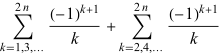
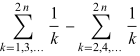
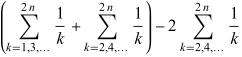
👁 H_(2n)^'
has the particularly beautiful
form








Alternating harmonic numbers may be supported in a future version of the Wolfram Language.
The harmonic number 👁 H_n
is never an integer except for 👁 H_1
, which can be proved by using the strong triangle inequality
to show that the 2-adic value of 👁 H_n
is greater than 1 for 👁 n>1
. This result was proved in 1915 by Taeisinger, and the
more general results that any number of consecutive terms not necessarily starting
with 1 never sum to an integer was proved by Kűrschák in 1918 (Hoffman
1998, p. 157).


The harmonic numbers have odd numerators and even denominators.
The 👁 n
th
harmonic number is given asymptotically by


where 👁 gamma
is the Euler-Mascheroni constant (Conway
and Guy 1996; Havil 2003, pp. 79 and 89), where the general 👁 (2n)
th term is 👁 zeta(1-2n)
, giving 👁 -12
, 120, 👁 -252
, 240, ... for 👁 n=1
, 2, ... (OEIS A006953).
This formula is a special case of an Euler-Maclaurin
integration formulas (Havil 2003, p. 79).


Inequalities bounding 👁 H_n
include

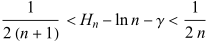
(Young 1991; Havil 2003, pp. 73-75) and

(DeTemple 1991; Havil 2003, pp. 76-78).
An interesting analytic sum is given by
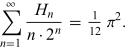
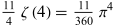
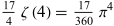
(Coffman 1987). Borwein and Borwein (1995) show that






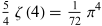


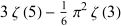


![👁 1/(540)pi^6-1/2[zeta(3)]^2,](https://mathworld.wolfram.com/images/equations/HarmonicNumber/Inline80.svg)
where 👁 zeta(z)
is the Riemann zeta function. The first of
these had been previously derived by de Doelder (1991), and the third by Goldbach
in a 1742 letter to Euler (Borwein and Bailey 2003, pp. 99-100; Bailey et
al. 2007, p. 256). These identities are corollaries of the identity

![👁 1/piint_0^pix^2{ln[2cos(1/2x)]}^2dx=(11)/2zeta(4)=(11)/(180)pi^4](https://mathworld.wolfram.com/images/equations/HarmonicNumber/NumberedEquation8.svg)
(Borwein and Borwein 1995). Additional identities due to Euler are
| 👁 sum_(n=1)^(infty)(H_n)/(n^2) | 👁 = | 👁 2zeta(3) |
(23)
|
| 👁 2sum_(n=1)^(infty)(H_n)/(n^m) | 👁 = | 👁 (m+2)zeta(m+1)-sum_(n=1)^(m-2)zeta(m-n)zeta(n+1) |
(24)
|


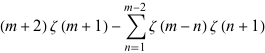
for 👁 m=2
,
3, ... (Borwein and Borwein 1995), where 👁 zeta(3)
is Apéry's constant.
These sums are related to so-called Euler sums.


A general identity due to B. Cloitre (pers. comm., Jan. 7, 2006) is
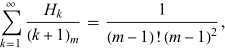
where 👁 (x)_n
is a Pochhammer symbol.

Gosper gave the interesting identity
| 👁 sum_(i=0)^(infty)(z^iH_i)/(i!) | 👁 = | 👁 -e^zsum_(k=1)^(infty)((-z)^k)/(kk!) |
(26)
|
| 👁 Image | 👁 = | 👁 e^z[lnz+Gamma(0,z)+gamma], |
(27)
|


![👁 e^z[lnz+Gamma(0,z)+gamma],](https://mathworld.wolfram.com/images/equations/HarmonicNumber/Inline96.svg)
where 👁 Gamma(0,z)
is the incomplete gamma function and
👁 gamma
is the Euler-Mascheroni
constant.


G. Huvent (2002) found the beautiful formula
![👁 zeta(5)=-(16)/(11)sum_(n=1)^infty([2(-1)^n+1]h_n)/(n^4).](https://mathworld.wolfram.com/images/equations/HarmonicNumber/NumberedEquation10.svg)
A beautiful double series is given by
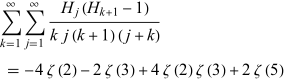
(Bailey et al. 2007, pp. 273-274). Another double sum is
| 👁 sum_(i=0)^(k-1)sum_(j=k)^n((-1)^(i+j-1))/(j-i)(n; i)(n; j)=sum_(i=1)^(k-1)(n; i)^2(H_(n-i)-H_i) |
(30)
|

for 👁 1<=k<=n
(Sondow 2003, 2005).

There is an unexpected connection between the harmonic numbers and the Riemann hypothesis.
Generalized harmonic numbers in power 👁 r
can be defined by the relationship


where
| 👁 H_(n,1)=H_n. |
(32)
|

These number are implemented as [n, r].
The numerators of the special case 👁 H_(n,2)
are known as Wolstenholme
numbers. B. Cloitre (pers. comm., ) gave the surprising identity

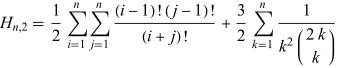
which relates 👁 H_(n,2)
to an indefinite version of a famous series for 👁 zeta(2)
. 👁 H_(n,2)
also satisfies


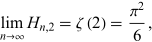
where 👁 zeta(2)
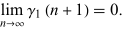
is the Riemann zeta function. This follows
from the identity


where 👁 gamma_1(z)
is the trigamma function since

For odd 👁 r>=3
,
the generalized harmonic numbers have the explicit form

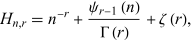
where 👁 psi_r(n)
is the polygamma function, 👁 Gamma(r)
is the gamma function,
and 👁 zeta(r)
is the Riemann zeta function.


The 2-index harmonic numbers satisfy the identity

(P. Simon, pers. comm., Aug. 30, 2004).
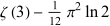
Sums of the generalized harmonic numbers 👁 H_(n,r)
include

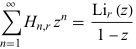
for 👁 |z|<1
,
where 👁 Li_r(z)
is a polylogarithm,


![👁 1/(15)pi^2-1/2[csch^(-1)2]^2](https://mathworld.wolfram.com/images/equations/HarmonicNumber/Inline119.svg)




![👁 [zeta(3)]^2-(pi^6)/(2835)](https://mathworld.wolfram.com/images/equations/HarmonicNumber/Inline125.svg)


![👁 (37pi^6)/(11340)-[zeta(3)]^2,](https://mathworld.wolfram.com/images/equations/HarmonicNumber/Inline131.svg)
where equations (40), (41), (42), and (44) are due to B. Cloitre (pers. comm., Oct. 4,
2004) and 👁 Li_2(z)
is a dilogarithm. In general,

![👁 sum_(k=1)^infty(H_(k,r))/(k^r)=1/2{[zeta(r)]^2+zeta(2r)}](https://mathworld.wolfram.com/images/equations/HarmonicNumber/NumberedEquation22.svg)
(P. Simone, pers. comm. June 2, 2003). The power harmonic numbers also obey the unexpected identity
![👁 9H_(8,n)-19H_(9,n)+10H_(10,n)+sum_(k=1)^(n-1)[H_(8,n-k)H_(9,k)-H_(9,n-k)H_(9,k) -H_(8,n-k)H_(10,k)+H_(9,n-k)H_(10,k)]=0](https://mathworld.wolfram.com/images/equations/HarmonicNumber/NumberedEquation23.svg)
(M. Trott, pers. comm.).
P. Simone (pers. comm., Aug. 30, 2004) showed that
| 👁 [C(t)]^2+[S(t)]^2=1/(90)pi^4+2/3pi^2C(t)
-2sum_(m=1)^infty((H_(m,2))/(m^2)+(2H_m)/(m^3))cos(mt), |
(48)
|
![👁 [C(t)]^2+[S(t)]^2=1/(90)pi^4+2/3pi^2C(t) -2sum_(m=1)^infty((H_(m,2))/(m^2)+(2H_m)/(m^3))cos(mt),](https://mathworld.wolfram.com/images/equations/HarmonicNumber/NumberedEquation24.svg)
where
| 👁 C(t) | 👁 = | 👁 sum_(n=1)^(infty)(cos(nt))/(n^2) |
(49)
|
| 👁 Image | 👁 = | 👁 1/2[Li_2(e^(-it))+Li_2(e^(it))] |
(50)
|
| 👁 S(t) | 👁 = | 👁 sum_(n=1)^(infty)(sin(nt))/(n^2) |
(51)
|
| 👁 Image | 👁 = | 👁 1/2i[Li_2(e^(-it))-Li_2(e^(it))]. |
(52)
|


![👁 1/2[Li_2(e^(-it))+Li_2(e^(it))]](https://mathworld.wolfram.com/images/equations/HarmonicNumber/Inline138.svg)


![👁 1/2i[Li_2(e^(-it))-Li_2(e^(it))].](https://mathworld.wolfram.com/images/equations/HarmonicNumber/Inline144.svg)
This gives the special results
![👁 sum_(n=1)^infty(H_n)/(n^3)=1/(72)pi^4 1/8sum_(n=1)^infty((2H_(4k,2))/(k^2)+(H_(2k))/(k^3))=(211pi^4)/(11520)-K^2 2sum_(k=1)^infty[((-1)^(k+1)H_(k,2))/(k^2)+(2(-1)^(k+1)H_k)/(k^3)]=(37pi^4)/(720)](https://mathworld.wolfram.com/images/equations/HarmonicNumber/NumberedEquation25.svg)
for 👁 t=0,pi/2,pi
,
respectively.

Conway and Guy (1996) define the second-order harmonic number by
| 👁 H_n^((2)) | 👁 = | 👁 sum_(i=1)^(n)H_i |
(54)
|
| 👁 Image | 👁 = | 👁 (n+1)(H_(n+1)-1) |
(55)
|
| 👁 Image | 👁 = | 👁 (n+1)(H_(n+1)-H_1), |
(56)
|






the third-order harmonic number by

and the 👁 k
th-order
harmonic number by


A slightly different definition of a two-index harmonic number 👁 c_n^((j))
is given by Roman (1992) in connection with the harmonic logarithm. Roman (1992) defines this
by


plus the recurrence relation

For general 👁 n>0
and 👁 j>0
,
this is equivalent to


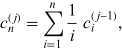
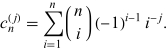
and for 👁 n>0
,
it simplifies to

For 👁 n<0
,
the harmonic number can be written

![👁 c_n^((j))=(-1)^j|_n]!s(-n,j),](https://mathworld.wolfram.com/images/equations/HarmonicNumber/NumberedEquation31.svg)
where 👁 |_n]!
is the Roman factorial and 👁 s
is a Stirling
number of the first kind.
![👁 |_n]!](https://mathworld.wolfram.com/images/equations/HarmonicNumber/Inline167.svg)

A separate type of number sometimes also called a "harmonic number" is a harmonic divisor number (or Ore number).
See also
Apéry's Constant, Book Stacking Problem, Egyptian Fraction, Euler Sum, Faulhaber's Formula, Harmonic Divisor Number, Harmonic Logarithm, Harmonic Series, Unit Fraction, Wolstenholme NumberRelated Wolfram sites
http://functions.wolfram.com/GammaBetaErf/HarmonicNumber/, http://functions.wolfram.com/GammaBetaErf/HarmonicNumber2/Portions of this entry contributed by Jonathan Sondow (author's link)
Explore with Wolfram|Alpha

More things to try:
References
Bailey, D. H.; Borwein, J. M.; Calkin, N. J.; Girgensohn, R.; Luke, D. R.; and Moll, V. H. Experimental Mathematics in Action. Wellesley, MA: A K Peters, 2007.Borwein, J. and Bailey, D. Mathematics by Experiment: Plausible Reasoning in the 21st Century. Wellesley, MA: A K Peters, 2003.Borwein, D. and Borwein, J. M. "On an Intriguing Integral and Some Series Related to 👁 zeta(4)
." Proc. Amer. Math. Soc. 123, 1191-1198, 1995.Coffman, S. W. "Problem 1240 and Solution: An Infinite Series with Harmonic Numbers." Math. Mag. 60, pp. 118-119, 1987.Conway, J. H. and Guy, R. K. The Book of Numbers. New York: Springer-Verlag, pp. 143 and 258-259, 1996.de Doelder, P. J. "On Some Series Containing 👁 Psi(x)-Psi(y)

and 👁 (Psi(x)-Psi(y))^2
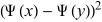
for Certain Values of 👁 x

and 👁 y

." J. Comp. Appl. Math. 37, 125-141, 1991.DeTemple, D. W. "The Non-Integer Property of Sums of Reciprocals of Consecutive Integers." Math. Gaz. 75, 193-194, 1991.Flajolet, P. and Salvy, B. "Euler Sums and Contour Integral Representation." Experim. Math. 7, 15-35, 1998.Graham, R. L.; Knuth, D. E.; and Patashnik, O. "Harmonic Numbers" and "Harmonic Summation." §6.3 and 6.4 in Concrete Mathematics: A Foundation for Computer Science, 2nd ed. Reading, MA: Addison-Wesley, pp. 272-282, 1994.Gosper, R. W. "harmonic Summation and exponential gfs." math-fun@cs.arizona.edu posting, Aug. 2, 1996.Havil, J. Gamma: Exploring Euler's Constant. Princeton, NJ: Princeton University Press, 2003.Hoffman, P. The Man Who Loved Only Numbers: The Story of Paul Erdős and the Search for Mathematical Truth. New York: Hyperion, 1998.Huvent, G. "Autour de la primitive de 👁 t^pcoth(alphat/2)
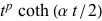
." Feb. 3, 2002. http://perso.orange.fr/gery.huvent/articlespdf/Autour_primitive.pdf.Roman, S. "The Logarithmic Binomial Formula." Amer. Math. Monthly 99, 641-648, 1992.Roman, S. The Umbral Calculus. New York: Academic Press, p. 99, 1984.Savio, D. Y.; Lamagna, E. A.; and Liu, S.-M. "Summation of Harmonic Numbers." In Computers and Mathematics (Ed. E. Kaltofen and S. M. Watt). New York: Springer-Verlag, pp. 12-20, 1989.Sloane, N. J. A. Sequences A001008/M2885, A002285/M3210, A002805/M1589, A004080, A006953/M2039, A056903, A082912, A089729, A091590, A096618, A114467, and A114468 in "The On-Line Encyclopedia of Integer Sequences."Sondow, J. "Criteria for Irrationality of Euler's Constant." Proc. Amer. Math. Soc. 131, 3335-3344, 2003.Sondow, J. "Problem 11026: An Identity Involving Harmonic Numbers." Amer. Math. Monthly 112, 367-369, 2005.Trott, M. "The Mathematica Guidebooks Additional Material: Harmonic Numbers Inversion." http://www.mathematicaguidebooks.org/additions.shtml#S_3_06.Young, R. M. "Euler's Constant." Math. Gaz. 75, 187-190, 1991.
Referenced on Wolfram|Alpha
Harmonic NumberCite this as:
Sondow, Jonathan and Weisstein, Eric W. "Harmonic Number." From MathWorld--A Wolfram Resource. https://mathworld.wolfram.com/HarmonicNumber.html