

Finite Group

A finite group is a group having finite group order. Examples of finite groups are the modulo multiplication groups, point groups, cyclic groups, dihedral groups, symmetric groups, alternating groups, and so on.
Properties of finite groups are implemented in the Wolfram Language as [group, prop].
The classification theorem of finite groups states that the finite simple groups can be classified completely into one of five types.

A convenient way to visualize groups is using so-called cycle graphs, which show the cycle structure of a given abstract group. For example, cycle graphs of the 5 nonisomorphic groups of order 8 are illustrated above (Shanks 1993, p. 85).
Frucht's theorem states that every finite group is the graph automorphism group of a finite undirected graph.
The finite (cyclic) group 👁 C_2
forms the subject for the humorous a capella song "Finite
Simple Group (of Order 2)" by the Northwestern University mathematics department
a capella group "The Klein Four."

The following table gives the numbers and names of the distinct groups of group order 👁 h
for small 👁 h
.
In the table, 👁 C_n
denotes an cyclic group of group
order 👁 n
,
👁 ×
a group
direct product, 👁 D_n
a dihedral group, 👁 Q_8
the quaternion group,
👁 A_n
an alternating
group, 👁 T
the non-Abelian finite group of order 12 that is not 👁 A_4
and not 👁 D_6
(and is not the purely rotational subgroup 👁 T
of the point group 👁 T_h
), 👁 G_(16)^((4))
the quasihedral (or semihedral) group of order
16 with group presentation 👁 <s,t;s^8=t^2=1,st=ts^3>
, 👁 G_(16)^((5))
the modular group of order 16 with group
presentation 👁 <s,t;s^8=t^2=1,st=ts^5>
,
👁 G_(16)^((6))
the group of order 16 with
group presentation 👁 <s,t;s^4=t^4=1,st=ts^3>
, 👁 G_(16)^((7))
the group of order 16 with group
presentation 👁 <a,b,c;a^4=b^2=c^2=1,cbca^2b=1,bab=a,cac=a>
,
👁 G_(16)^((8))
the group 👁 G_(4,4)
with group presentation 👁 <s,t;s^4=t^4=1,stst=1,ts^3=st^3>
,
👁 G_(16)^((9))
the generalized quaternion
group of order 16 with group presentation 👁 <s,t;s^8=1,s^4=t^2,sts=t>
, 👁 S_n
a symmetric
group, 👁 G_(18)^((3))
the semidirect product of 👁 C_3×C_3
with 👁 C_2
with group presentation 👁 <x,y,z;x^2=y^3=z^3=1,yz=zy,yxy=x,zxz=x>
,
👁 F_n
the Frobenius group of order 👁 n
, 👁 G_(20)^((3))
the semidirect product of 👁 C_5
by 👁 C_4
with group presentation 👁 <s,t;s^4=t^5=1,tst=s>
, 👁 G_(27)^((1))
the group with group
presentation 👁 <s,t;s^9=t^3=1,st=ts^4>
,
👁 G_(27)^((2))
the group with group
presentation 👁 <x,y,z;x^3=y^3=z^3=1,yz=zyx,xy=yx,xz=zx>
,
and 👁 G_(28)^((2))
the semidirect product of
👁 C_7
by 👁 C_4
with group presentation 👁 <s,t;s^4=t^7=1,tst=s>
































The following table lists some properties of small finite groups. Here 👁 h
is again the group order, PG indicates that a group can be
generated by a single permutation, MMG indicates
that a group is a modulo multiplication group, 👁 C
is the number of conjugacy classes, 👁 S
is the number of subgroups, and 👁 N
is the number of normal subgroups. Note that the smallest
groups that are neither permutation nor modulo multiplication groups are 👁 Q_8
, 👁 C_3×C_3
, and 👁 T
.


| 👁 h | group | Abelian | PG | MMG | 👁 C | 👁 C lengths | 👁 S | 👁 S lengths | 👁 N | counts of 👁 A s.t. 👁 A^i=1 |
| 1 | 👁 <e> | yes | yes | yes | 1 | 1 | 1 | 1 | 1 | 1 |
| 2 | 👁 C_2 | yes | yes | no | 2 | 👁 2×1 | 2 | 1, 2 | 2 | 1, 2 |
| 3 | 👁 C_3 | yes | yes | yes | 3 | 👁 3×1 | 2 | 1, 3 | 2 | 1, 1, 3 |
| 4 | 👁 C_4 | yes | yes | yes | 4 | 👁 4×1 | 3 | 1, 2, 4 | 3 | 1, 2, 1, 4 |
| 👁 C_2×C_2 | yes | no | yes | 4 | 👁 4×1 | 5 | 1, 👁 3×2 , 4 | 5 | 1, 4, 1, 4 | |
| 5 | 👁 C_5 | yes | yes | no | 5 | 👁 5×1 | 2 | 1, 4 | 2 | 1, 1, 1, 1, 5 |
| 6 | 👁 C_6 | yes | yes | yes | 6 | 👁 6×1 | 4 | 1, 2, 3, 6 | 4 | 1, 2, 3, 2, 1, 6 |
| 👁 D_3 | no | yes | no | 3 | 1, 2, 3 | 6 | 1, 👁 3×2 , 3, 6 | 3 | 1, 4, 3, 4, 1, 6 | |
| 7 | 👁 C_7 | yes | yes | no | 7 | 👁 7×1 | 2 | 1, 7 | 2 | 1, 1, 1, 1, 1, 1, 7 |
| 8 | 👁 C_8 | yes | yes | yes | 8 | 👁 8×1 | 4 | 1, 2, 4, 8 | 4 | 1, 2, 1, 4, 1, 2, 1, 8 |
| 👁 C_2×C_4 | yes | no | yes | 8 | 👁 8×1 | 8 | 1, 👁 3×2 , 👁 3×4 , 8 | 4 | 1, 4, 1, 8, 1, 4, 1, 8 | |
| 👁 C_2×C_2×C_2 | yes | no | yes | 8 | 👁 8×1 | 16 | 1, 👁 7×2 , 👁 7×4 , 8 | 4 | 1, 8, 1, 8, 1, 8, 1, 8 | |
| 👁 D_4 | no | yes | no | 5 | 👁 2×1 , 👁 3×2 | 10 | 1, 👁 5×2 , 👁 3×4 , 8 | 6 | 1, 6, 1, 8, 1, 6, 1, 8 | |
| 👁 Q_8 | no | no | no | 5 | 👁 2×1 , 👁 3×2 | 6 | 1, 2, 👁 3×4 , 8 | 6 | 1, 2, 1, 8, 1, 2, 1, 8 | |
| 9 | 👁 C_9 | yes | yes | no | 9 | 👁 9×1 | 3 | 1, 3, 9 | 3 | 1, 1, 3, 1, 1, 3, 1, 1, 9 |
| 👁 C_3×C_3 | yes | no | no | |||||||
| 10 | 👁 C_(10) | yes | yes | yes | 10 | 👁 10×1 | 4 | 1, 2, 5, 10 | 4 | 1, 2, 1, 2, 5, 2, 1, 2, 1, 10 |
| 👁 D_5 | no | yes | no | 4 | 1, 👁 2×2 , 5 | 8 | 1, 👁 5×2 , 5, 10 | 3 | 1, 6, 1, 6, 5, 6, 1, 6, 1, 10 | |
| 11 | 👁 C_(11) | yes | yes | no | 11 | 👁 11×1 | 2 | 1, 11 | 2 | 1, 1, 1, 1, 1, 1, 1, 1, 1, 1, 11 |
| 12 | 👁 C_(12) | yes | yes | yes | 12 | 👁 12×1 | 6 | 1, 2, 3, 4, 6, 12 | 6 | 1, 2, 3, 4, 1, 6, 1, 4, 3, 2, 1, 12 |
| 👁 C_2×C_6 | yes | no | yes | 12 | 👁 12×1 | 10 | 1, 👁 3×2 , 3, 4, 👁 3×6 , 12 | 10 | 1, 4, 3, 4, 1, 12, 1, 4, 3, 4, 1, 12 | |
| 👁 A_4 | no | yes | no | 4 | 1, 3, 👁 2×4 | 10 | 1, 👁 3×2 , 👁 4×3 , 4, 12 | 3 | 1, 4, 9, 4, 1, 12, 1, 4, 9, 4, 1, 12 | |
| 👁 D_6 | no | yes | no | 6 | 👁 2×1 , 👁 2×2 , 👁 2×3 | 16 | 1, 👁 7×2 , 3, 👁 3×4 , 👁 3×6 , 12 | 8 | 1, 8, 3, 8, 1, 12, 1, 8, 3, 8, 1, 12 | |
| 👁 T | no | no | no | 6 | 👁 2×1 , 👁 2×2 , 👁 2×3 | 8 | 1, 2,
3, 👁 3×4 , 6, 12 | 3 | 1, 2, 3, 8, 1, 6, 1, 8, 3, 2, 1, 12 | |
| 13 | 👁 C_(13) | yes | yes | yes | 13 | 👁 13×1 | 2 | 1, 13 | 2 | 1, 1, 1, 1, 1, 1, 1, 1, 1, 1, 1, 1, 13 |
| 14 | 👁 C_(14) | yes | yes | no | 14 | 👁 14×1 | 4 | 1, 2, 7, 14 | 4 | 1, 2, 1, 2, 1, 2, 7, 2, 1, 2, 1, 2, 1, 14 |
| 👁 D_7 | no | yes | no | 5 | 1, 👁 3×2 , 7 | 10 | 1,
👁 7×2 , 7, 14 | 3 | 1, 8, 1, 8, 1, 8, 7, 8, 1, 8, 1, 8, 1, 14 | |
| 15 | 👁 C_(15) | yes | yes | no | 15 | 👁 15×1 | 4 | 1, 3, 5, 15 | 4 | 1, 1, 3, 1, 5, 3, 1, 1, 3, 5, 1, 3, 1, 1, 15 |


The problem of determining the nonisomorphic finite groups of order 👁 h
was first considered by Cayley (1854). There is no known formula to give the number of possible finite groups 👁 g(h)
as a function of the group
order 👁 h
.
However, there are simple formulas for special forms of 👁 h
.


| 👁 g(1) | 👁 = | 👁 1 |
(1)
|
| 👁 g(p) | 👁 = | 👁 1 |
(2)
|
| 👁 g(pq) | 👁 = | 👁 {1 if p(q-1); 2 if p|(q-1) |
(3)
|
| 👁 g(p^2) | 👁 = | 👁 2 |
(4)
|
| 👁 g(p^3) | 👁 = | 👁 5, |
(5)
|


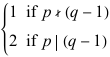


where 👁 p
and 👁 q>p
are distinct primes. In addition, there is a beautiful algorithm due to Hölder
(Hölder 1895, Alonso 1976) for determining 👁 g(n)
for squarefree 👁 n
, namely


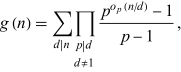
where 👁 o_p(m)
is the number of primes 👁 q
such that 👁 q|m
and 👁 p|(q-1)
(Dennis).


Miller (1930) gave the number of groups for orders 1-100, including an erroneous 297 as the number of groups of group order 64. Senior
and Lunn (1934, 1935) subsequently completed the list up to 215, but omitted 128
and 192. The number of groups of group order 64 was
corrected in Hall and Senior (1964). James et al. (1990) found 2328 groups
in 115 isoclinism families of group
order 128, correcting previous work, and O'Brien (1991) found the number of groups
of group order 256. Currently, the number of groups
is known for orders up to 2047, with the difficult cases of orders 512 (👁 g(512)=10494213
; Eick and O'Brien 1999b), 768 (Besche and Eick
2001ab), and 1024 now put to rest (Conway et al. 2008). The numbers of nonisomorphic
finite groups 👁 N
of each group order 👁 h
for the first few hundred orders are given in the table below
(OEIS A000001--the very first sequence). The
number of nonisomorphic groups of orders 👁 2^n
for 👁 n=0
, 1, ... are 1, 1, 2, 5, 14, 51, 267, 2328, 56092, ... (OEIS
A000679).



The smallest orders 👁 h
for which there exist 👁 n=1
,
2, ... nonisomorphic groups are 1, 4, 75, 28, 8, 42, ... (OEIS A046057).
The incrementally largest number of nonisomorphic finite groups are 1, 2, 5, 14,
15, 51, 52, 267, 2328, ... (OEIS A046058),
which occur for orders 1, 4, 8, 16, 24, 32, 48, 64, 128, ... (OEIS A046059).
Dennis has conjectured that the number of groups 👁 g(h)
of order 👁 h
assumes every positive integer as a value an infinite number
of times.


It is simple to determine the number of Abelian groups using the Kronecker decomposition theorem,
and there is at least one Abelian group for every
finite order 👁 h
.
The number 👁 A
of Abelian groups of group
order 👁 h=1
,
2, ... are given by 1, 1, 1, 2, 1, 1, 1, 3, ... (OEIS A000688).
The following table summarizes the total number of finite groups 👁 N
and the number of Abelian finite groups 👁 A
for orders 👁 h
from 1 to 400. A table of orders up to 1000 is given by Royle;
the software package includes a table of the number of finite groups
up to order 2000, excluding 1024. The number of finite groups of a given order is
implemented in the Wolfram Language
as [n].


| 👁 h | 👁 N | 👁 A | 👁 h | 👁 N | 👁 A | 👁 h | 👁 N | 👁 A | 👁 h | 👁 N | 👁 A |
| 1 | 1 | 1 | 51 | 1 | 1 | 101 | 1 | 1 | 151 | 1 | 1 |
| 2 | 1 | 1 | 52 | 5 | 2 | 102 | 4 | 1 | 152 | 12 | 3 |
| 3 | 1 | 1 | 53 | 1 | 1 | 103 | 1 | 1 | 153 | 2 | 2 |
| 4 | 2 | 2 | 54 | 15 | 3 | 104 | 14 | 3 | 154 | 4 | 1 |
| 5 | 1 | 1 | 55 | 2 | 1 | 105 | 2 | 1 | 155 | 2 | 1 |
| 6 | 2 | 1 | 56 | 13 | 3 | 106 | 2 | 1 | 156 | 18 | 2 |
| 7 | 1 | 1 | 57 | 2 | 1 | 107 | 1 | 1 | 157 | 1 | 1 |
| 8 | 5 | 3 | 58 | 2 | 1 | 108 | 45 | 6 | 158 | 2 | 1 |
| 9 | 2 | 2 | 59 | 1 | 1 | 109 | 1 | 1 | 159 | 1 | 1 |
| 10 | 2 | 1 | 60 | 13 | 2 | 110 | 6 | 1 | 160 | 238 | 7 |
| 11 | 1 | 1 | 61 | 1 | 1 | 111 | 2 | 1 | 161 | 1 | 1 |
| 12 | 5 | 2 | 62 | 2 | 1 | 112 | 43 | 5 | 162 | 55 | 5 |
| 13 | 1 | 1 | 63 | 4 | 2 | 113 | 1 | 1 | 163 | 1 | 1 |
| 14 | 2 | 1 | 64 | 267 | 11 | 114 | 6 | 1 | 164 | 5 | 2 |
| 15 | 1 | 1 | 65 | 1 | 1 | 115 | 1 | 1 | 165 | 2 | 1 |
| 16 | 14 | 5 | 66 | 4 | 1 | 116 | 5 | 2 | 166 | 2 | 1 |
| 17 | 1 | 1 | 67 | 1 | 1 | 117 | 4 | 2 | 167 | 1 | 1 |
| 18 | 5 | 2 | 68 | 5 | 2 | 118 | 2 | 1 | 168 | 57 | 3 |
| 19 | 1 | 1 | 69 | 1 | 1 | 119 | 1 | 1 | 169 | 2 | 2 |
| 20 | 5 | 2 | 70 | 4 | 1 | 120 | 47 | 3 | 170 | 4 | 1 |
| 21 | 2 | 1 | 71 | 1 | 1 | 121 | 2 | 2 | 171 | 5 | 2 |
| 22 | 2 | 1 | 72 | 50 | 6 | 122 | 2 | 1 | 172 | 4 | 2 |
| 23 | 1 | 1 | 73 | 1 | 1 | 123 | 1 | 1 | 173 | 1 | 1 |
| 24 | 15 | 3 | 74 | 2 | 1 | 124 | 4 | 2 | 174 | 4 | 1 |
| 25 | 2 | 2 | 75 | 3 | 2 | 125 | 5 | 3 | 175 | 2 | 2 |
| 26 | 2 | 1 | 76 | 4 | 2 | 126 | 16 | 2 | 176 | 42 | 5 |
| 27 | 5 | 3 | 77 | 1 | 1 | 127 | 1 | 1 | 177 | 1 | 1 |
| 28 | 4 | 2 | 78 | 6 | 1 | 128 | 2328 | 15 | 178 | 2 | 1 |
| 29 | 1 | 1 | 79 | 1 | 1 | 129 | 2 | 1 | 179 | 1 | 1 |
| 30 | 4 | 1 | 80 | 52 | 5 | 130 | 4 | 1 | 180 | 37 | 4 |
| 31 | 1 | 1 | 81 | 15 | 5 | 131 | 1 | 1 | 181 | 1 | 1 |
| 32 | 51 | 7 | 82 | 2 | 1 | 132 | 10 | 2 | 182 | 4 | 1 |
| 33 | 1 | 1 | 83 | 1 | 1 | 133 | 1 | 1 | 183 | 2 | 1 |
| 34 | 2 | 1 | 84 | 15 | 2 | 134 | 2 | 1 | 184 | 12 | 3 |
| 35 | 1 | 1 | 85 | 1 | 1 | 135 | 5 | 3 | 185 | 1 | 1 |
| 36 | 14 | 4 | 86 | 2 | 1 | 136 | 15 | 3 | 186 | 6 | 1 |
| 37 | 1 | 1 | 87 | 1 | 1 | 137 | 1 | 1 | 187 | 1 | 1 |
| 38 | 2 | 1 | 88 | 12 | 3 | 138 | 4 | 1 | 188 | 4 | 2 |
| 39 | 2 | 1 | 89 | 1 | 1 | 139 | 1 | 1 | 189 | 13 | 3 |
| 40 | 14 | 3 | 90 | 10 | 2 | 140 | 11 | 2 | 190 | 4 | 1 |
| 41 | 1 | 1 | 91 | 1 | 1 | 141 | 1 | 1 | 191 | 1 | 1 |
| 42 | 6 | 1 | 92 | 4 | 2 | 142 | 2 | 1 | 192 | 1543 | 11 |
| 43 | 1 | 1 | 93 | 2 | 1 | 143 | 1 | 1 | 193 | 1 | 1 |
| 44 | 4 | 2 | 94 | 2 | 1 | 144 | 197 | 10 | 194 | 2 | 1 |
| 45 | 2 | 2 | 95 | 1 | 1 | 145 | 1 | 1 | 195 | 2 | 1 |
| 46 | 2 | 1 | 96 | 231 | 7 | 146 | 2 | 1 | 196 | 17 | 4 |
| 47 | 1 | 1 | 97 | 1 | 1 | 147 | 6 | 2 | 197 | 1 | 1 |
| 48 | 52 | 5 | 98 | 5 | 2 | 148 | 5 | 2 | 198 | 10 | 2 |
| 49 | 2 | 2 | 99 | 2 | 2 | 149 | 1 | 1 | 199 | 1 | 1 |
| 50 | 5 | 2 | 100 | 16 | 4 | 150 | 13 | 2 | 200 | 52 | 6 |


| 👁 h | 👁 N | 👁 A | 👁 h | 👁 N | 👁 A | 👁 h | 👁 N | 👁 A | 👁 h | 👁 N | 👁 A |
| 201 | 2 | 1 | 251 | 1 | 1 | 301 | 2 | 1 | 351 | 14 | 3 |
| 202 | 2 | 1 | 252 | 46 | 4 | 302 | 2 | 1 | 352 | 195 | 7 |
| 203 | 2 | 1 | 253 | 2 | 1 | 303 | 1 | 1 | 353 | 1 | 1 |
| 204 | 12 | 2 | 254 | 2 | 1 | 304 | 42 | 5 | 354 | 4 | 1 |
| 205 | 2 | 1 | 255 | 1 | 1 | 305 | 2 | 1 | 355 | 2 | 1 |
| 206 | 2 | 1 | 256 | 56092 | 22 | 306 | 10 | 2 | 356 | 5 | 2 |
| 207 | 2 | 2 | 257 | 1 | 1 | 307 | 1 | 1 | 357 | 2 | 1 |
| 208 | 51 | 5 | 258 | 6 | 1 | 308 | 9 | 2 | 358 | 2 | 1 |
| 209 | 1 | 1 | 259 | 1 | 1 | 309 | 2 | 1 | 359 | 1 | 1 |
| 210 | 12 | 1 | 260 | 15 | 2 | 310 | 6 | 1 | 360 | 162 | 6 |
| 211 | 1 | 1 | 261 | 2 | 2 | 311 | 1 | 1 | 361 | 2 | 2 |
| 212 | 5 | 2 | 262 | 2 | 1 | 312 | 61 | 3 | 362 | 2 | 1 |
| 213 | 1 | 1 | 263 | 1 | 1 | 313 | 1 | 1 | 363 | 3 | 2 |
| 214 | 2 | 1 | 264 | 39 | 3 | 314 | 2 | 1 | 364 | 11 | 2 |
| 215 | 1 | 1 | 265 | 1 | 1 | 315 | 4 | 2 | 365 | 1 | 1 |
| 216 | 177 | 9 | 266 | 4 | 1 | 316 | 4 | 2 | 366 | 6 | 1 |
| 217 | 1 | 1 | 267 | 1 | 1 | 317 | 1 | 1 | 367 | 1 | 1 |
| 218 | 2 | 1 | 268 | 4 | 2 | 318 | 4 | 1 | 368 | 42 | 5 |
| 219 | 2 | 1 | 269 | 1 | 1 | 319 | 1 | 1 | 369 | 2 | 2 |
| 220 | 15 | 2 | 270 | 30 | 3 | 320 | 1640 | 11 | 370 | 4 | 1 |
| 221 | 1 | 1 | 271 | 1 | 1 | 321 | 1 | 1 | 371 | 1 | 1 |
| 222 | 6 | 1 | 272 | 54 | 5 | 322 | 4 | 1 | 372 | 15 | 2 |
| 223 | 1 | 1 | 273 | 5 | 1 | 323 | 1 | 1 | 373 | 1 | 1 |
| 224 | 197 | 7 | 274 | 2 | 1 | 324 | 176 | 10 | 374 | 4 | 1 |
| 225 | 6 | 4 | 275 | 4 | 2 | 325 | 2 | 2 | 375 | 7 | 3 |
| 226 | 2 | 1 | 276 | 10 | 2 | 326 | 2 | 1 | 376 | 12 | 3 |
| 227 | 1 | 1 | 277 | 1 | 1 | 327 | 2 | 1 | 377 | 1 | 1 |
| 228 | 15 | 2 | 278 | 2 | 1 | 328 | 15 | 3 | 378 | 60 | 3 |
| 229 | 1 | 1 | 279 | 4 | 2 | 329 | 1 | 1 | 379 | 1 | 1 |
| 230 | 4 | 1 | 280 | 40 | 3 | 330 | 12 | 1 | 380 | 11 | 2 |
| 231 | 2 | 1 | 281 | 1 | 1 | 331 | 1 | 1 | 381 | 2 | 1 |
| 232 | 14 | 3 | 282 | 4 | 1 | 332 | 4 | 2 | 382 | 2 | 1 |
| 233 | 1 | 1 | 283 | 1 | 1 | 333 | 5 | 2 | 383 | 1 | 1 |
| 234 | 16 | 2 | 284 | 4 | 2 | 334 | 2 | 1 | 384 | 20169 | 15 |
| 235 | 1 | 1 | 285 | 2 | 1 | 335 | 1 | 1 | 385 | 2 | 1 |
| 236 | 4 | 2 | 286 | 4 | 1 | 336 | 228 | 5 | 386 | 2 | 1 |
| 237 | 2 | 1 | 287 | 1 | 1 | 337 | 1 | 1 | 387 | 4 | 2 |
| 238 | 4 | 1 | 288 | 1045 | 14 | 338 | 5 | 2 | 388 | 5 | 2 |
| 239 | 1 | 1 | 289 | 2 | 2 | 339 | 1 | 1 | 389 | 1 | 1 |
| 240 | 208 | 5 | 290 | 4 | 1 | 340 | 15 | 2 | 390 | 12 | 1 |
| 241 | 1 | 1 | 291 | 2 | 1 | 341 | 1 | 1 | 391 | 1 | 1 |
| 242 | 5 | 2 | 292 | 5 | 2 | 342 | 18 | 2 | 392 | 44 | 6 |
| 243 | 67 | 7 | 293 | 1 | 1 | 343 | 5 | 3 | 393 | 1 | 1 |
| 244 | 5 | 2 | 294 | 23 | 2 | 344 | 12 | 3 | 394 | 2 | 1 |
| 245 | 2 | 2 | 295 | 1 | 1 | 345 | 1 | 1 | 395 | 1 | 1 |
| 246 | 4 | 1 | 296 | 14 | 3 | 346 | 2 | 1 | 396 | 30 | 4 |
| 247 | 1 | 1 | 297 | 5 | 3 | 347 | 1 | 1 | 397 | 1 | 1 |
| 248 | 12 | 3 | 298 | 2 | 1 | 348 | 12 | 2 | 398 | 2 | 1 |
| 249 | 1 | 1 | 299 | 1 | 1 | 349 | 1 | 1 | 399 | 5 | 1 |
| 250 | 15 | 3 | 300 | 49 | 4 | 350 | 10 | 2 | 400 | 221 | 10 |


See also
Abelian Group, Abhyankar's Conjecture, Alternating Group, Burnside Problem, Cauchy-Frobenius Lemma, Chevalley Groups, Classification Theorem of Finite Groups, Composition Series, Continuous Group, Crystallographic Point Groups, Cycle Graph, Cyclic Group, Dihedral Group, Discrete Group, Feit-Thompson Theorem, Frucht's Theorem, Group, Group Order, Jordan-Hölder Theorem, Kronecker Decomposition Theorem, Lie Group, Lie-Type Group, Modulo Multiplication Group, Orthogonal Group, p-Group, Point Groups, Quaternion Group, Simple Group, Sporadic Group, Symmetric Group, Symplectic Group, Twisted Chevalley Groups, Unitary Group Explore this topic in the MathWorld classroomExplore with Wolfram|Alpha

More things to try:
References
Alonso, J. "Groups of Square-Free Order, an Algorithm." Math. Comput. 30, 632-637, 1976.Arfken, G. "Discrete Groups." §4.9 in Mathematical Methods for Physicists, 3rd ed. Orlando, FL: Academic Press, pp. 243-251, 1985.Artin, E. "The Order of the Classical Simple Groups." Comm. Pure Appl. Math. 8, 455-472, 1955.Aschbacher, M. Finite Group Theory, 2nd ed. Cambridge, England: Cambridge University Press, 2000.Aschbacher, M. The Finite Simple Groups and Their Classification. New Haven, CT: Yale University Press, 1980.Ball, W. W. R. and Coxeter, H. S. M. Mathematical Recreations and Essays, 13th ed. New York: Dover, pp. 73-75, 1987.Besche, H.-U. and Eick, B. "Construction of Finite Groups." J. Symb. Comput. 27, 387-404, 1999a.Besche, H.-U. and Eick, B. "The Groups of Order at Most 1000 Except 512 and 768." J. Symb. Comput. 27, 405-413, 1999b.Besche, H.-U. and Eick, B. "The Groups of Order 👁 q^n·p
." Comm. Algebra 29, 1759-1772, 2001a.Besche, H.-U. and Eick, B. "The Groups of Order at Most 2000." Elec. Res. Announcements Amer. Math. Soc. 7, 1-4, 2001b. http://www.ams.org/era/home-2001.html.Besche, H.-U.; Eick, B.; and O'Brien, E. A. "A Millennium Project: Constructing Small Groups." Internat. J. Algebra Comput. 12, 623-644, 2002.Blackburn, S. R.; Neumann, P. M.; and Venkataraman, G. Enumeration of Finite Groups. Cambridge, England: Cambridge University Press, 2007.Cayley, A. "On the Theory of Groups as Depending on the Symbolic Equation 👁 theta^n=1

." Philos. Mag. 7, 33-39, 1854.Cayley, A. "On the Theory of Groups as Depending on the Symbolic Equation 👁 theta^n=1

.--Part II." Philos. Mag. 7, 408-409, 1854.Cayley, A. "On the Theory of Groups as Depending on the Symbolic Equation 👁 theta^n=1

.--Part III." Philos. Mag. 18, 34-37, 1859.Conway, J. H.; Curtis, R. T.; Norton, S. P.; Parker, R. A.; and Wilson, R. A. Atlas of Finite Groups: Maximal Subgroups and Ordinary Characters for Simple Groups. Oxford, England: Clarendon Press, 1985.Conway, J. H.; Dietrich, H.; O'Brien, E. A. "Counting Groups: Gnus, Moas, and Other Exotica." Math. Intell. 30, 6-18, 2008.Dennis, K. "The Number of Groups of Order 👁 n

." Preprint.Eick, B. and O'Brien, E. A. "Enumerating 👁 p

-Groups." J. Austral. Math. Soc. Ser. A 67, 191-205, 1999a.Eick, B. and O'Brien, E. A. "The Groups of Order 512." In Algorithmic Algebra and Number Theory: Selected Papers from the Conference held at the University of Heidelberg, Heidelberg, October 1997 (Ed. B. H. Matzat, G.-M. Greuel, and G. Hiss). Berlin: Springer-Verlag, pp. 379-380, 1999b.GAP Group. "GAP--Groups, Algorithms, and Programming." http://www-history.mcs.st-and.ac.uk/~gap/.Hall, M. Jr. and Senior, J. K. The Groups of Order 2-n(n<=6). New York: Macmillan, 1964.Hölder, O. "Die Gruppen der Ordnung 👁 p^3

, 👁 pq^2

, 👁 pqr

, 👁 p^4

." Math. Ann. 43, 300-412, 1893.Hölder, O. "Die Gruppen mit quadratfreier Ordnungszahl." Nachr. Königl. Gesell. Wissenschaft. Göttingen, Math.-Phys. Kl., 211-229, 1895.Huang, J.-S. "Finite Groups." Part I in Lectures on Representation Theory. Singapore: World Scientific, pp. 1-25, 1999.James, R. "The Groups of Order 👁 p^6

(👁 p

an Odd Prime)." Math. Comput. 34, 613-637, 1980.James, R.; Newman, M. F.; and O'Brien, E. A. "The Groups of Order 128." J. Algebra 129, 136-158, 1990.The Klein Four. "Finite Simple Group (of Order Two)." http://www.math.northwestern.edu/~matt/kleinfour/.The L-Functions and Modular Forms Database (LMFDB). "Abstract Groups." https://www.lmfdb.org/Groups/Abstract/.Laue, R. "Zur Konstruktion und Klassifikation endlicher auflösbarer Gruppen." Bayreuther Mathemat. Schriften 9, 1982.Miller, G. A. "Determination of All the Groups of Order 64." Amer. J. Math. 52, 617-634, 1930.Miller, G. A. "Orders for which a Given Number of Groups Exist." Proc. Nat. Acad. Sci. 18, 472-475, 1932.Miller, G. A. "Orders for which there Exist Exactly Four or Five Groups." Proc. Nat. Acad. Sci. 18, 511-514, 1932.Miller, G. A. "Groups whose Orders Involve a Small Number of Unity Congruences." Amer. J. Math. 55, 22-28, 1933.Miller, G. A. "Historical Note on the Determination of Abstract Groups of Given Orders." J. Indian Math. Soc. 19, 205-210, 1932.Miller, G. A. "Enumeration of Finite Groups." Math. Student 8, 109-111, 1940.Murty, M. R. and Murty, V. K. "On the Number of Groups of a Given Order." J. Number Th. 18, 178-191, 1984.Neubüser, J. Die Untergruppenverbände der Gruppen der Ordnung 👁 <=100

mit Ausnahme der Ordnungen 64 und 96. Habilitationsschrift. Kiel, Germany: Universität Kiel, 1967.O'Brien, E. A. "The Groups of Order 256." J. Algebra 143, 219-235, 1991.O'Brien, E. A. and Short, M. W. "Bibliography on Classification of Finite Groups." Manuscript, Australian National University, 1988.Pedersen, J. "Groups of Small Order." http://www.math.usf.edu/~eclark/algctlg/small_groups.html.Royle, G. "Numbers of Small Groups." http://school.maths.uwa.edu.au/~gordon/remote/cubcay/.Senior, J. K. and Lunn, A. C. "Determination of the Groups of Orders 101-161, Omitting Order 128." Amer. J. Math. 56, 328-338, 1934.Senior, J. K. and Lunn, A. C. "Determination of the Groups of Orders 162-215, Omitting Order 192." Amer. J. Math. 57, 254-260, 1935.Simon, B. Representations of Finite and Compact Groups. Providence, RI: Amer. Math. Soc., 1996.Sloane, N. J. A. Sequences A000001/M0098, A000679/M1470, A000688/M0064, A046057, A046058, and A046059 in "The On-Line Encyclopedia of Integer Sequences."Spiro, C. A. "Local Distribution Results for the Group-Counting Function at Positive Integers." Congr. Numer. 50, 107-110, 1985.University of Sydney Computational Algebra Group. "The Magma Computational Algebra for Algebra, Number Theory and Geometry." http://magma.maths.usyd.edu.au/magma/.Wilson, R. A. "ATLAS of Finite Group Representation." http://for.mat.bham.ac.uk/atlas/.
Referenced on Wolfram|Alpha
Finite GroupCite this as:
Weisstein, Eric W. "Finite Group." From MathWorld--A Wolfram Resource. https://mathworld.wolfram.com/FiniteGroup.html