

Generalized Hypergeometric Function
The generalized hypergeometric function is given by a hypergeometric series, i.e., a series for which the ratio of successive terms can be written

(The factor of 👁 k+1
in the denominator is present
for historical reasons of notation.) The resulting generalized hypergeometric function
is written

| 👁 sum_(k=0)^(infty)c_kx^k | 👁 = | 👁 _pF_q[a_1,a_2,...,a_p; b_1,b_2,...,b_q;x] |
(2)
|
| 👁 Image | 👁 = | 👁 sum_(k=0)^(infty)((a_1)_k(a_2)_k...(a_p)_k)/((b_1)_k(b_2)_k...(b_q)_k)(x^k)/(k!), |
(3)
|


![👁 _pF_q[a_1,a_2,...,a_p; b_1,b_2,...,b_q;x]](https://mathworld.wolfram.com/images/equations/GeneralizedHypergeometricFunction/Inline4.svg)


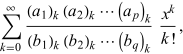
where 👁 (a)_k
is the Pochhammer symbol
or rising factorial


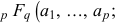
A generalized hypergeometric function 👁 _pF_q(a_1,...,a_p;
👁 b_1,...,b_q;x)
therefore has 👁 p
parameters of type 1 and 👁 q
parameters of type 2.


A number of generalized hypergeometric functions has special names. 👁 _0F_1(;b;z)
is called a confluent
hypergeometric limit function, and is implemented in the Wolfram
Language as [b,
z]. 👁 _1F_1(a;b;z)
(also denoted 👁 M(z)
) is called a confluent
hypergeometric function of the first kind, and is implemented in the Wolfram
Language as [a,
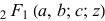
b, z]. The function 👁 _2F_1(a,b;c;z)
is often called "the" hypergeometric
function or Gauss's hypergeometric function, and is implemented in the Wolfram
Language as [a,
b, c, x]. Arbitrary generalized hypergeometric functions are
implemented as [👁 {
a1,
...ap👁 }
, 👁 {
b1, ..., bq👁 }
, x].




The notation for generalized hypergeometric functions was introduced by Pochhammer in 1870 and modified by Barnes (1907, 1908ab; Slater 1960, p. 2; Hardy 1999, p. 111). A number of notational variations are commonly used, including

used primarily for 👁 p,q<=2
, using square brackets instead of parentheses

![👁 _pF_q[a_1,...,a_p;b_1,...,b_q;x]](https://mathworld.wolfram.com/images/equations/GeneralizedHypergeometricFunction/NumberedEquation4.svg)
(Slater 1960, p. 2), including 👁 x
at the end of the first row and aligning slots in the second
row from the right

![👁 _pF_q[a_1,a_2,...,a_p;; b_1,...,b_q z; ]](https://mathworld.wolfram.com/images/equations/GeneralizedHypergeometricFunction/NumberedEquation5.svg)
(Bailey 1935, p. 9), including 👁 x
at the end of the first row and centering each row

![👁 _pF_q[a_1,a_2,...,a_p;z; b_1,...,b_q]](https://mathworld.wolfram.com/images/equations/GeneralizedHypergeometricFunction/NumberedEquation6.svg)
(Bailey 1935, p. 14), using strict matrix-like alignment of each column with columns right-aligned along their right-most elements
![👁 _pF_q[a_1 a_2 ... a_p;; b_1 ..., b_q z; ]](https://mathworld.wolfram.com/images/equations/GeneralizedHypergeometricFunction/NumberedEquation7.svg)
or
![👁 _pF_q[a_1 a_2 ... a_p;; b_1 ..., b_q;z]](https://mathworld.wolfram.com/images/equations/GeneralizedHypergeometricFunction/NumberedEquation8.svg)
(Slater 1960, p. 31), and a variation in which rows are centered and 👁 x
is placed to the right separated by a vertical bar and using
parenthesis

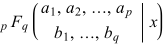
(Graham et al. 1994, p. 205) or using square brackets and a semicolon
![👁 _pF_q[a_1,a_2,...,a_p; b_1,...,b_q;x].](https://mathworld.wolfram.com/images/equations/GeneralizedHypergeometricFunction/NumberedEquation10.svg)
The latter convention will be used in this work, as it provides the clearest delineation of the argument 👁 x
while making the most sparing use of white space in the typesetting
of expressions that may contain a large number of symbolic parameters of differing
lengths.

If the argument is equal to 👁 x=1
, then it is conventional to omit the argument altogether,
although the trailing semicolon may be either retained or also discarded depending
on notational convention. Bailey (1935, p. 9) uses the notation

![👁 _pF_q[a_1,a_2,...,a_p;; b_1,...,b_q]=_pF_q[a_1,a_2,...,a_p;1; b_1,b_2,...,b_q],](https://mathworld.wolfram.com/images/equations/GeneralizedHypergeometricFunction/NumberedEquation11.svg)
although in this work, the semicolon will be omitted, i.e.,
![👁 _pF_q[a_1,a_2,...,a_p; b_1,b_2,...,b_q]=_pF_q[a_1,a_2,...,a_p; b_1,b_2,...,b_q].](https://mathworld.wolfram.com/images/equations/GeneralizedHypergeometricFunction/NumberedEquation12.svg)
The Kampe de Feriet function is a generalization of the generalized hypergeometric function to two variables.
The generalized hypergeometric function 👁 F_n(x)=_pF_q[a_1,a_2...,a_p; b_1,b_2,...,b_q;x]
satisfies
![👁 F_n(x)=_pF_q[a_1,a_2...,a_p; b_1,b_2,...,b_q;x]](https://mathworld.wolfram.com/images/equations/GeneralizedHypergeometricFunction/Inline27.svg)
![👁 thetaF_n(x)=n[F_(n+1)(x)-F_n(x)]](https://mathworld.wolfram.com/images/equations/GeneralizedHypergeometricFunction/NumberedEquation13.svg)
for any of its numerator parameters 👁 n=alpha_k
, and

![👁 thetaF_n(x)=(n-1)[F_(n-1)(x)-F_n(x)]](https://mathworld.wolfram.com/images/equations/GeneralizedHypergeometricFunction/NumberedEquation14.svg)
for any of its denominator parameters 👁 n=beta_k
, where

| 👁 theta=zd/(dz) |
(17)
|

is the differential operator (Rainville 1971, Koepf 1998, p. 27).
The generalized hypergeometric function
![👁 _(p+1)F_p[a_1,a_2,...,a_(p+1); b_1,b_2,...,b_p;z]](https://mathworld.wolfram.com/images/equations/GeneralizedHypergeometricFunction/NumberedEquation16.svg)
is a solution to the differential equation
![👁 [theta(theta+b_1-1)...(theta+b_p-1)-z(theta+a_1)(theta+a_2)...(theta+a_(p+1))]y=0](https://mathworld.wolfram.com/images/equations/GeneralizedHypergeometricFunction/NumberedEquation17.svg)
(Bailey 1935, p. 8). The other linearly independent solution is
![👁 z^(1-b_1)_(p+1)F_p[1+a_1-b_1,1-a_2-b_2,...,1+a_(p+1)-b_1; 2-b_1,1-b_2-b_1,...,1-b_p-b_1;z].](https://mathworld.wolfram.com/images/equations/GeneralizedHypergeometricFunction/NumberedEquation18.svg)
A generalized hypergeometric function 👁 _(q+1)F_q
converges absolutely on the unit circle if

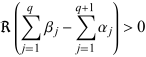
(Rainville 1971, Koepf 1998).
Many sums can be written as generalized hypergeometric functions by inspection of the ratios of consecutive terms in the generating hypergeometric series. For example, for
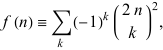
the ratio of successive terms is
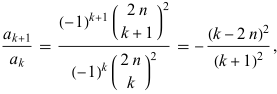
yielding
![👁 f(n)=_2F_1[-2n,-2n; 1;-1]=_2F_1(-2n,-2n;1;-1)](https://mathworld.wolfram.com/images/equations/GeneralizedHypergeometricFunction/NumberedEquation22.svg)
(Petkovšek et al. 1996, pp. 44-45).
Gosper (1978) discovered a slew of unusual hypergeometric function identities, many of which were subsequently proven by Gessel and Stanton (1982). An important generalization of Gosper's technique, called Zeilberger's algorithm, in turn led to the powerful machinery of the Wilf-Zeilberger pair (Zeilberger 1990).
Special hypergeometric identities include Gauss's hypergeometric theorem

for 👁 R[c-a-b]>0
,
Kummer's formula
![👁 R[c-a-b]>0](https://mathworld.wolfram.com/images/equations/GeneralizedHypergeometricFunction/Inline31.svg)

where 👁 a-b+c=1
and 👁 b
is a positive integer, Saalschütz's
theorem



for 👁 d+e=a+b+c+1
with 👁 c
a negative integer and 👁 (a)_n
the Pochhammer symbol,
Dixon's theorem




where 👁 1+a/2-b-c
has a positive real part,
👁 d=a-b+1
,
and 👁 e=a-c+1
,
the Clausen formula



![👁 _4F_3[a,b,c,d; e,f,g;1]=((2a)_(|d|)(a+b)_(|d|)(2b)_(|d|))/((2a+2b)_(|d|)a_(|d|)b_(|d|)),](https://mathworld.wolfram.com/images/equations/GeneralizedHypergeometricFunction/NumberedEquation27.svg)
for 👁 a+b+c-d=1/2
,
👁 e=a+b+1/2
,
👁 a+f=d+1=b+g
,
👁 d
a nonpositive integer, and the Dougall-Ramanujan
identity




![👁 _7F_6[a_1,a_2,a_3,a_4,a_5,a_6,a_7; b_1,b_2,b_3,b_4,b_5,b_6;1] =((a_1+1)_n(a_1-a_2-a_3+1)_n)/((a_1-a_2+1)_n(a_1-a_3+1)_n)((a_1-a_2-a_4+1)_n(a_1-a_3-a_4+1)_n)/((a_1-a_4+1)_n(a_1-a_2-a_3-a_4+1)_n),](https://mathworld.wolfram.com/images/equations/GeneralizedHypergeometricFunction/NumberedEquation28.svg)
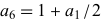
where 👁 n=2a_1+1=a_2+a_3+a_4+a_5
, 👁 a_6=1+a_1/2
, 👁 a_7=-n
, and 👁 b_i=1+a_1-a_(i+1)
for 👁 i=1
, 2, ..., 6. For all these identities, 👁 (a)_n
is the Pochhammer symbol.





Gessel (1995) found a slew of new identities using Wilf-Zeilberger pairs, including the following:
![👁 _5F_4[-a-b,n+1,n+c+1,2n-a-b+1,n+1/2(3-a-b); n-a-b-c+1,n-a-b+1,2n+2,n+1/2(1-a-b);1]=0](https://mathworld.wolfram.com/images/equations/GeneralizedHypergeometricFunction/NumberedEquation29.svg)
![👁 _3F_2[-3n,2/3-c,3n+2; 3/2,1-3c;3/4]=((c+2/3)_n(1/3)_n)/((1-c)_n(4/3)_n)](https://mathworld.wolfram.com/images/equations/GeneralizedHypergeometricFunction/NumberedEquation30.svg)
![👁 _3F_2[-3b,-3/2n,1/2(1-3n); -3n,2/3-b-n;4/3]=((1/3-b)_n)/((1/3+b)_n)](https://mathworld.wolfram.com/images/equations/GeneralizedHypergeometricFunction/NumberedEquation31.svg)
| 👁 _4F_3[3/2+1/5n,2/3,-n,2n+2; n+(11)/6,4/3,1/5n+1/2;2/(27)]=((5/2)_n((11)/6)_n)/((3/2)_n(7/2)_n) |
(34)
|
![👁 _4F_3[3/2+1/5n,2/3,-n,2n+2; n+(11)/6,4/3,1/5n+1/2;2/(27)]=((5/2)_n((11)/6)_n)/((3/2)_n(7/2)_n)](https://mathworld.wolfram.com/images/equations/GeneralizedHypergeometricFunction/NumberedEquation32.svg)
(Petkovšek et al. 1996, pp. 135-137).
The following table gives various named identities ordered by the orders 👁 (p,q)
of the 👁 _pF_q
s they involve. Bailey (1935) gives a large number of such
identities.


Nørlund (1955) gave the general transformation
![👁 _nF_(n-1)[a_1,a_2,...,a_n; b_1,b_2,...,b_(n-1);xz] =(1-z)^(-a_1)sum_(nu=0)^infty((a_1)_nu)/(nu!)_nF_(n-1)[-nu,a_2,a_3,...,a_n; b_1,b_2,...,b_(n-1);x](z/(z-1))^nu,](https://mathworld.wolfram.com/images/equations/GeneralizedHypergeometricFunction/NumberedEquation33.svg)
where 👁 (a)_n
is the Pochhammer symbol.
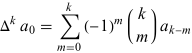
This identity is based on the transformation due to Euler

| 👁 sum_(n=0)^infty((a)_n)/(n!)a_nz^n=(1-z)^(-a)sum_(n=0)^infty((a)_n)/(n!)Delta^na_0(z/(1-z))^n, |
(36)
|

where 👁 Delta
is the forward difference
and

(Nørlund 1955).
See also
Carlson's Theorem, Clausen Formula, Confluent Hypergeometric Function of the First Kind, Confluent Hypergeometric Limit Function, Dixon's Theorem, Dougall-Ramanujan Identity, Dougall's Theorem, Generalized Hypergeometric Differential Equation, Gosper's Algorithm, Hypergeometric Function, Hypergeometric Identity, Hypergeometric Series, Jackson's Identity, k-Balanced, Kampe de Feriet Function, Kummer's Theorem, Lauricella Functions, Nearly-Poised, q-Hypergeometric Function, Ramanujan's Hypergeometric Identity, Saalschütz's Theorem, Saalschützian, Sister Celine's Method, Slater's Formula, Thomae's Theorem, Watson's Theorem, Well-Poised, Whipple's Identity, Whipple's Transformation, Wilf-Zeilberger Pair, Zeilberger's AlgorithmRelated Wolfram sites
http://functions.wolfram.com/HypergeometricFunctions/HypergeometricPFQ/, http://functions.wolfram.com/HypergeometricFunctions/HypergeometricPFQRegularized/, http://functions.wolfram.com/HypergeometricFunctions/Hypergeometric1F0/, http://functions.wolfram.com/HypergeometricFunctions/Hypergeometric1F1/, http://functions.wolfram.com/HypergeometricFunctions/Hypergeometric2F2/, http://functions.wolfram.com/HypergeometricFunctions/Hypergeometric2F3/, http://functions.wolfram.com/HypergeometricFunctions/Hypergeometric3F2/, http://functions.wolfram.com/HypergeometricFunctions/Hypergeometric4F3/, http://functions.wolfram.com/HypergeometricFunctions/Hypergeometric5F4/, http://functions.wolfram.com/HypergeometricFunctions/Hypergeometric6F5/Explore with Wolfram|Alpha

More things to try:
References
Bailey, W. N. "Some Identities Involving Generalized Hypergeometric Series." Proc. London Math. Soc. Ser. 2 29, 503-516, 1929.Bailey, W. N. Generalised Hypergeometric Series. Cambridge, England: Cambridge University Press, 1935.Barnes, E. W. "The Asymptotic Expansion of Integral Functions Defined by Generalised Hypergeometric Series." Proc. London Math. Soc. 5, 59-116. 1907.Barnes, E. W. "On Functions Defined by Simple Hypergeometric Series." Trans. Cambridge Philos. Soc. 20, 253-279, 1908a.Barnes, E. W. "A New Development of the Theory of Hypergeometric Functions." Proc. London Math. Soc. 6, 141-177, 1908b.Dwork, B. Generalized Hypergeometric Functions. Oxford, England: Clarendon Press, 1990.Exton, H. Multiple Hypergeometric Functions and Applications. New York: Wiley, 1976.Exton, H. Handbook of Hypergeometric Integrals: Theory, Applications, Tables, Computer Programs. Chichester, England: Ellis Horwood, 1978.Gessel, I. "Finding Identities with the WZ Method." J. Symb. Comput. 20, 537-566, 1995.Gessel, I. and Stanton, D. "Strange Evaluations of Hypergeometric Series." SIAM J. Math. Anal. 13, 295-308, 1982.Gosper, R. W. "Decision Procedures for Indefinite Hypergeometric Summation." Proc. Nat. Acad. Sci. USA 75, 40-42, 1978.Graham, R. L.; Knuth, D. E.; and Patashnik, O. "Hypergeometric Functions." §5.5 in Concrete Mathematics: A Foundation for Computer Science, 2nd ed. Reading, MA: Addison-Wesley, pp. 204-216 1994.Hardy, G. H. "Hypergeometric Series." Ch. 7 in Ramanujan: Twelve Lectures on Subjects Suggested by His Life and Work, 3rd ed. New York: Chelsea, pp. 101-112, 1999.Ishkhanyan, T. "Hypergeometric Functions: From Euler to Appell and Beyond." Jan. 25, 2024. https://blog.wolfram.com/2024/01/25/hypergeometric-functions-from-euler-to-appell-and-beyond/.Klein, F. Vorlesungen über die hypergeometrische Funktion. Berlin: J. Springer, 1933.Koekoek, R. and Swarttouw, R. F. The Askey-Scheme of Hypergeometric Orthogonal Polynomials and its 👁 q
-Analogue. Delft, Netherlands: Technische Universiteit Delft, Faculty of Technical Mathematics and Informatics Report 98-17, 1-168, 1998.Koepf, W. "Hypergeometric Database." Ch. 3 in Hypergeometric Summation: An Algorithmic Approach to Summation and Special Function Identities. Braunschweig, Germany: Vieweg, pp. 12 and 31-43, 1998.Nørlund, N. E. "Hypergeometric Functions." Acta Math. 94, 289-349, 1955.Petkovšek, M.; Wilf, H. S.; and Zeilberger, D. A=B. Wellesley, MA: A K Peters, 1996. http://www.cis.upenn.edu/~wilf/AeqB.html.Rainville, E. D. Special Functions. New York: Chelsea, 1971.Saxena, R. K. and Mathai, A. M. Generalized Hypergeometric Functions with Applications in Statistics and Physical Sciences. New York: Springer-Verlag, 1973.Slater, L. J. Confluent Hypergeometric Functions. Cambridge, England: Cambridge University Press, 1960.Slater, L. J. Generalized Hypergeometric Functions. Cambridge, England: Cambridge University Press, 1966.Zeilberger, D. "A Fast Algorithm for Proving Terminating Hypergeometric Series Identities." Discrete Math. 80, 207-211, 1990.
Referenced on Wolfram|Alpha
Generalized Hypergeometric FunctionCite this as:
Weisstein, Eric W. "Generalized Hypergeometric Function." From MathWorld--A Wolfram Resource. https://mathworld.wolfram.com/GeneralizedHypergeometricFunction.html