

Thomae's Theorem

Thomae's theorem, also called Thomae's transformation, is the generalized hypergeometric function identity
![👁 (Gamma(a))/(Gamma(e)Gamma(f))_3F_2[a,b,c; e,f;1]=(Gamma(s))/(Gamma(s+b)Gamma(s+c))_3F_2[s,e-a,f-a; s+b,s+c;1],](https://mathworld.wolfram.com/images/equations/ThomaesTheorem/NumberedEquation1.svg)
where 👁 Gamma(z)
is the gamma function, 👁 _3F_2(a,b,c;e,f;z)
is a generalized
hypergeometric function,


| 👁 s=e+f-a-b-c, |
(2)
|

and 👁 R[a],R[s]>0
(Bailey 1935, p. 14). It is a generalization of Dixon's
theorem (Slater 1966, p. 52).
![👁 R[a],R[s]>0](https://mathworld.wolfram.com/images/equations/ThomaesTheorem/Inline3.svg)
An equivalent formulation is given by
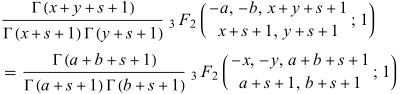
(Hardy 1999, p. 104). The symmetry of this form was used by Ramanujan in his proof of the identity, which is essentially the same as Thomae's. Interestingly, this is one of the few cases in which Ramanujan gives an explicit proof of one of his propositions (Hardy 1999, p. 104).
A special case of the theorem is given by
![👁 1/a_3F_2[1,a,b; a+1,d]=1/a_3F_2[a,1,b; a+1,d] =(Gamma(a+1)Gamma(d)Gamma(d-b))/(Gamma(a)Gamma(d-b+1)Gamma(d))1/a_3F_2[d-b,1,d-a; d-b+1,d] =1/(d-b)_3F_2[d-b,1,d-a; d-b+1,d] =1/(d-b)_3F_2[1,d-b,d-a; d-b+1,d]](https://mathworld.wolfram.com/images/equations/ThomaesTheorem/NumberedEquation4.svg)
(J. Sondow, pers. comm., May 25, 2003).
See also
Gauss's Hypergeometric Theorem, Generalized Hypergeometric FunctionExplore with Wolfram|Alpha

More things to try:
References
Bailey, W. N. Generalised Hypergeometric Series. Cambridge, England: University Press, 1935.Hardy, G. H. "A Chapter from Ramanujan's Note-Book." Proc. Cambridge Philos. Soc. 21, 492-503, 1923.Hardy, G. H. Ramanujan: Twelve Lectures on Subjects Suggested by His Life and Work, 3rd ed. New York: Chelsea, pp. 104-105, 1999.Slater, L. J. Generalized Hypergeometric Functions. Cambridge, England: Cambridge University Press, p. 52, 1966.Thomae, J. "Ueber die Funktionen welche durch Reihen von der Form dargestellt werden: 👁 1+(pp^'p^(''))/(1qq^(''))+...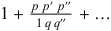
." J. für Math. 87, 26-73, 1879.
Referenced on Wolfram|Alpha
Thomae's TheoremCite this as:
Weisstein, Eric W. "Thomae's Theorem." From MathWorld--A Wolfram Resource. https://mathworld.wolfram.com/ThomaesTheorem.html