

Watson's Triple Integrals

Watson (1939) considered the following three triple integrals,





![👁 (4[K(1/2sqrt(2))]^2)/(pi^2)](https://mathworld.wolfram.com/images/equations/WatsonsTripleIntegrals/Inline6.svg)


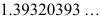





![👁 (sqrt(3)[K(1/4(sqrt(6)-sqrt(2)))]^2)/(pi^2)](https://mathworld.wolfram.com/images/equations/WatsonsTripleIntegrals/Inline18.svg)








![👁 (4(18+12sqrt(2)-10sqrt(3)-7sqrt(6))[K((2-sqrt(3))(sqrt(3)-sqrt(2)))]^2)/(pi^2)](https://mathworld.wolfram.com/images/equations/WatsonsTripleIntegrals/Inline30.svg)


![👁 (18+12sqrt(2)-10sqrt(3)-7sqrt(6))[1+2sum_(k=1)^(infty)exp(-k^2pisqrt(6))]^4](https://mathworld.wolfram.com/images/equations/WatsonsTripleIntegrals/Inline33.svg)





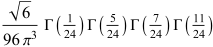



(OEIS A091670, A091671, and A091672), where 👁 K(k)
is a complete
elliptic integral of the first kind, 👁 theta_3(0,q)
is a Jacobi
theta function, and 👁 Gamma(z)
is the gamma function.
Analytic computation of these integrals is rather challenging, especially 👁 I_2
and 👁 I_3
.


Watson (1939) treats all three integrals by making the transformations
| 👁 x | 👁 = | 👁 tan(1/2u) |
(15)
|
| 👁 y | 👁 = | 👁 tan(1/2v) |
(16)
|
| 👁 z | 👁 = | 👁 tan(1/2w), |
(17)
|


regarding 👁 x
,
👁 y
,
and 👁 z
as Cartesian coordinates, and changing to
polar coordinates,


| 👁 x | 👁 = | 👁 rsinthetacosphi |
(18)
|
| 👁 y | 👁 = | 👁 rsinthetasinphi |
(19)
|
| 👁 z | 👁 = | 👁 rcostheta |
(20)
|


after writing 👁 2phi=psi
.

Performing this transformation on 👁 I_1
gives












👁 I_1
can then be directly integrated using computer algebra, although Watson (1939) used
the additional transformation


to separate the integral into





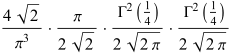


The integral 👁 I_1
can also be done by performing one of the integrations

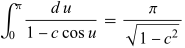
with 👁 c=cosvcosw
to obtain


Expanding using a binomial series


where 👁 (z)_n
is a Pochhammer symbol and

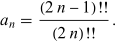
Integrating gives





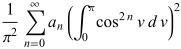


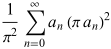


Now, as a result of the amazing identity for the complete elliptic integral of the first kind 👁 K(k)

![👁 [K(k)]^2=1/4pi^2sum_(n=0)^inftya_n^3(2kk^')^(2n),](https://mathworld.wolfram.com/images/equations/WatsonsTripleIntegrals/NumberedEquation5.svg)
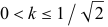
where 👁 k^'
is the complementary modulus and 👁 0<k<=1/sqrt(2)
(Watson 1908, Watson 1939), it follows
immediately that with 👁 k=k^'=1/sqrt(2)
(i.e., 👁 k=k_1
, the first singular value),

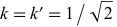

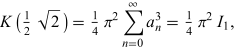
so


![👁 (4[K(1/2sqrt(2))]^2)/(pi^2)](https://mathworld.wolfram.com/images/equations/WatsonsTripleIntegrals/Inline121.svg)


👁 I_2
can be transformed using the same prescription to give














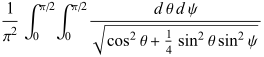


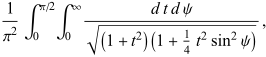
where the substitution 👁 t=tantheta
has been made in the last step. Computer algebra
can return this integral in the form of a Meijer
G-function

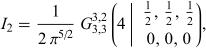
but more clever treatment is needed to obtain it in a nicer form. For example, Watson (1939) notes that
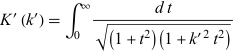
immediately gives
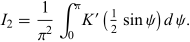
However, quadrature of this integral requires very clever use of a complicated series identity for 👁 K(k)
to obtain term by term integration that can then be recombined as recognized as

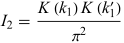
(Watson 1939).
For 👁 I_3
,
only a single integration can be done analytically, namely

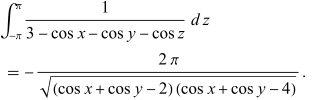
It can be reduced to a single infinite sum by defining 👁 w=(cosx+cosy+cosz)/3
and using a binomial
series expansion to write


But this can then be written as a multinomial series and plugged back in to obtain

Exchanging the order of integration and summation allows the integrals to be done, leading to
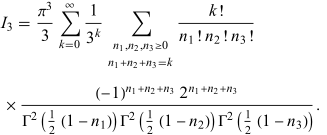
Rather surprisingly, the sums over 👁 n_i
can be done in closed form, yielding

![👁 I_3=1/3sum_(n=0)^infty([(2n)!]^2)/(36^n(n!)^3)_3F_2(-n,-n,-n;1,1/2-n;1/4),](https://mathworld.wolfram.com/images/equations/WatsonsTripleIntegrals/NumberedEquation15.svg)
where 👁 _3F_2(a,b,c;d,e;z)
is a generalized hypergeometric
function. However, this sum cannot be done in closed form.

Watson (1939) transformed the integral to
| 👁 I_3=(2sqrt(2))/piint_0^(pi/2)int_0^infty(dtdpsi)/(sqrt((1+4t^2+3t^4sin^2psi)(1+t^2sin^2psi))). |
(57)
|

However, to obtain an entirely closed form, it is necessary to do perform some analytic wizardry (see Watson 1939 for details). The fact that a closed form exists at all for this integral is therefore rather amazing.
See also
Pólya's Random Walk Constants, Watson's Formula, Watson's IdentitiesExplore with Wolfram|Alpha

More things to try:
References
Bailey, D. H.; Borwein, J. M.; Kapoor, V.; and Weisstein, E. W. "Ten Problems in Experimental Mathematics." Amer. Math. Monthly 113, 481-509, 2006b.Borwein, J. and Bailey, D. Mathematics by Experiment: Plausible Reasoning in the 21st Century. Wellesley, MA: A K Peters, 2003.Domb, C. "On Multiple Returns in the Random-Walk Problem." Proc. Cambridge Philos. Soc. 50, 586-591, 1954.Glasser, M. L. and Zucker, I. J. "Extended Watson Integrals for the Cubic Lattices." Proc. Nat. Acad. Sci. U.S.A. 74, 1800-1801, 1977.Joyce, G. and Zucker, I. J. "On the Evaluation of Generalized Watson Integrals." Proc. Amer. Math. Soc. 133, 71-81, 2005.McCrea, W. H. and Whipple, F. J. W. "Random Paths in Two and Three Dimensions." Proc. Roy. Soc. Edinburgh 60, 281-298, 1940.Sloane, N. J. A. Sequences A091670, A091671, and A091672 in "The On-Line Encyclopedia of Integer Sequences."Watson G. N. "The Expansion of Products of Hypergeometric Functions." Quart. J. Pure Appl. Math. 39, 27-51, 1907.Watson G. N. "A Series for the Square of the Hypergeometric Function." Quart. J. Pure Appl. Math. 40, 46-57, 1908.Watson, G. N. "Three Triple Integrals." Quart. J. Math., Oxford Ser. 2 10, 266-276, 1939.Referenced on Wolfram|Alpha
Watson's Triple IntegralsCite this as:
Weisstein, Eric W. "Watson's Triple Integrals." From MathWorld--A Wolfram Resource. https://mathworld.wolfram.com/WatsonsTripleIntegrals.html