
| 👁 Image Cassini view of Rhea's anti-Saturnian hemisphere, showing the moon's two largest impact basins (Mamaldi above and left of center, and adjacent Tirawa to its upper right). At highest resolution, several long linear features are visible: halfway down from center is Harahvaiti Fossa, while near the limb left of the bottom is Koykamou Catena. | ||||||||
| Discovery | ||||||||
|---|---|---|---|---|---|---|---|---|
| Discoveredby | G. D. Cassini | |||||||
| Discoverydate | December 23, 1672 | |||||||
| Designations | ||||||||
| Saturn V | ||||||||
| Adjectives | Rhean | |||||||
| Orbital characteristics [1] | ||||||||
| 527108 km | ||||||||
| Eccentricity | 0.0012583 | |||||||
| 4.518212 d | ||||||||
| Inclination | 0.345° (to Saturn's equator) | |||||||
| Satelliteof | Saturn | |||||||
| Physical characteristics | ||||||||
| Dimensions | 1532.4×1525.6×1524.4 km | |||||||
Mean radius | 763.8 ± 1.0km | |||||||
| 7337000 km² | ||||||||
| Mass | (2.306518±0.000353)×1021 kg (~3.9×10⁻⁴ Earths) | |||||||
Mean density | 1.236 ± 0.005g/cm³ | |||||||
| 0.265 m/s² | ||||||||
| 0.635 km/s | ||||||||
| 4.518212 d (synchronous) | ||||||||
| zero | ||||||||
| Albedo | 0.949 ± 0.003 (geometric) | |||||||
| ||||||||
| 10 [2] | ||||||||


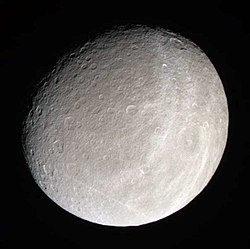
Rhea (/ˈriːə/;[a] Ancient Greek: Ῥέᾱ) is Saturn's second largest moon. It is made of ice and rock.
Ring system
[change | change source]Rhea may have a thin ring system with three narrow bands in a disk of solid particles. These would be the first rings seen around a moon. The discovery was announced in the journal Science on March 6, 2008.
Notes
[change | change source]References
[change | change source]
- ↑ Natural Satellites Ephemeris Service Minor Planet Center
- ↑ Observatorio ARVAL (April 15, 2007). "Classic Satellites of the Solar System". Observatorio ARVAL. Archived from the original on 2013-10-22. Retrieved 2011-12-17.

👁 Image
This short article about science can be made longer. You can help Wikipedia by adding to it.


This short article about science can be made longer. You can help Wikipedia by adding to it.