
.jpg)
_NIST_ASD_emission_spectrum.png)


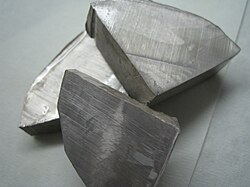
Sodium is a chemical element with an atomic number of 11. Its symbol is Na (from its Latin name natrium). It is an alkali metal. Although sodium has many isotopes, most decay in a short time. Because of this, all sodium in nature (mainly found in seawater) is of the isotope 11Na23. The atomic mass of sodium is 22.9898.
Properties
[change | change source]Sodium is a light-weight, silver-colored metal. Sodium is soft. It can easily be cut with a knife. When someone cuts it, the exposed part will become white over time. It reacts with air to form, at first sodium oxide, then slowly sodium hydroxide and sodium carbonate. Sodium is a little less dense than water. It floats and reacts instantly with water, producing hydrogen and sodium hydroxide. This reaction makes a lot of heat, usually causing the hydrogen to light on fire. When this happens, sodium melts because of its low melting point. Sodium is highly reactive because it has one valence electron, which is easily removed.
Compared with other alkali metals, sodium is less reactive than potassium and more reactive than lithium.[6]
Chemical compounds
[change | change source]These are chemical compounds that contain sodium ions. Sodium only exists in one oxidation state: +1.
- Sodium aluminum fluoride, used to make aluminum
- Sodium amide, very strong base
- Sodium arsenite, colorless solid, very toxic
- Sodium arsenate, oxidizing agent, very toxic
- Sodium azide, used in airbags
- Sodium bicarbonate, baking soda, used in cooking
- Sodium bismuthate, oxidizing agent, used to test for manganese
- Sodium bisulfate, acidic, used to lower pH
- Sodium bromate, oxidizing agent, used to dye hair
- Sodium bromide, rare, used in some medicine
- Sodium carbonate, used to make glass
- Sodium chlorate, used in some explosives
- Sodium chlorite, used in disinfectants
- Sodium chloride, table salt
- Sodium chromate, yellow, oxidizing agent, toxic
- Sodium dichromate, orange, oxidizing agent, toxic
- Sodium fluoride, used in toothpaste, bitter, toxic in large doses
- Sodium hydroxide, lye, used in soap, strong base
- Sodium hypochlorite, bleach, disinfectant
- Sodium hypophosphite, reducing agent, poisonous
- Sodium iodate, oxidizing agent, prevents iodine deficiency
- Sodium iodide, a weak reducing agent, prevents iodine deficiency
- Sodium manganate, rare green solid
- Sodium nitrate, used in blasting powder
- Sodium nitrite, used in food preservation
- Sodium periodate, oxidizing agent
- Sodium permanganate, less common than potassium permanganate, oxidizing agent
- Sodium phosphate, various uses
- Sodium phosphide, catalyst, used to speed up chemical reactions
- Sodium phosphite, toxic, reducing agent
- Sodium selenate, strong oxidizing agent, other selenium compounds
- Sodium selenide, strong reducing agent, reactive
- Sodium selenite, weak oxidizing agent, vitamin supplement
- Sodium sulfate, bitter, laxative
- Sodium sulfite, a weak reducing agent, used to preserve dried food
- Sodium tellurate, strong oxidizing agent
- Sodium telluride, a strong reducing agent, reacts with air easily
- Sodium tellurite, main tellurite compound
Discovery and name origins
[change | change source]Sodium was discovered by Sir Humphrey Davy, an English scientist, in 1807. He created it by electrolyzing sodium hydroxide. Davy named the element after soda[disambiguation needed], a name for sodium hydroxide or sodium carbonate.
Uses
[change | change source]Scientists can use it in the creation of organic compounds. It is used in orange streetlights and lamps that emit ultraviolet light.
Sodium compounds are used in soaps, toothpaste, baking, and antacids.
The human body needs sodium ions, taken in the form of sodium chloride, to live. Too much of it can cause health problems. Many organisms in the ocean depend on the concentration of sodium ions in water to survive.
Occurrence and production
[change | change source]Sodium does not occur as an element in nature, because it is not stable enough. It exists only in chemical compounds. Sodium ions are found in the ocean and in the Earth's crust.
Sodium is normally made by electrolysis of sodium chloride, which is mined from the Earth's crust.
Related pages
[change | change source]- List of common elements
- Hyponatremia (a medical problem caused by not having enough sodium in the body)
References
[change | change source]- ↑ "Standard Atomic Weights: Sodium". CIAAW. 2005.
- ↑ The compound NaCl has been shown in experiments to exists in several unusual stoichiometries under high pressure, including Na3Cl in which contains a layer of sodium(0) atoms; see Zhang, W.; Oganov, A. R.; Goncharov, A. F.; Zhu, Q.; Boulfelfel, S. E.; Lyakhov, A. O.; Stavrou, E.; Somayazulu, M.; Prakapenka, V. B.; Konôpková, Z. (2013). "Unexpected Stable Stoichiometries of Sodium Chlorides". Science. 342 (6165): 1502–1505. arXiv:1310.7674. Bibcode:2013Sci...342.1502Z. doi:10.1126/science.1244989. PMID24357316. S2CID15298372.
- ↑ Magnetic susceptibility of the elements and inorganic compounds, in Lide, D. R., ed. (2005). CRC Handbook of Chemistry and Physics (86thed.). Boca Raton (FL): CRC Press. ISBN0-8493-0486-5.
- ↑ Weast, Robert (1984). CRC, Handbook of Chemistry and Physics. Boca Raton, Florida: Chemical Rubber Company Publishing. pp.E110. ISBN0-8493-0464-4.
- ↑ Kondev, F. G.; Wang, M.; Huang, W. J.; Naimi, S.; Audi, G. (2021). "The NUBASE2020 evaluation of nuclear properties" (PDF). Chinese Physics C. 45 (3): 030001. doi:10.1088/1674-1137/abddae.
- ↑ De Leon, N. "Reactivity of Alkali Metals". Indiana University Northwest. Archived from the original on 2018-10-16. Retrieved 2007-12-07.
| H | He | ||||||||||||||||||||||||||||||||||||||||
| Li | Be | B | C | N | O | F | Ne | ||||||||||||||||||||||||||||||||||
| Na | Mg | Al | Si | P | S | Cl | Ar | ||||||||||||||||||||||||||||||||||
| K | Ca | Sc | Ti | V | Cr | Mn | Fe | Co | Ni | Cu | Zn | Ga | Ge | As | Se | Br | Kr | ||||||||||||||||||||||||
| Rb | Sr | Y | Zr | Nb | Mo | Tc | Ru | Rh | Pd | Ag | Cd | In | Sn | Sb | Te | I | Xe | ||||||||||||||||||||||||
| Cs | Ba | La | Ce | Pr | Nd | Pm | Sm | Eu | Gd | Tb | Dy | Ho | Er | Tm | Yb | Lu | Hf | Ta | W | Re | Os | Ir | Pt | Au | Hg | Tl | Pb | Bi | Po | At | Rn | ||||||||||
| Fr | Ra | Ac | Th | Pa | U | Np | Pu | Am | Cm | Bk | Cf | Es | Fm | Md | No | Lr | Rf | Db | Sg | Bh | Hs | Mt | Ds | Rg | Cn | Nh | Fl | Mc | Lv | Ts | Og | ||||||||||
| |||||||||||||||||||||||||||||||||||||||||


This short article about chemistry can be made longer. You can help Wikipedia by adding to it.
