|
VOOZH | about |
|
VOOZH | about |
| Sonic Championship |
|---|
|
Also known as: Sonic the Fighters (JP, INT rereleases) 👁 AnimationsIcon.png 👁 PrereleaseIcon.png This game has a prerelease article |
Now more commonly advertised under its Japanese name of Sonic the Fighters, Sonic Championship sees the spiky blue mascot taking on Fighting Vipers, with mixed results. Due to Sega of America's fear of the game being seen as violent (despite its violence being 100% slapstick), the game saw an extremely limited release outside Japan.
A Saturn port was planned but never materialized, and the game remained an obscurity until Sonic Gems Collection. The game was rereleased on Xbox Live Arcade and PlayStation Network in November 2012, which included a couple of characters who weren't playable in the arcade release.
| This page is loooong... Consider grouping related content into additional subpages to ease readability. |
To do:
|
| Prerelease Info |
| Unused Models Take a closer look at scrapped and unused objects found within the game's files! |
| Unused Moves View the various mystique animations that could have been. |
| Debug Mode Check out 𝙏𝙝𝙚 𝙉𝙚𝙭𝙩 𝙇𝙚𝙫𝙚𝙡! |
There are some characters that exist in the game who are inaccessible without cheats. Some of these were finished up and made available in the HD rerelease.
Honey in the character select.
Honey in gameplay. Note the bugged eye and unique Player 2 palette.
Honey's full eyeset.
Honey's squished state as it appears in-game.
The intended body piece for Honey's squished model.
Honey's unused Vs. screen image; Player-1 side...
... and Player-2 side.
A yellow cat-like character with black hair, based on the character of the same name from Fighting Vipers (Whom was named Candy outside of Japan). She was discovered after the release of Sonic Gems Collection due to leftover code referring to her despite the majority of her assets being removed from that version. In an interview with Hiroshi Kataoka, he stated that with Sonic the Fighters being initially designed around placing Sonic characters in the Fighting Vipers engine, the character was likely conceived and implemented as a tribute to the game's development origins.
Honey's in-game data is nearly complete, featuring a full moveset deriving largely from Knuckles' plus a few moves from Amy. But she does have a handful of bugs that most likely prevented her from being fully implemented, namely:
Notably, unlike other characters, Honey's Player 2 color palette is a unique design derived from her namesake's Player 2 palette in Fighting Vipers, instead of the greyscale palette every other character has. Honey would later make a cameo appearance in the intro FMV for Fighting Vipers' Saturn port.
While Honey's model was removed completely from the Sonic Gems Collection port, the XBLA and PSN versions (as well as the later version of the game included in Like a Dragon Gaiden: The Man Who Erased His Name and Lost Judgment) added her as a secret playable character (move the cursor over Amy and press Start, which also unlocks an achievement/trophy) with all of the above issues corrected.
Metal Sonic in the character select.
Metal Sonic is listed as "METAL" on the high score screen.
The head piece from Metal Sonic's unused greyscale model.
The sub boss of the game's arcade ladder. Has a unique moveset, the most remarkably so of any of the unplayable characters, though still borrows a handful of moves from the playable characters, including Sonic's Emerald Dive (*In Hyper* Half Circle, P + K).
Although he normally only appears in the game as a boss character, there is evidence to suggest Metal Sonic was actually meant to be a playable character. His name appears properly on the high-score table unlike some other unplayable characters mentioned below, and while he doesn't display a greyscale model in mirror matches, the model for such a purpose exists in the files entirely unused.
He would eventually be made playable in the HD re-release alongside Mech Eggman, albeit only being accessible in the VS. modes and unable to engage in mirror matches. He is accessed by pressing Start over Sonic on the character select.
Eggman in the character select.
Eggman in gameplay.
Eggman is listed as "EGGMAN" on the high score screen.
Eggman's unseen Vs. screen image and title card.
An alternate form of Dr. Eggman unseen in gameplay. He appears without the "E-Mech" he uses in his boss fight, being colloquially dubbed as "Mechless Eggman". He has an unusual moveset, featuring moves other characters have mapped to different inputs, e.g. his Skip Kicks are his standard K instead of Up + K and his actual standard Kicks are instead mapped to Down-Forward + K, K, K. Aside from that, he has a few unique moves including a three-punch combo ending in a slow uppercut (P, P, P) and bomb throw move that can throw up to three in a row (Forward + P, P, P). Notably, Tails and Bean respectively seemed to have these moves in the game's AOU '96 build. This, plus the unusual input mappings seems to indicate Eggman's moveset reflects an earlier stage of the game's development compared to every other character in the final game.
Interestingly, similar to Metal Sonic, there's evidence to suggest this form of Eggman was meant to be playable, including his name appearing in the high-score table whilst his boss form does not, and having a normally unseen Vs. Screen image and title card (shown above), though the latter elements also display for Mech Eggman should he be made playable. Although he lacks an intro animation, he also has several unique animations that are unseen, including an idle and Game Over animation.
He has not been made playable in any version of the game to date.
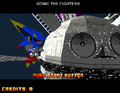
Rocket Metal as he appears in the game's intro.
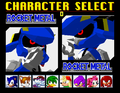
Rocket Metal in the character select.
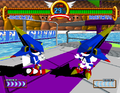
Rocket Metal in gameplay.
An unseen shadow model for Rocket Metal's rocket form.
One of Eggman's robots that is normally only seen in the intro, with a visible name "Mecha Sonic Model No.29". When made to be playable, it can be seen that he has his own nameplate and titlecard, giving him the name "Rocket Metal". His moveset is wholly derivative, entirely copying Knuckles' moveset and animations, albeit with some visual quirks. He turns into Sonic when performing a Spin Dash, he uses Metal Sonic's idle animation for his Game Over screen, his head becomes Metal's when he's put into squished mode (He has his own head model for this purpose, but it's entirely unused) and he seems to have the same eye-tracking bug that Honey has.
Though Rocket Metal has elements that indicate he was meant to be encountered in gameplay, he lacks a VS. screen image (though he may have been intended to use the EGM logo mentioned below), a greyscale model or a name display on the high-score table. The game's dedicated boss character Mech Eggman has a similar combination of elements, which seems to suggest that this character was intended to be fought in the game as a boss character.
As an aside, the rocket form that Rocket Metal takes on in the intro has a separate model for its shadow that's normally never seen in-game. Shadows are normally seen under the player in gameplay. This model's existence may suggest that Rocket Metal was planned to have a move involving its rocket form in gameplay that was never implemented, or otherwise was meant to use it in an in-game cutscene of sorts.
He has not appeared in a playable or boss form in any version of the game to date. He did, however, have a cameo in the Saturn version of Fighting Vipers, where his rocket form can be seen in the intro similarly to the Honey cameo mentioned above.
RoboEgg as it appears in the game's intro.
RoboEgg in the character select.
RoboEgg in gameplay.
RoboEgg's unused titlecard.
RoboEgg's unused nameplate.
Eggman's robot from the intro cutscene. When made playable, it can be seen to have a virtually identical moveset to the final boss, Mech Eggman, with the exception of being able to crouch. Aside from that, it has a few visual quirks, most notably that it will continuously rotate its head as it does in the intro cutscene once every 6 seconds. It's triple punch string ender (P, P, P) uses purple speed lines instead of Mech Eggman's white, and it also uses Metal Sonic's Idle animation for the Game Over screen, same as Rocket Metal.
Among other similarities to Rocket Metal, it neither has a name entry in the high score screen or a greyscale model in mirror matches, and it even seems to lack its nameplate and titlecard, instead defaulting to Eggman's. As it turns out, it does have its own unique title card and nameplate in the files, both of which referring to it as "RoboEgg", that go completely unused. As with Rocket Metal, it was likely intended to be fought as a boss character in Arcade mode.
It has not appeared in a playable or boss form in any version of the game to date.
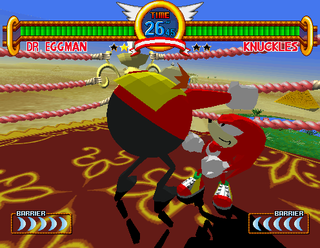
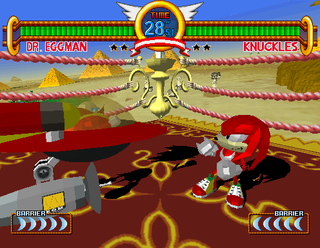
👁 Comparison shot of the two Eggmans
👁 Knuckles: Missed Me!
A larger version of Mechless Eggman. This may be a leftover from Fighting Vipers, mirroring the small and big forms the final boss has in that game. It may also have been a test on Sega AM2's part to see what size would look right for Eggman in-game. He uses the smaller Eggman's animation data for his idle and walking animations, causing him to appear broken in those states, but otherwise appears normal.
Notably, a third, even larger Eggman can be found in the files, inaccessible even through the Debug Mode. It's properties are similar to the Big Eggman seen here, except its head is erroneously placed in its body.
The UFO that Eggman uses to create the greyscale clones in Mirror Matches. It was certainly not meant to appear in gameplay as it copies Knuckles' moveset and animations, and its hitbox and shadow is completely inaccurate to its model.
Data in the game exists for an unused form for Mech Eggman that appears to include tank treads and rocket launchers. This design exists in individual pieces that have been put together in the mockup seen above. Not included here, the tank treads have multiple model variants with different tread positions in the files, indicating that they were to be animated.
👁 MechEggman-SonicTheFighters-AltDesign1.png
A slight variation on the form also exists in the game, which take the form of a singular model with a semi-complete body. This is highly uncommon for this game, indicating the model was either meant for a cutscene or is a mockup of how the design would look in game.
The form's intended purpose is unknown. It may have been an early design for the E-Mech seen in game that was scrapped.
👁 DUM-SonicTheFighters-Gameplay.png
An assortment of dummy characters can be found in the Debug Menu following the game's implemented characters. These all re-use Sonic's model and either use Knuckles' moveset for DUM9-15 or a very limited moveset capable only of walking, jumping, and guarding for DUM16 and DUM17. The latter two are also weirdly unstable. DUM17 is capable of crashing the game if jumping in certain ways.
A number of themes exist in the game and can even be played in the sound test present in both the test menu and in the Options menu in Sonic Gems Collection, but never end up used during actual gameplay. It should be noted that the PSN/Xbox Live Arcade releases of the game offers the capacity to replace the main menu theme with any track from the game, and as such these tracks are unused in any variant predating them.
| Arcade | Soundtrack |
|---|
A second arrangement of the character select screen, which never ends up used in the actual game because the first version is used. The port in Sonic Gems Collection uses this as the Option theme.
| Arcade | Soundtrack |
|---|
A mysterious track which is given the title of "Sunset Town" on the game's OST, a stage which doesn't even exist in the final product. Remixed versions of this song later found use in Sonic Boom: Fire & Ice.
Present in the test menu's sound test, this track proves very interesting in that it isn't featured on the OST CD, and it is unknown how it would've been used if properly implemented.
| Arcade | Soundtrack |
|---|
This track, christened "Hurry Up" by the OST, also attributes it to the Death Egg's Hangar level... which does exist unlike Sunset Town (it's the final boss location), but the battle against Eggman uses a completely different track ("North Wind", or more precisely the Sonic VS. Knuckles theme). The track is still listed in a used list of songs used in order for single-player mode. The song was to come after the final boss, but since there is no stage after the final boss, this renders the music unused. This could mean the value for the "North Wind" track was simply inserted by accident which caused the song to go unused. It may also be that what was set as the final boss stage in the final game was meant to proceed another fight in the arcade ladder which ended up getting cut.
Bizarrely, this track would finally end up used in the Death Egg DLC level, Egg Hangar from Sonic & Sega All-Stars Racing, where it's played in the pre-race cinematic.
| To do: Get ID labels here. |
| ID/s | Sound/s | Notes |
|---|---|---|
| No. 147 - Sd_aou1 No. 148 - Sd_aou2 No. 149 - Sd_auch1 No. 150 - Sd_auch2 No. 151 - Sd_kyuu01 No. 152 - Sd_scream01 No. 153 - Sd_scream02 |
An assortment of voice clips that are never heard in-game. Given that the game features little-to-no voice clips at all, these clips' presence here is curious. Purpose unknown, may have been early damage sounds. | |
| No. 272 - Sd_bean_damage_01 No. 273 - Sd_bean_damage_02 No. 274 - Sd_bean_kwa_01 No. 275 - Sd_bean_kwe_01 No. 276 - Sd_bean_tongescream_01 |
Another assortment of unused voice clips that are never heard in-game. These ones are associated with Bean specifically in their ID label. They may have been early damage sounds for Bean, or otherwise associated with his attacks in some form. | |
| No. 90 - Sd_pinball_2 No. 91 - Sd_pinball_6 No. 92 - Sd_pinball_a No. 95 - Sd_pinball_d No. 96 - Sd_pinball_e No. 97 - Sd_pinball_f |
A collection of sounds listed under "PINBALL" in the Sound Test. Other sounds used in the Casino Night stage are present under this label, consisting primarily of recorded sounds from the Mega Drive Sonic games. These particular recorded sounds aren't used, though. |
👁 DeathEggII-SonicTheFighters-Stage.png
Located right next to the final boss stage in the game's list of stage IDs, this appears to be a complete copy of said stage. The game seems to struggle with loading certain stage elements like the warning sign on the floor depending on the prior final boss stage's current state, which can either be in pre or post-cutscene mode. What makes this stage of particular interest is that it was likely intended to be playable in the game's Vs. Mode battles.
👁 DeathEggII-SonicTheFighters-Titlecard.png
Supporting this idea is an unused title card referring to a "Death Egg II" stage. Should this stage be loaded into a Vs. battle, this graphic will appear before the fight begins. Additionally, as a result of how the stage music IDs are set as described above, this stage will actually play its intended theme when loaded. Aside from the above implication, these elements also correlate with evidence that an additional fight was planned in the arcade ladder that was scrapped.
👁 ShowcaseStage-SonicTheFighters-Stage.png
Labelled "NAMEENTRY" in the debug menu, this stage appears to consist only of a blue background and lacks a proper name or title card. Despite the label, the stage is not used for the name entry screen. It instead uses the ADV_MOVIE2 stage, which is also used for most other cutscenes in the game.
Aside from that, it appears to be an innocuous test/placeholder stage with little to remark on. Despite this, it does actually have elements unique to it such as its own distinct background colour which is a lighter blue than the game's typical default background, and pointers to load some 3D models, albeit ones that do not exist and simply appear blank. This could be a sign that it was intended to be a developed stage at some point, perhaps even the "Sunset Town" stage alluded to in the game's OST.
👁 MushroomHillCopy-SonicTheFighters-Stage.png
A version of the Mushroom Hill stage with some differences. The background uses a texture for the sky instead of a solid colour like the used version. Said texture appears to be of the spores that the mushrooms around the arena release. This stage may be a leftover from an earlier version of the game, as some early screenshots depict the stage with a different background.
👁 SouthIslandCopy1-SonicTheFighters-Stage.png
A version of the South Island stage with a few differences. The arena is noticeably smaller and more closed in than the used version. The bridge in the background is also missing.
👁 SouthIslandCopy2-SonicTheFighters-Stage.png
Another version of the South Island stage. This one appears to be identical to the used version.
While not exactly unused, you can never play on this stage normally. As its name suggests, it’s responsible for cutscenes like the advertise screen and even the ranking mode screen.
| To do: Add CG values here. |
| 👁 Misc-SonicTheFighters-CharacterList1.png |
👁 Misc-SonicTheFighters-CharacterList2.png |
Two graphics showing a list of the game's playable characters. Purpose unknown. Could possibly have a correlation with the unused attract mode sequence.
| 👁 AttractMode-SonicTheFighters-UnusedSubtitles1.png |
A subtitle graphic reading "WHO WILL SAVE THE WORLD?". A version of this subtitle is used in the Attract Mode sequence showing it on one line, but this alternate version that spreads it across two lines isn't.
| English | ||
|---|---|---|
| 👁 AttractMode-SonicTheFighters-UnusedSubtitles2.png |
👁 AttractMode-SonicTheFighters-UnusedSubtitles2a.png |
👁 AttractMode-SonicTheFighters-UnusedSubtitles2b.png |
| Japanese |
|---|
| 👁 AttractMode-SonicTheFighters-UnusedSubtitles3.png |
A subtitle graphic split across multiple cells in Scroll_Test_2 reading "WHO WILL CHALLENGE "DEATH EGG II?". Includes a larger English graphic and smaller Japanese subtitle, neither of which are ever seen in the final game.
| English | Japanese |
|---|---|
| 👁 AttractMode-SonicTheFighters-UnusedSubtitles4.png |
👁 AttractMode-SonicTheFighters-UnusedSubtitles5.png |
A smaller subtitle graphic reading "CHAOS EMERALD ENERGY REFINERY SYSTEM". Is present in both English and Japanese, neither of which are ever seen in the final game.
| 👁 Boss-SonicTheFighters-VsScreenImage.png |
👁 Boss-SonicTheFighters-VsScreenImage2.png |
A Vs. screen image that is completely unseen in the game. The icon depicted is the exact same one that appears on the side of Eggman's "E-Mech" and his other creations in the game. This icon may have been intended for the scrapped boss characters.
👁 MushroomHill-SonicTheFighters-UnusedTitlecard.png
An alternate title card for the Mushroom Hill stage containing an "Engrish" mistranslation. This likely occurred as the japanese katakana rendition of the stage's name uses a "Ma" symbol in place of "Mu" to better replicate the sound of the english word "Mushroom". Notably, the very same mistake occurred in Sonic and Knuckles' Japanese manual. It was replaced with the used title card later in development.
While every used stage has a larger titlecard that appears before a fight starts, they also have smaller nameplate variants that are normally never seen in game, which notably includes the "Death Egg II" stage mentioned above. These will only load correctly in Scroll_Test_2 when the CG. no is set to 84, which also loads some of the credits screen images. This seems to indicate that these were meant for use in the credits screen, perhaps displaying as each associated stage appears on the rolling replay. Fighting Vipers did exactly that for its credits sequence, leading credence to this.
👁 Misc-SonicTheFighters-BetaTitle.png
A title screen from very early in development with the title "SONIC FIGHT". The kanji shown below the title means "temporary".
👁 Misc-SonicTheFighters-AOUThanks.png
This screen displayed upon completing the arcade ladder in the AOU '96 build.
👁 SonicTheFighters-EarlyHealthbarColor.png
👁 SonicTheFighters-BlueHealthbarColor.png
The early Health Bar colors from the game's AOU '96 build. Instead of changing color dynamically based on the player's health, both players are assigned static colors for each side, blue for Player 1 and yellow for Player 2, though the same color can be set to both players individually as shown above. The colors chosen seem to derive from Sonic and Tails. This may simply be a leftover from their early implementation in the game. It could also be an indication that each character was going to have their own health bar color at one point. As an aside, the barrier indicator does not function correctly with these colors active, an indication that the functionality wasn't yet coded in at the time these were in use.
👁 Misc-SonicTheFighters-FVLeftover1.png
An image that was used for the Name Entry screen in Fighting Vipers.
👁 Misc-SonicTheFighters-FVLeftover2.png
An image that was used for the Game Over screen in Fighting Vipers.
👁 Jane-SonicTheFighters-Titlecard1.png
👁 Jane-SonicTheFighters-Titlecard2.png
These title cards belonged to the character Jane in Fighting Vipers, pertaining to both of her colour palettes. Of note, the standard idle animation most characters use in this game derive from Jane's.
👁 SonicAndTails-SonicTheFighters-Titlecard1.png
👁 SonicAndTails-SonicTheFighters-Titlecard2.png
These title cards belonged to the "Sonic and Tails" character in Fighting Vipers, whose design formed the basis for this game. The latter title card was wholly unused even in that game.
Aside from the typical Arcade Mode, a few additional modes were planned to be available to spice up the arcade ladder, but ultimately failed to materialize. Said modes include:
A mode where opponents were supposedly replaced by other ones. This mode previously appeared in Fighting Vipers, and the sprites and coding indicate that it was properly set to return in this game and wasn't merely a leftover. Even so, it wasn't quite completed and several oddities occur as a result, including:
This mode would give the task of completing arcade mode whilst trying to attain the highest score. It's another carry-over from Fighting Vipers, and is even less developed than the other mode. The game does actually have the programming to keep track of the player's score and show it on a final ranking screen, but essentially all the associated code and score values are copied over with little change. Even said ranking screen is carried over, sprites and all, just with a missing background.
Honey has programming in place for Automatic Mode, the only unused character with such a distinction, though it is clearly incomplete. While most of her moves function as expected, including being set to use her regular grab and Foot Crush up close, she performs Spin Dash when pressing Punch from far away, a move she should not have access to. This is presumably a leftover from Knuckles' programming, as his Automatic Mode system seems to have been used as a basis for the other characters.
Deep within the game's files, an unused version of the game's Attract Mode cinematic can be found. Compared to the final version, which gives a short story summary before jumping into gameplay demos, this version is more in line with the Attract Modes from Sega AM2's other fighting games, giving a roll-call for each of the playable characters as they perform one of their signature actions. This cinematic seems to date back to a much earlier version of the game that was closer to Fighting Vipers codebase, in fact it was made assessible in the first place through injecting that game's code into this one, namely the code it uses to call Attract Mode functions. That aside, with regards to the sequence itself the following observations can be made:
The game's Test Menu features a "Region" setting, which causes changes to accommodate the game's region of release depending on the option. Sonic The Fighters defaults to the "JP" setting. Switching the game to the "USA" setting causes the following changes to occur:
👁 AttractMode-SonicTheFighters-DrugsScreen.png
The game shows a "Winners don't use Drugs" screen before starting, a common occurrence in arcade games released in the U.S. at the time.
| JP | USA |
|---|
The intro text reading "REVENGE OF DR. EGGMAN" is changed to "REVENGE OF DR. ROBOTONIC", a clear misspelling of Dr. Robotnik, Eggman's localized overseas name at the time of release.
| JP | USA |
|---|
All text that displayed in English with Japanese subtitles simply shows the English text with no subtitles.
| JP | USA |
|---|
The message box showing that the Death Egg II is going to self-destruct is in Japanese on the "JP" setting and in English on the "US" setting.
Despite the game already having an English mode in the "US" setting, and little non-English text otherwise, SEGA opted to slightly alter the game internally for its overseas release as Sonic Championship. The game, which is set to "US" by default, contains the previously mentioned differences plus the following more:
Several new graphics were added to the game to replace certain existing ones, listed directly after the preceding final graphics in the Scroll_Test_2 menu. These new graphics do not over-ride their original equivalents internally, thus said graphics simply exist unused in this release.
| Sonic The Fighters | Sonic Championship |
|---|---|
| 👁 AttractMode-SonicTheFighters-TitleJP.png |
👁 AttractMode-SonicTheFighters-TitleUS.png |
All instances of the game's title being shown were naturally altered to reflect the new title.
| Sonic The Fighters | Sonic Championship |
|---|---|
| 👁 DrEggman-SonicTheFighters-NameplateJP.png |
👁 DrEggman-SonicTheFighters-NameplateUS.png |
Eggman's nameplate was replaced with a new "Robotnik" one. This is only seen during the Mech Eggman boss fight in the arcade ladder, but the change was also applied to all other characters that used the nameplate.
👁 Misc-SonicTheFighters-FVLogoUS.png
For whatever reason, a Fighting Vipers logo was also added to this release's files. Of course, it's unused.