 |
VOOZH | about |
|
VOOZH | about |
…
6 pages
This research investigates the antifungal activity of various weed extracts against Fusarium oxysporum, a significant wilt-causing pathogen. The study highlights the potential of plants like Cannabis sativa and Ageratum conyzoides, demonstrating their ability to inhibit mycelial growth effectively. With the rising concern over synthetic fungicides' environmental impact, this paper promotes the use of eco-friendly, natural alternatives for plant disease management.
2020
In modern-day agriculture, with the population increasing at an alarming rate, it's difficult to increase the production with the ever-decreasing land and water resources. The plant diseases alone account for more that 15-20% of the yield loss caused by the various biotic and abiotic factors. Efficient management of these plant pathogens will help in increasing the productivity of the crop and lead to enhanced production. Among the various disease management strategies, the chemical control using the fungicides has been the most widely adopted method for fungal disease management. There have been many adverse effects on the environment and human health associated with the use of the traditional fungicides that were less efficient and broad spectrum. In order to overcome the limitation of these fungicides, many new fungicides with novel mode of action have been developed in the past two decades. These so-called new-generation fungicides are highly efficient even at low doses, are more target specific, and leave no or very less residue on the produce. This chapter reiterates the different new-generation fungicides along with their mode of action and target pathogens.
Review article, 2018
Agricultural setup is changing very fast in modern day agricultural system with a need to produce high quality and quantity of grains per unit area to feed the huge world population. For this we need effective management of plant diseases which alone account for 26% of food crop loss. The fungicides play a major role in the management of the plant diseases. But, excessive and irrational use of fungicides causes environment deterioration and has non-target effects on plants and animals. The fungicides are responsible for residue problems, resistance development in pathogens and different health hazards to human beings and other living organisms. To avoid these non-target effects of fungicides, there is a need for judicious use of fungicides along with Integrated Pest Management (IPM) practices. High field performance, environment and mammalian safety will remain important issues in the development of new fungicide molecules. Combinatorial chemistry and high-throughput screens are important tools in the development of safe and effective fungicides with novel modes of action. Highlights m Use of fungicide molecules is important for the effective plant disease management. m Excessive, regular and irrational use of fungicides leads to residue problem in edible food, resistance in pathogens and environmental pollution.
International sypmposium Agriculture and Environment, Faculty of Agriculture, University of Ruhuna, 2012
Fungicides, 2010
Different authors have differing classification systems according to chemical structure, which somewhat complicates and confuses both the presentation and the discussion of fungicides. Several classification systems based on structure appear more of a web organization than a rationalized listing. In addition to classification by chemical structural grouping, fungicides can be categorized agriculturally and horticulturally according to the www.intechopen.com Fungicides 364 mode of application (use). According to the origin of fungicides, we can classify them in two major groups of fungicides 1. Biologically based fungicides (biofungicides): Contain living microorganisms (bacteria, fungi) that are antagonistic to the pathogens that cause turf disease. Examples: Ecoguard contains Bacillus licheniformis; Bio-Trek 22G contains Trichoderma harzianum. In the case of a biofungicide, the Latin name of the microbe that it contains is the generic name of the fungicide. 2. Chemically based fungicides: Synthesized from organic and inorganic chemicals, most of the fungicides that are sold throughout the world are chemically-based. They can be recognized according to similarities in three groups: 2.1 Chemical structure
Horticulturae
The use of synthetic fungicides to control fungal diseases has growing limitations due to eco-toxicological risks. Therefore, it is necessary to replace or integrate high risk chemicals with safer tools for human health and environment. Consequently, research on the selection, evaluation, characterization, and use of biocontrol agents (BCAs) has consistently increased in the last decades. BCA formulates, particularly in some countries, are still scarce in coping with the growing demand for their use in sustainable agricultural management. To foster development and utilization of new effective bioformulates, there is a need to optimize BCA activity, to share knowledge on their formulation processes and to simplify the registration procedures. Studies based on new molecular tools can significantly contribute to achieve such objectives. The present review provides the state of the art on biocontrol of fungal plant diseases with special emphasis on (i) features of the most studied BCAs;...
International Journal of Advanced Academic Research, 2021
Fungi are the major infectious agents of plant diseases causing significant economic loses to farmers and nations alike. These plant fungal diseases are mostly treated with synthetic chemicals. However, indiscriminate use of these chemicals has increased fungi resistance in plants; constitute residues in plants, their fruits and the environment, and consequently has negative impact on the health of consumers as well as the eco-system. This has led to the drive to search for plant bioactive chemicals which are biodegradable and eco-friendly. Organic products have been researched for use as safe alternative to the use of synthetic chemicals for use and management of plant diseases. The products are not harmful to the health of man and his environment. This paper reviews the bioactive compounds of plants for anti-fungal and bio-fungicidal potencies for plant disease management and the mode of actions of these compounds. From the findings of this study, there are myriads of plant specie...
Sorry, preview is currently unavailable. You can download the paper by clicking the button above.
Reviews in Food and Agriculture (RFNA) , 2021
About 70-80% losses in agricultural production due to microbial disease is caused by fungal pathogens. There are around 8,000 fungal species that cause 100,000 diseases in plants. It is impossible to control such a large species of fungi with chemical fungicides alone. Even if it is made possible, it would bring negative impacts to the environment and human health. Thus, it is a high time to seek an alternative to chemical fungicides which should be eco-friendly. Botanical fungicides can be the viable and sustainable alternative in this regard. A number of researches have proved the fungicidal properties of phytochemicals. They are easily degradable; maintain soil properties and safe to the environment and human. In the present context, researchers are showing interest towards botanical fungicides. Nevertheless, their commercialization and wide-scale adoption have not yet achieved. Thus, this study aims to reveal the current status and fungicidal properties of various potential plants and, also to investigate challenges for its adoption in commercial scale through critical analysis of the related literatures. Lack of sufficient knowledge and extension facilities at the farmer's level and slow result as compared to chemical fungicides are the major reasons behind their poor adoption. Thus, it is a high time for the collaboration among researchers, policy makers, businessman and farmers for the exploration, legalization, proper marketing and wide-scale adoption of botanical fungicides. If the approaches like sustainable agriculture, organic farming and integrated pest management (IPM) need to be extended, focuses should be given towards botanical fungicides.
Natural Bioactive Products in Sustainable Agriculture, 2020
Seeking solutions from nature for solving one and all problems is the age-old practice for mankind, and natural products are proved to be the most effective one for keeping up the balance of development as well as the "healthy, wealthy, and well" condition of mother nature. Fungal pathogens are proved to be a common and popular contaminant of agroecosystem that approximately causes 70-80% of total microbial crop loss. To meet the proper global increasing need of food products as a result of population explosion, managing agricultural system in an eco-friendly and profitable manner is the prime target; thus the word "sustainable agriculture" plays it part, and this package is highly effective when coupled with nature-derived fungicidal products that can minimize the event of fungal infections in agrarian ecosystem. Present study enlists the most common and effective natural products that might be of plant or microbial origin, their mode of action, day-by-day development of phytopathogenic resistance against the prevailing fungicides, and also their role in maintenance of sustainability of agricultural practices with special emphasis on their acceptance over the synthetic or chemical one. A large number of bioactive compounds ranging from direct plant (both cryptogams algae and moss and phanerogams)-derived natural extracts, essential oil of aromatic plants, and low-molecular-weight antimicrobial compounds known as phytoalexins to secondary metabolites that are both volatile and nonvolatile organic compounds of microbes (fungal and actinobacterial members) residing inside the host tissue, called endophyte, are widely used as agricultural bioweapons. The rhizospheric partners of plant, mycorrhizae, are also a prime agent of this chemical warfare and protect their green partners from fungal invaders and emphasize the concept of "sustainable agriculture.
Research Article, 2024
T he exponential growth of the global human population led to an increasing demand for food production. Addressing the increasing demand for food production in the face of a growing global population is a complex issue that requires collaboration between governments, organizations, and individuals. In order to attain the goal of ensuring food security, it is imperative to tackle Abstract | Synthetic fungicides, while effective at controlling plant diseases, have brought about a range of adverse consequences i.e., environmental implications, the emergence of fungicide-resistant microbes and food poisoning posing a significant challenge in the realm of plant disease control. The persistent need for eco-friendly disease management strategies has arisen as a direct consequence of the detrimental effects associated with the usage of synthetic fungicides, on both food safety and environmental sustainability. Chemical fungicides have had significant and far-reaching consequences on the environment. Perhaps most notably, they have left traces of harmful residues in the food we consume, posing a significant health risk to consumers. To combat these issues, alternative disease management strategies have emerged. Several approaches are categorized as ecofriendly. Among these, the utilization of weed extracts, derived from various plant sources, has gained prominence for their role as natural fungicide in reducing growth of fungi without harming the environment. These strategies collectively aim to alleviate the adverse consequences of synthetic pesticides, promote safe food production, and ensure a more sustainable future for agriculture. Research activities conducted have generated very encouraging data however When compared to traditional techniques, the initial investments needed to implement sustainable approaches may be more. Practitioners and communities may need to adapt and undergo a transition period when switching from traditional techniques to sustainable alternatives.
2012
INTRODUCTION Fungicides are widely used in conventional agriculture to control plant diseases. Prolonged usage often poses health problems as modern society is becoming more health-conscious. Penicillium digitatum, the cause of citrus green mould, is an important postharvest pathogen which causes serious losses annually. The disease is currently managed with synthetic fungicides. There is, however, a growing concern globally about the continuous use of synthetic chemicals on food crops because of their potential effects on human health and the environment. MATERIALS AND METHODS Different concentrations (500-5,000 ppm) of 5 ethanol extracts of Neem, Pong-pong, Chili, Lemon grass, and Ginger were compared with DMSO and fungicide (Guazatine,1,000 ppm) for their anti-fungal activity (inhibition zone) in vitro on PDA media and during storage conditions. Lethality test LC50 (BST) was followed to determine the lethal dose from plant extract compared with the lethal dose for synthetic chemi...
International journal of current discoveries and innovations, 2013
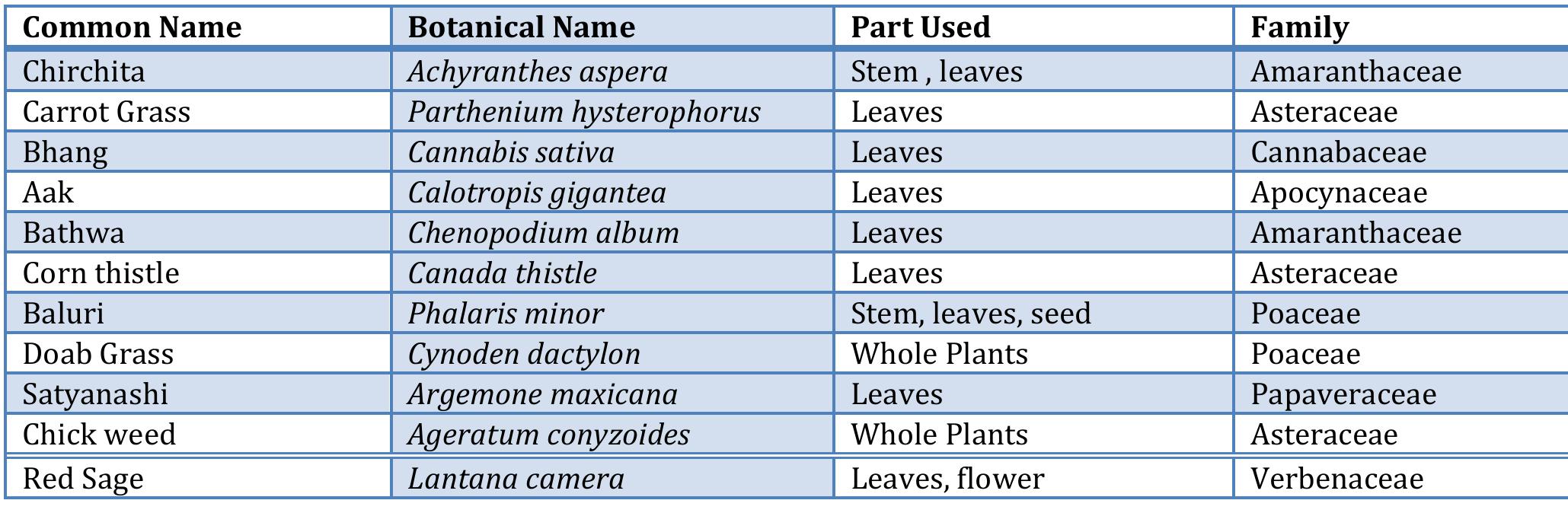
Herbal fungicides are mostly used to control plant disease because of their ecofriendly nature and cost effectiveness. The present investigation focuses on the antifungal activity of some weed extracts viz., Achyranthes aspera, Parthenium hysterophorus, Cannabis sativa, Calotropis gigantean, Chenopodium album, Canada thistle, Phalaris minor, Cynoden dactylon, Argemone maxicana, Ageratum conyzoides, and Lantana camera against seed-borne phytopathogenic fungi causing wilt disease. Out of 11 weed tested, the extracts of Cannabis sativa, Ageratum conyzoides and Argemone maxicana, were found most effective against phytopathogenic fungi, Fusarium oxysporum. The MICs of the extracts were found to be 6.25 X 10⁻⁴, 3.125 X 10⁻⁵ and 3.125 X 10⁻⁵ l/ml against the tested pathogen respectively. On the basis of present results, the methanol extracts of Cannabis sativa, Argemone maxicana, and acetone extract of Ageratum conyzoides, can be used for the development of novel broad spectrum herbal fungicidal formulations after in vivo and field trial. Which is in progress.




![👁 Thus, the extract of Cannabis sativa, and Ageratum conyzoides could be a possible source to obtain new and effective biofungicides to control Fusarium oxysporum caused wilt disease in various crops. Biofungicides are easily biodegradable, selective and locally produced, especially for the farmers who cannot afford expensive synthetics fungicides. By using weed plant species as raw materials for plant derived fungicides, can manage the disease, and at the same time might create economic uses for these unwanted species [30]. Table 3. Minimum inhibitory concentrations of bioactive plant against Fusarium oxysporum. Citation: Pal GK and Kumar B (2013) Antifungal activity of some common weed extracts against wilt causing fungi, Fusarium oxysporum Current Discovery 2(1): 62-67.](https://figures.academia-assets.com/32849197/table_002.jpg)
![👁 AE=Acetone Extract, BE=Benzene Extract, CE=Chloroform extract, EAE=Ethyl Acetate Extract, ME=Methanol extract Table 2. Antifungal screening of weed plant extracts against wilt causing fungi Fusarium oxysporum In the present the solvent extract of Ageratum conyzoides, Cannabis sativa which recorded 84.21% growth inhibition against Fusarium oxysporum, followed by Argemone maxicana 61.84% growth inhibition. Similar findings on antifungal and nature of Cannabis sativa were documented [27]. Ageratum conyzoides, Cannabis sativa, (84.21%) and Argemone maxicana (61.84%) showed a _ broad _ spectrum antifungal activity against wilt causing fungi Fusarium oxysporum. The solvents based extracts of Ageratum conyzoides and Cannabis sativa showed good activity against Fusarium oxysporum at 100 ~ ul/ml concentrations. Our results also showed that the Methanol extract of Argemone maxicana is highly active against Fusarium oxysporum at 100~ ul/ml concentrations. The antimicrobial potency of plants is believed to be due to tannis, saponins, phenolic Compounds, essential oils and flavonoids [28]. The antimicrobial activity of plant oils and extracts has formed the basis of many applications, including raw and _ processed food preservation, pharmaceuticals, alternative medicine and natural therapies [29].](https://figures.academia-assets.com/32849197/table_003.jpg)


