|
VOOZH | about |
|
VOOZH | about |
The ability to solve case studies comes with regular practice. Many a times, if you find yourself failing at thinking like a pro, perhaps, it’s just because you haven’t practiced enough.
To help you become confident, I’ve written multiple case studies in last one month. You can check the recent ones here. If you haven’t solved any of them, I’d suggest you to check them out first.
Dynamic Programming a.k.a Dynamic Optimization isn’t any trick or a mathematical formula which delivers correct answer just by providing the inputs. Rather, it’s a combination of structured thinking & analytical mindset which does the job. The concept is an old one, yet used by just few of us.
In this article, I have explained the art of dynamic programming using a Taxi-Replacement case study. The case study is meant for advanced users. Also, I’ve used R to implement dynamic programming so that, you get some real coding experience as well.
For freshers, I’d recommend checking out the previous case study before trying their hand at this one. And if you truly want to land your first data science role, you can’t go wrong with the ‘Ace Data Science Interviews‘ course. Start your data science journey today!
👁 analytics case studies using dynamic programming
Assume, you’ve decided to start a Taxi Operator firm. In fact, you’ve a meeting scheduled with top investors next week. For which, you need to present your business plan. The focus of your plan should be the amount of revenue expected year on year for next 25 years and your growth strategy.
A critical decision which can set you for success is to consider / estimate the time to change the cars. You know, you can’t operate on a taxi forever. Precisely, a car (taxi) cannot be used for more than 10 years. Also, you are not allowed to buy a used car.
You plan to run 100 cars in total, however doing calculations for a single car will suffice. Here are the assumptions you need to make in this case study :
👁 assumptions1
Cost (INR/Km)
The salvage value is the price of the used car (second hand) at the end of respective year. As you see, the demand of the car decreases as the car grows old. Also, the mileage of the car decreases over the years.
The initial car cost (as of now) is 100,000 INR. As you can see, the value of car depreciates to 0 INR in the 11th year. This is because a car is not allowed to be driven more than 10 years (national rules). In addition, you need to take into account the inflation of values as below :
Let’s get started!
Dynamic programming/Optimization is a method for solving a complex problem by breaking it down into a collection of simpler subproblems, solving each of those subproblems just once, and storing their solutions – ideally, using a memory-based data structure. It is a widely known algorithm in Operation Research.
But today, we will try to use this technique to solve the problem at hand.
Let’s define a simple optimization function for the current problem. We are trying to optimize the profit in the current problem and profit is given as:
Profit(t) = Demand(t) * (Cab Fare(t)-Cost(t)) + Sell of flag * (NewCarCost - SalvageValue(t))
Total Profit = Profit(t) + Profit(t+) +Profit(t-)
Sell of flag is 1 if we decide to sell the car and 0 otherwise. You should notice that all the values in this function are dependent on time. So, from where do we start solving this problem?
From the very last time point. The reason being, at the last time point, we do not have any dependency of future time points. For instance at the last time point (l), we know that
Profit(l) = Demand(l)*(Cab Fare(l)-Cost(l)) + Sell off flag * (NewCarCost - SalvageValue(l))
and,
Profit(l-1,l) = Demand(l-1)*(CabFare(l-1) - Cost(l-1)) + Sell off flag *
(NewCarCost - SalvageValue(l-1)) + Max(Profit(l))
Max(Profit(l)) is the maximum value of Profit(l) for the decision variable “Sell off flag”
So on till..
Total Profit = Max(Profit(l)) + Max(Profit(l-1)) + ......+Max(Profit(1))
We can solve the problem at hand with the following R code :
#Basic Assumptions
> Demand <- c(50000,49000,48000,47000,46000,45000,44000,43000,42000,41000,40000)
> cost <- c(3.1,3.3,3.6,4,4.5,5,5.6,6.3,7,8,9)
> Salvage<-c(1000000,600000,500000,400000,350000,300000,250000,200000,150000,130000,100000,0)
#Inflation rates
> Salvagegrowth <- 1.01
> InitialCostgrowth <- 1.05
> Demandgrowth <- 1.03
> cabfaregrowth <- 1.04
> costinggrowth <- 1.02
#Build the function to do dynamic programming
> findpath <- function(time){
profit_sell <- matrix(0,time + 1,12)
profit_keep <- matrix(0,time + 1,12)
profit_sell[,12] <- -100000000000
profit_keep[,12] <- -100000000000
sell_keep_grid <- matrix("Keep",time + 1,11)
Demand <- Demand*(Demandgrowth)^time
Salvage[1] <- Salvage[1]* (InitialCostgrowth)^time
Salvage[2:11] <- Salvage[2:11]*(Salvagegrowth)^time
cabfare <- 12*(cabfaregrowth)^time
cost <- cost*(costinggrowth)^time
for (i in time:1){
Demand <- Demand/Demandgrowth
Salvage[1] <- Salvage[1]/InitialCostgrowth
Salvage[2:11] <- Salvage[2:11]/Salvagegrowth
cabfare <- cabfare/cabfaregrowth
cost <- cost/costinggrowth
Profit <- Demand*(cabfare - cost)
for (j in 1:11){
profit_sell[i,j] <- max(profit_sell[i+1,2],profit_keep[i+1,2])+ Profit[1] + Salvage[j] - Salvage[1]
profit_keep[i,j] <-max(profit_sell[i+1,j+1],profit_keep[i+1,j+1])+Profit[j]
sell_keep_grid[i,j] <- ifelse(profit_sell[i,j] > profit_keep[i,j],"Sell","Keep")
sell_keep_grid[i,j] <- ifelse(i < j,"N/A",sell_keep_grid[i,j])
}
}
Path <- rep("Keep",time)
num_years <- rep(0,time)
lookat <- 1
for(i in 1:time) {
Path[i] <- sell_keep_grid[i,lookat]
num_years[i] <- lookat
lookat <- ifelse(sell_keep_grid[i,lookat] == "Sell",1,lookat+1)
}
setwd("C:\\Users\\ts93856\\Desktop\\Insurance")
write.csv(profit_sell,"Sell.csv")
write.csv(profit_keep,"keep.csv")
write.csv(sell_keep_grid,"sellkeepgrid.csv")
write.csv(Path,"Path.csv")
print(num_years)
print(Path)
return(Path)
}
findpath(time = 25)
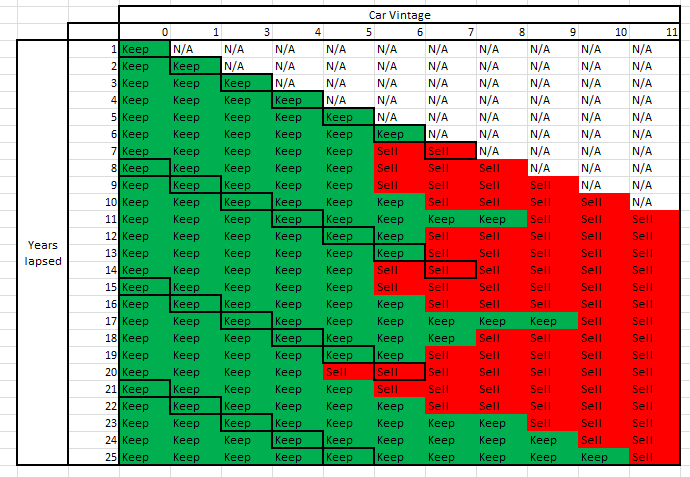
Here is the final output you get for Keep/Sell decision :
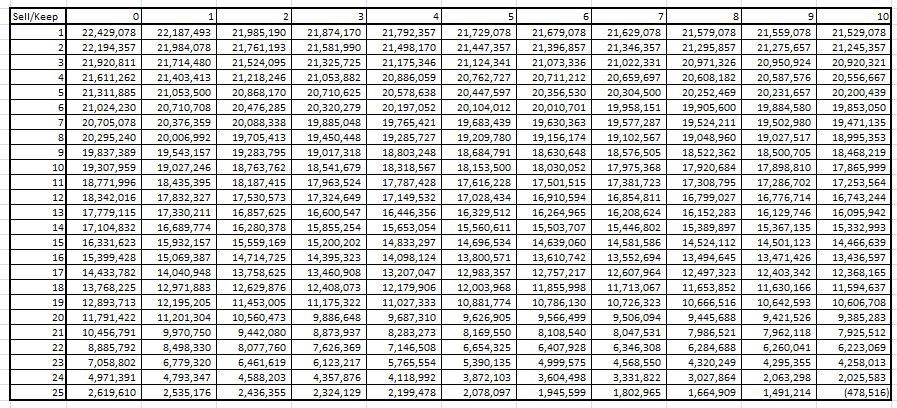
Further, let’s look at the Optimum revenue matrix :
As you can see, the total revenue in 1st cell is INR 22.4 Million which is the maximum profit expected by a single car in 25 years. Hence, the total expected profit by 100 cars will be 100*22.4 Million = INR 2.24 Billion based on our current assumptions.
Let’s try to answer a few more question using the same analysis.
Solved Questions:
There are 4 cycles evident from the first table. So, we need 1 original and 3 replacements for each car requirement. The first car stays for 7 years, 2nd stays for 7 years, 3rd for 6 years and last for 5 years. So, the maximum age of the car here is 7 years.
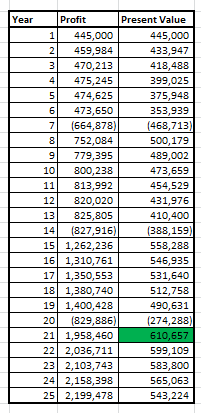
To find the year wise profit in present value, following is the table:
Hence, the maximum profit in present value happens at 21st year.
I have left one of the question for you to practice the concept. This is one of the most powerful tools given by operation research domain to optimize such complex problems. You just saw, it isn’t any difficult to learn. You just need to put a framework around the give problems.
In future articles I will illustrate with more examples of how Dynamic Programming/Optimization is used in different industries. I’d recommend you to practice this technique so that you do well in your next job interview. All the best.
Did you like reading this article ? Do share your experience / suggestions in the comments section below. I’d love to know your
Tavish Srivastava, co-founder and Chief Strategy Officer of Analytics Vidhya, is an IIT Madras graduate and a passionate data-science professional with 8+ years of diverse experience in markets including the US, India and Singapore, domains including Digital Acquisitions, Customer Servicing and Customer Management, and industry including Retail Banking, Credit Cards and Insurance. He is fascinated by the idea of artificial intelligence inspired by human intelligence and enjoys every discussion, theory or even movie related to this idea.
GPT-4 vs. Llama 3.1 – Which Model is Better?
Llama-3.1-Storm-8B: The 8B LLM Powerhouse Surpa...
A Comprehensive Guide to Building Agentic RAG S...
Top 10 Machine Learning Algorithms in 2026
45 Questions to Test a Data Scientist on Basics...
90+ Python Interview Questions and Answers (202...
8 Easy Ways to Access ChatGPT for Free
Prompt Engineering: Definition, Examples, Tips ...
What is LangChain?
What is Retrieval-Augmented Generation (RAG)?
Hi Tavish, Its really nice article to enhance dynamic programming knowledge. I want some guidance to create demand forecasting tool by any of big data analytic tool? like it's approach and implementation for easy accessibility.
very nice article.i could see replacement model concept being used with all other costs involved
Edit
Resend OTP
Resend OTP in 45s