|
VOOZH | about |
|
VOOZH | about |
Cab aggregator is a new business concept in India. Today we have Ola, Uber, Taxi for Sure etc. which not only compete to provide better service to customers but also design more consumer friendly price structures. Gone are the days, when your trip cost only depended on the number of kilometers. Today it depends on a number of factors making it confusing enough to puzzle customers and the drivers. Here are a few charges you might see on your hired taxi’s invoice :
You see ? Undoubtedly, travelling in India has become a lot convenient. But, the companies have found subtle ways to get compensated well. Now, imagine comparing these taxi services with all these components together. Can we make this puzzle easier for Bengaluru, India population ? Let’s crack this puzzle for once and for all.
In this article, we’ll solve a case study of taxi aggregators. Along side, I’ll also focus on the essentials required for solving a case like a pro. Specially, consultant firms like Bain, BCG, McKinsey prefer candidates who think like a pro in solving any case study. Let’s make you one.
Disclaimer: This case is a hypothetical scenario associated with the popular brand names. The intention is to let people relate the importance of this case study in real life. We do not intend to promote / besmirch any brand.
You should also check out the ‘Ace Data Science Interviews‘ course if you’re struggling to land your first data science job! The course has been curated by experts who has conducted hundreds of interviews and includes multiple resources including the most comprehensive interview guide!
Always remember, playing with structured thinking in any case study will put you at the front foot (dominant
👁 success
position). The technique of structured thinking is beneficial in many ways such as:
Now, you have the weapon. The questions are below. Let’s get ready!
If you’ve trembled at the thought of ‘structured thinking’, don’t worry! There are numerous ways using which you can build and improve this skill. It’s easy to build but difficult to master. With time and practice, that can also be achieved. I was terrible at solving case studies until few years back. But, I patiently worked towards it and became better with time.
Here are few useful resources to build structured thinking:
In this case study, the taxi aggregator companies are selected from Indian markets. The currency used to denote travel fare is INR (Indian National Rupee). For people outside India, if you face any difficulty in understanding the severity of the travel fare, simply divide the fare by your currency’s conversion rate to get travel fare in your currency.
There are four categories of taxis:
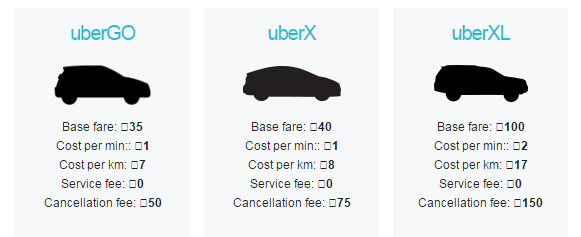
Here are the taxi service providers you need to consider :
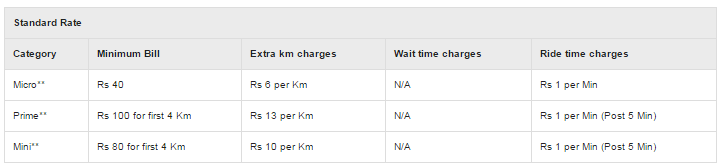
Ola: They have three category for Taxis : 1. Micro , 2. Mini , 3. Prime
In addition to this, minimum fare of Micro is fixed at Rs. 50.
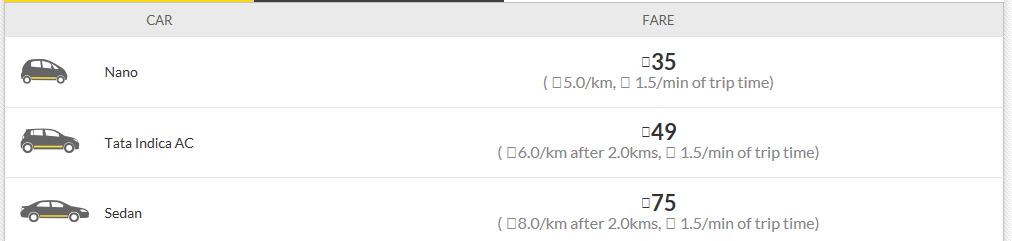
Taxi For Sure: They also have 3 categories of Taxis as shown:
Before you rush to answer section, think!
👁 think
Try to find out your way of solving this case. This phase is known as “approaching the problem”. It requires complete understanding of the problem. Considering the fact that this case has too many numbers, it will be a good practice to check their trend. This will help you to analyze taxis fare much faster.
Using structured thinking, break the problem into 3 sections (one for each taxi class). Now, look for trends within each taxi type. Always keep the questions asked in mind. This gives you an aim to target. Once you start digging for answers, it becomes much easier to know where to stop!
Which of the MICRO vehicles will be cheapest if your distance lies between 1 to 8 kms?
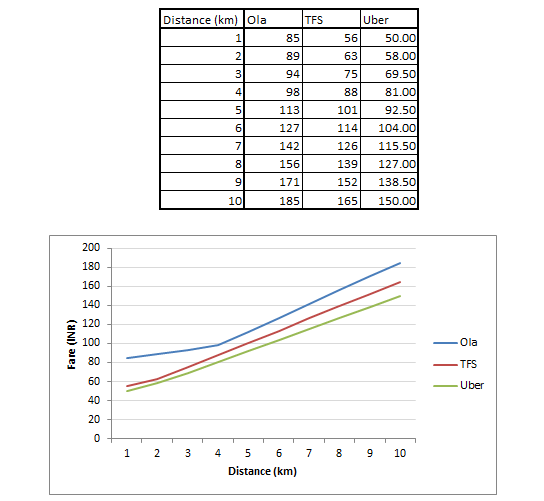
1 . Only Ola and Taxi for sure have the option of taxi type Micro. So, if we compare the two in the given distance range, TFS (Taxi For Sure) starts lower and crosses Ola at 4 km. Beyond 4 km Ola comes out to be cheaper. The answer will be cannot be determined in the distance range.
👁 mini compare
Which MINI vehicles are the cheapest if your distance is between 1 to 10 kms?
2. All the three taxi aggregators have option for Mini taxi. We clearly see that Uber is the cheapest car for the distance range and also seem to be the cheapest option for distances beyond 10 km looking at the trend.
👁 micro compare
If you get a free upgrade from Ola Micro to Mini, will it be cheaper than Uber Mini for distance 2-6 kms?
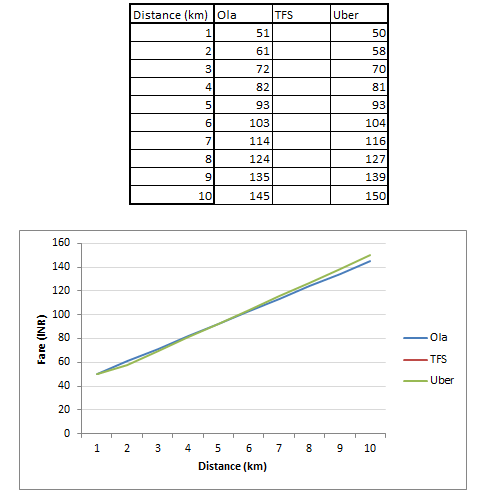
3. Free upgrade is a common scenario in Ola from Micro to Mini. So, this is a very relevant question to ask. The trend looks to be very interesting. Uber Go starts at a slightly lower rate than Ola Micro but Ola takes over after 5 km distance. So, again our answer will be cannot be determined in the distance range. However, it is interesting to notice that a Ola Micro taxi comes out to be more expensive than Uber Mini car for shorter than 5 km distance.
👁 OlamicrovsUbermini
Uber is charging a muliplier of 2.1 and Ola is charging a multiplier of 1.4 on their Sedan Vehicles (Ola Prime vs. UBER X). Which one will cost less ?
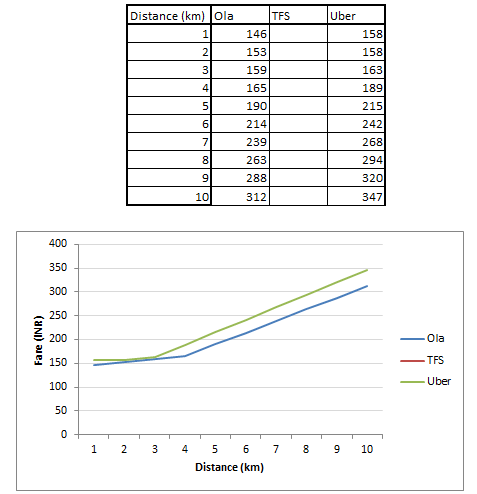
4. Multipliers are often added in peak traffic hours. It becomes very difficult to compare rates in such cases. Here’s one of those scenarios. Ola is generally more expensive compared to Uber, but in such extreme multiplier cases, we see that Ola comes out to be cheaper option throughout.
👁 OlapremvsUberX
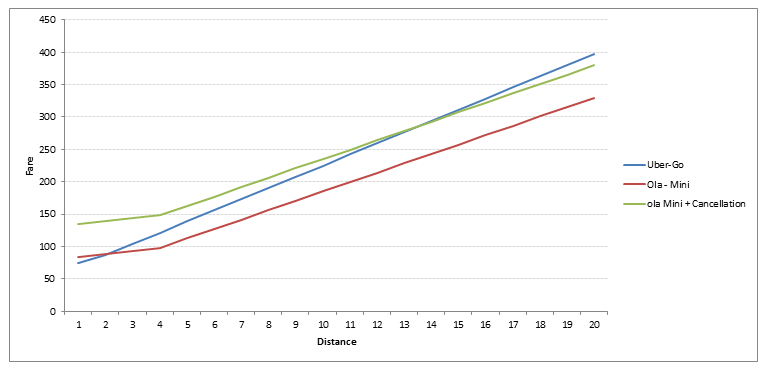
You have already booked UberGo for a multiplier of 1.5 and now you are getting a Ola Mini vehicle without peak charges? The challenge is that if you cancel an Uber you will incur a cancellation charge penalty. However, if you choose to cancel, you stand a chance to save on peak charges for Uber. At what distance will you break even on the cancellation charges on Uber, in case you choose to go ahead with Ola?
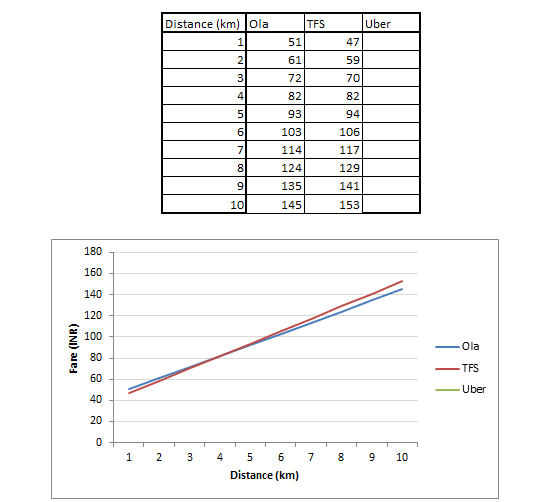
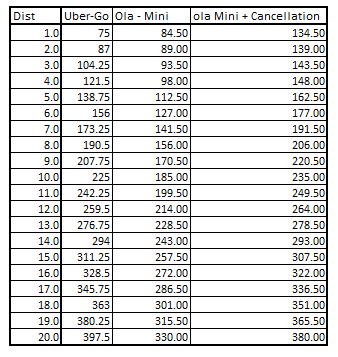
5. What you need to keep in mind is the cancellation charges of UBER. Here is the table for OLA vs. UBER :
As can be seen from both table and the graph, the break even only happens between 13-14 kms. Hence, you should make a switch only if you want to travel more than 13 kms.
This was a fun exercise and hopefully useful for Indian population, who are confused with which cab service to take. You can expect such realistic case study in your interviews which might break many myths you had about the subject. For instance, before doing this analysis, I always assumed OLA Micro is the cheapest available option for all distances. However, looks like UBER Mini can be cheaper than OLA micro for smaller distance.
Did you like reading this article ? Have you encountered any such case studies in your interview? Do share your experience / suggestions in the comments section below.
Tavish Srivastava, co-founder and Chief Strategy Officer of Analytics Vidhya, is an IIT Madras graduate and a passionate data-science professional with 8+ years of diverse experience in markets including the US, India and Singapore, domains including Digital Acquisitions, Customer Servicing and Customer Management, and industry including Retail Banking, Credit Cards and Insurance. He is fascinated by the idea of artificial intelligence inspired by human intelligence and enjoys every discussion, theory or even movie related to this idea.
GPT-4 vs. Llama 3.1 – Which Model is Better?
Llama-3.1-Storm-8B: The 8B LLM Powerhouse Surpa...
A Comprehensive Guide to Building Agentic RAG S...
Top 10 Machine Learning Algorithms in 2026
45 Questions to Test a Data Scientist on Basics...
90+ Python Interview Questions and Answers (202...
8 Easy Ways to Access ChatGPT for Free
Prompt Engineering: Definition, Examples, Tips ...
What is LangChain?
What is Retrieval-Augmented Generation (RAG)?
Hi Tavish, A very interesting case study. I have a small query. In the text it is mentioned that Uber does not have a MINI service.But in the solution part of the article, it is been considered as Uber does not have a micro taxi service but has a mini taxi service available. Which is the correct assumption?? In case Uber has a micro service then UberGo will be a better service compared to Ola or Taxi For Sure.
Uber doesn't have a micro option. Article has been corrected.
Hi Tavish Nice article.I was trying to derive the solution part of question 2 for the Mini for UBER X. There is Minimum KM that can be used to travel with the Minimum fare. I am unable to arrive at the values for uber which you shared in the solution. Can you please help me with that part alone of uber calculation.
This is very simple solution. A better approach should have how these companies analytically reach to a consensus that only these parameters are included in the calculation part. Just a thought. Regards, Shivi
Edit
Resend OTP
Resend OTP in 45s