|
VOOZH | about |
|
VOOZH | about |
This article was published as a part of the Data Science Blogathon
Hello all, In this tutorial, we will cover some Intermediate statistics terms which are very helpful in exploratory data analysis, feature engineering tasks. If you are a beginner, I would like to request you to please look at our previous article Basic Statistics concepts for Machine Learning, which will familiarize you with statistics, its importance, and some basic terms required to understand these intermediate terms.
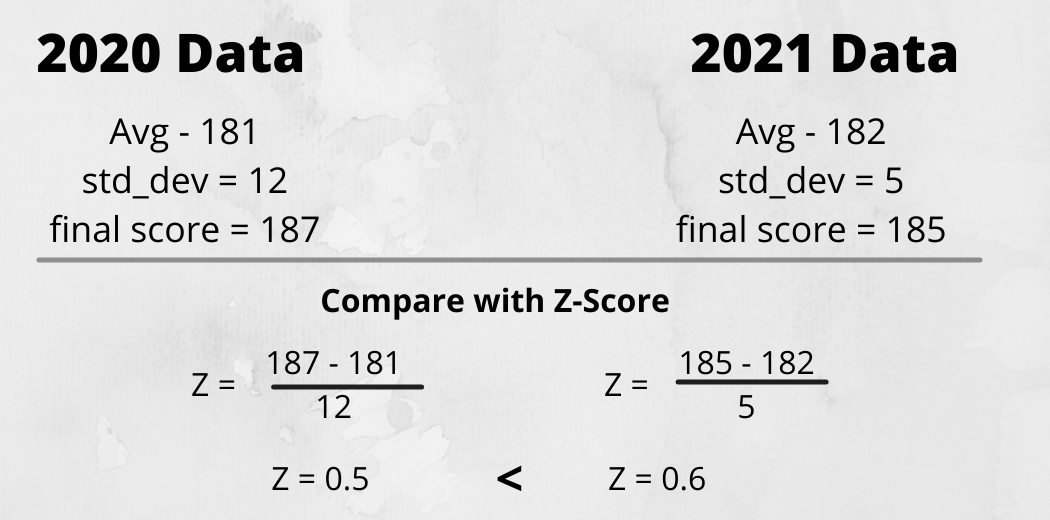
Z-score is a measure that describes a relationship of a particular value with the mean of a group of values. It is measured in terms of standard deviation from the mean. it is computed using the below formula.
z = (x – μ) / σ
Python Code:
import numpy as np
import scipy.stats as stat
arr = np.array([6, 7, 7, 12, 13, 13, 15, 16, 19, 22])
print(stat.zscore(arr, axis=0))
Confidence Interval is a probability that a population parameter will fall between a certain range for a certain proportion of times. In simple words, confidence interval tells the percentage confidence of certain events happening in a particular range. It is one of the important measures in data analysis for proving our assumptions true
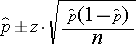
CI = point estimate ± Margin of an error
where the margin of error is basically a standard deviation and point estimate is mean. for calculating confidence interval we calculate point estimate, for example, we need to find 95 per cent confidence so we will assume point estimate as 95 and try to find the quantity of data lie between which range.
How to Compute Confidence Interval using Python
import scipy.stats as stat
np.random.seed(10)
data = np.random.randint(10, 30, 50)
#create 95% confidence interval for population mean weight
conf_interval = stat.norm.interval(alpha=0.95, loc=np.mean(data), scale=stat.sem(data))
print(conf_interval)
The 95 per cent Confidence interval for the true population mean is (18.93, 22.10)
A hypothesis in simple words is an assumption or a guess about something in a world around you. So results can be 2 things like either your guess is correct or incorrect. In data science terms we refer to hypothesis testing as where We try to evaluate 2 mutually exclusive statements on a population using a sample of data.
When we know the actual outcome that the Null Hypothesis is True but due to lack of evidence we failed to prove it and we have to reject it and select an Alternate hypothesis is known as Type-1 error. And in the opposite of it, the same applies to Type-II error, when we have cannot reject the Null hypothesis, there Type-II error is achieved. You can understand it in a better way in form of Confusion Matrix.
P-value is the probability of obtaining results at least as extreme as observed results for the Hypothesis test assuming the Null hypothesis as correct and is performed by knowing the distribution of data. The P-value is also known as significance level and also denoted as alpha. the default value assumed is 5 per cent or 0.05. when P-value is less than 5 per cent, it means we do not have enough evidence to prove the NULL hypothesis as correct and have to reject it. P-value is usually found using a also known as a .
If we have 2 categorical variables then we use the chi-square test.
Chi-square is a very good way to show a relationship between 2 categorical features. Chi-square is a measure that basically tells a difference that exists between your observed counts and the count you would expect if there would no relationship between 2 variables in the population.
Compute P-value for Chi-Square test using Python
stat.chi2.pdf(3.84, 1)
we apply the chi-square transformation and calculated the probability density function which in turn gives P-value.
When we assume continuous feature for Hypothesis testing then the type of test we use is T-test. T-test tells the significant difference between the mean of two groups which may or may not be related to a label. In simple words, the t-test helps us in comparing an average of 2 groups and determine that if they came from the same population or not.
For calculating T-value we require 3 data values. It includes differences between mean values, standard deviation, and several observations.
If we want to perform a test on a more continuous feature then we go with Correlation which we will study in the further part of the article.
Covariance is one of the very important topics when we consider data preprocessing in order. Quantifying the relationship between two random variables is known as Covariance. It is similar to variance, where variance tells how a single variable varies from the mean, covariance helps to know how two variables vary together. Covariance does not represent strength between two variable and only indicate the direction of the linear relationship between them.
Cov(x,y) = SUM [(xi – xm) * (yi – ym)] / (n – 1)
Covariance is an important term that will help you in the data analysis step and also it is used by many machine learning algorithms like Linear Regression.
Compute covariance using Python.
arr = np.array([[2,6,8],[1,5,7],[3,6,9]])
print("covariance: ", np.cov(arr))
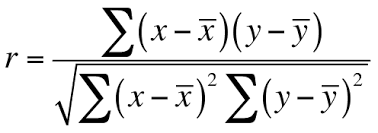
Correlation is a measure used to represent how strongly 2 variables relate to each other. Correlation is the scaled form of covariance. correlation ranges between -1 to +1. If the value of correlation is near +1, it means two variables are highly positively correlated. And in the opposite, its value is near -1 which means two variables are negatively correlated. It basically measures the strength and direction of a linear relationship between two variables.
We also use correlation in and to avoid in data. There are different ways to calculate the correlation coefficient between two variables.
It is the most used technique to find correlation coefficients. Pearson Correlation coefficient is the covariance of two variables divided by-product of their standard deviation. Its range is between -1 to +1 and It is represented by ρ (rho).
we can directly use the method of pandas dataframe to find the Pearson correlation coefficient.
df.corr()
It is a little bit different in both methods. In Spearman rank correlation we trying to find the Pearson correlation of rank of x and rank of y. now, what is the rank of X and Y?
Steps to compute Spearman Correlation coefficient is,
Now you have all the values, substitute values to the equation and you will get a correlation coefficient.
We have covered some of the important statistical concepts which are used in feature engineering, data analysis. I hope that it was easy for you to cope up with every concept. If you have any doubt then please drop it in the comment box below. At this point, our basic and intermediate statistics are completed, and Now in an upcoming article, we will discuss some advanced statistics terms which are mostly used and asked in interviews.
keep learning, happy learning
Raghav Agrawal
I am pursuing my bachelor’s in computer science. I am very fond of Data science and big data. I love to work with data and learn new technologies. Please feel free to connect with me on Linkedin.
If you like my article, please give it a read to others too. link
I am a software Engineer with a keen passion towards data science. I love to learn and explore different data-related techniques and technologies. Writing articles provide me with the skill of research and the ability to make others understand what I learned. I aspire to grow as a prominent data architect through my profession and technical content writing as a passion.
GPT-4 vs. Llama 3.1 – Which Model is Better?
Llama-3.1-Storm-8B: The 8B LLM Powerhouse Surpa...
A Comprehensive Guide to Building Agentic RAG S...
Top 10 Machine Learning Algorithms in 2026
45 Questions to Test a Data Scientist on Basics...
90+ Python Interview Questions and Answers (202...
8 Easy Ways to Access ChatGPT for Free
Prompt Engineering: Definition, Examples, Tips ...
What is LangChain?
What is Retrieval-Augmented Generation (RAG)?
One Question on Spearman Rank Correlation Coefficient? In the article there are steps mentioned to calculate the Spearman Rank Correlation Coefficient, where it says to Sort the Columns(i.e. X & Y) & assign rank to it. But if we sort the columns then the rank will start like 1,2,3...n for both X & Y. Now if we take the difference of the ranks then it is always going to be 0, as we will have the same rank to each data point of both variables. Eg - X = 10,20,30,40,50 & Y = 5,7,9,6,8 So if we sort both variables then data would look like - X = 10(Rank1) ,20(Rank2) ,30(Rank3) ,40(Rank4) ,50(Rank5) Y = 5(Rank1) ,6(Rank2) , 7(Rank3) ,8(Rank4) ,9(Rank5) d = rank of X - Rank of Y = (1-1) + (2-2) + (3-3) + (4-4) + (5-5) = 0 So if we sort the columns, then rank it and then take the rank difference, then its value is always going to zero. Kindly correct me in case i have misunderstood the concept as per the above explanation.
Edit
Resend OTP
Resend OTP in 45s