|
VOOZH | about |
|
VOOZH | about |
This article was published as a part of the Data Science Blogathon.
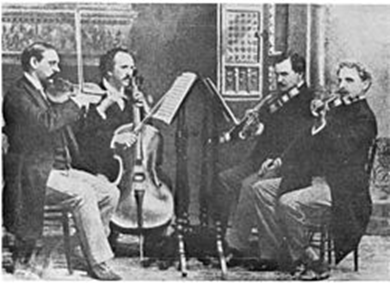
Ensemble – “A group of items viewed as a whole rather than individually.”. In the below picture a group of people who work or perform together, from the same instrument family.
The term is widely used in the musical world and best fit too. Just find the real meaning of Ensemble in the dictionary, you can understand it better.
Now let’s compare this within our Machine Learning world. As a group of people in orchestra are performing the synchronize and giving best performance out of them, likewise ensemble methods are techniques, that create multiple models and then combine them to produce an improved version of results for our model. It helps us to produces more quality and accurate solutions than a single model.
Ensemble Learning: is a group of predictors that are trained and used for predictions in ML
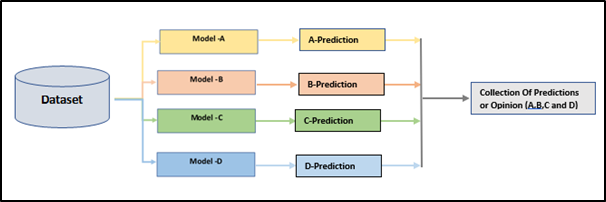
A simple representation of this technique is below.
Here a models A, B, C, and D could be anyone of the following Machining Learning algorithm as we are familiar with Logistic Regression, Decision Tree, Random Forest, SVM, etc. It makes sense to us that a group of learners (weak) comes together and to form a stronger community learner, as a result of increasing the accuracy of any Machine Learning model.
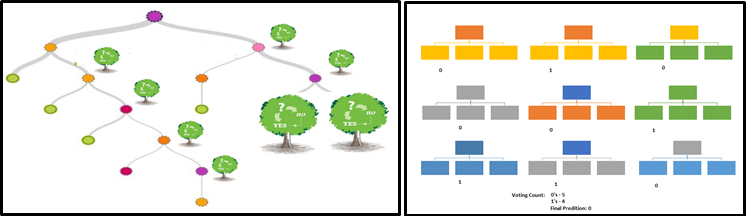
A quick flashback, hopes you all know the concept behind the Random Forest model. I mean arriving at the predictions of all individual trees of the decision tree model, taking votes from this group, and predicting the class. This is one way of the ensemble, through the decision tree model and so-called Random Forest.
A strong recommendation for Ensemble Learning as follows, If the predictors are independent, we could train them using a series of different algorithms. So, this approach would increase the chances of different types of errors, improving accuracy.
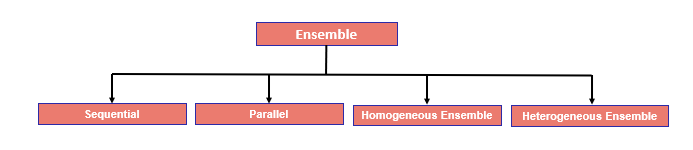
Let’s discuss the available Ensemble Learning. Before that let see high-level categories as a SEQUENTIAL and PARALLEL ensemble.
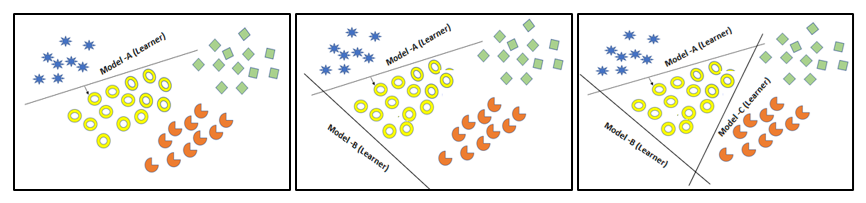
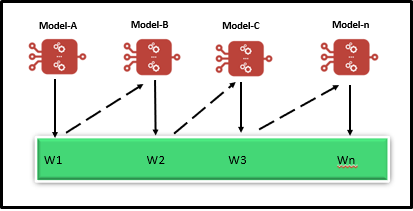
SEQUENTIAL ENSEMBLE TECHNIQUES: Sequentially generate the base learners as shown in the below diagram. In this sequential generation, the base learners are encouraging the dependency between the base learners. End of the day the performance of the model is then improved by assigning higher weights to previously misstated learners in the group.
PARALLEL ENSEMBLE TECHNIQUES: In which the base learners are generated in parallel as like in Random Forest, as we know that the collection of decision tree makes random forest with base learners to encourage independence between the other base learners. here the error can be reduced dramatically by averaging.
One step ahead, we can classify ensemble as HOMOGENEOUS and HETEROGENEOUS ENSEMBLE based on the building the model
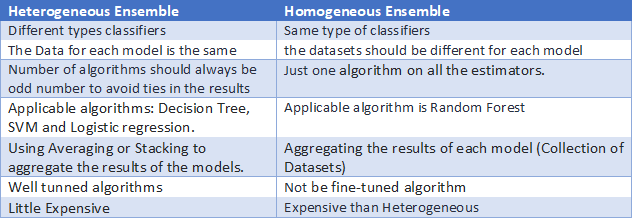
HOMOGENEOUS ENSEMBLE is a collection of classifiers of the same type, built upon a different subset of data as we use to do in the Random Forest model.
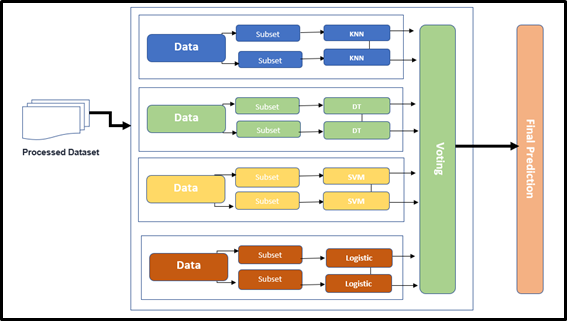
HETEROGENEOUS ENSEMBLE is a set of classifiers of different types, built upon the same data.
So far, we have discussed different category
Now, will move on to types in details,
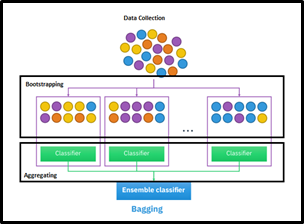
Bagging: Which reduces the variance to a large extent level and eventually increases accuracy. So, it is eliminating overfitting, which was a big challenge in many predictive models. This is often considered as a homogeneous weak learner and learns them independently from each other in parallel and combines them following by averaging process
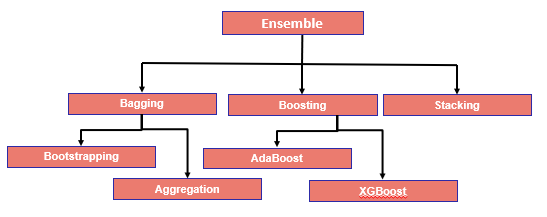
Further classified into two types as Bootstrapping and Aggregation.
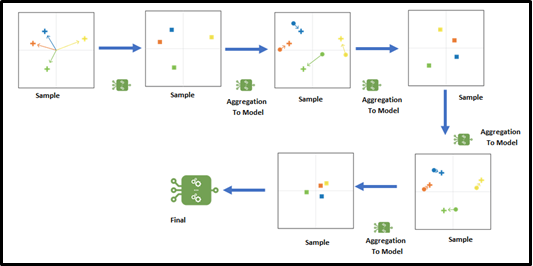
Bootstrapping is a sampling-based technique, where the samples are derived from the whole population using the replacement procedure. This replacement method helps make the selection procedure randomized. The base learning algorithm is run on the samples to complete the procedure.
Aggregation is based on the probability bootstrapping procedures (Shown in the above diagram) or based on all outcomes of the predictive models.
Boosting: Most widely used Ensemble method and powerful. Actually, speaking this was designed for classification problems and further extended to regression problem statement too. This is basically a combination of 3+ weak algorithms (learners) to generate a strong learner.
Available Boosting algorithms are AdaBoost, Gradient Boosting Machine (GBM), XGBoost, and Light GBM
The situation for Boosting, Let’s have a situation that first model predicted erroneous and followed by the second model as well predicted inaccurate, then will analyze these results by combining and extract the better prediction. This is nothing but Boosting overall results. Hence Boosting proves the ensemble core concepts as combining a weak learner into a stronger one.
Stacking [Stacked generalization]: Stacking is based on the normal way of training a model and perform the aggregation, as we have shown in the diagram – HETEROGENEOUS ENSEMBLE. In which we have two layers one is called the Base-model and Meta-model. The base-level models are trained based on a complete training set, then the meta-model is trained on the outputs of the base-level model, like features.
Since the base level often consists of different learning algorithms and therefore stacking ensembles are often called heterogeneous.
So, we understood different types of Ensemble Techniques!
Here the overall takeaway for you all,
Guys! Thanks for reading this article will discuss more in the upcoming blogs!
The media shown in this article are not owned by Analytics Vidhya and is used at the Author’s discretion.
Shanthababu Pandian has over 23 years of IT experience, specializing in data architecting, engineering, analytics, DQ&G, data science, ML, and Gen AI. He holds a BE in electronics and communication engineering and three Master’s degrees (M.Tech, MBA, M.S.) from a prestigious Indian university. He has completed postgraduate programs in AIML from the University of Texas and data science from IIT Guwahati. He is a director of data and AI in London, UK, leading data-driven transformation programs focusing on team building and nurturing AIML and Gen AI. He helps global clients achieve business value through scalable data engineering and AI technologies. He is also a national and international speaker, author, technical reviewer, and blogger.
GPT-4 vs. Llama 3.1 – Which Model is Better?
Llama-3.1-Storm-8B: The 8B LLM Powerhouse Surpa...
A Comprehensive Guide to Building Agentic RAG S...
Top 10 Machine Learning Algorithms in 2026
45 Questions to Test a Data Scientist on Basics...
90+ Python Interview Questions and Answers (202...
8 Easy Ways to Access ChatGPT for Free
Prompt Engineering: Definition, Examples, Tips ...
What is LangChain?
What is Retrieval-Augmented Generation (RAG)?
Edit
Resend OTP
Resend OTP in 45s