|
VOOZH | about |
|
VOOZH | about |
This article was published as a part of the Data Science Blogathon
In Machine learning or Deep Learning, some of the models such as Linear Regression, Logistic Regression, Artificial Neural Networks assume that features are normally distributed and can perform much better if the features provided to them during modeling are normally distributed.
But the data provided to us does not necessarily follow a normal distribution. So what should we do in such cases? That’s what we are going to cover in this article.
In probability theory, a normal (or Gaussian) distribution is a type of continuous probability distribution for a real-valued random variable. The general form of its probability density function is
👁 Gaussian Distribution
Samples of the Gaussian Distribution follow a bell-shaped curve and lies around the mean. The mean, median, and mode of Gaussian Distribution are the same.
To read more about Normal/Gaussian Distribution in detail, refer to the attached article.
There are various ways in which we can check the distribution of the variables. Some of them are:
We will see all the above-mentioned methods with the help of a dataset. For this, we will use a subset of Car price dataset where categorical variables will be excluded for now and will check the distributions on numerical variables.
Python Code:
#importing library
import pandas as pd
#reading the dataset
cp = pd.read_csv('CarPrice_Assignment.csv')
#taking the subset of the data
cp=cp[['symboling','wheelbase','carlength','carwidth','carheight','curbweight','boreratio','stroke','compressionratio','horsepower','peakrpm','citympg','highwaympg','price']]
#printing first five rows of the data
print(cp.head())#skewness in the data cp.skew()
Output:
cp.horsepower.hist()
plt.title('Distribution of horsepower');
Output: Highly positive Skewed i.e does not follow a normal distribution
cp.stroke.hist()
plt.title('Distribution of stroke');
Output: Moderately negatively Skewed i.e does not follow a normal distribution
cp.highwaympg.hist()
plt.title('Distribution of highway mpg');
Output: Symmetric i.e does follow a normal distribution
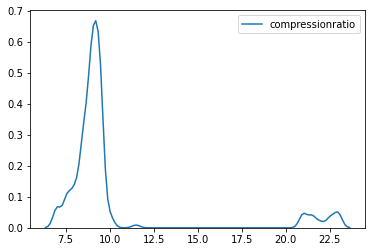
sns.kdeplot(cp.compressionratio);
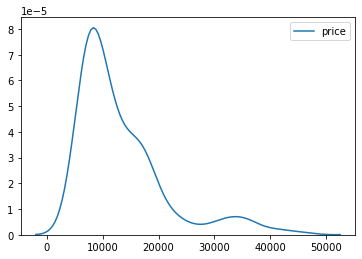
sns.kdeplot(cp.price);
The distribution of both the variables compression ratio and the price is highly positively skewed and is not normally distributed.
A Q-Q plot is a scatterplot created by plotting two sets of quantiles against one another. If both sets of quantiles came from the same distribution, we should see the points forming a roughly straight line.
That is, if the data falls in a straight line then the variable follows normal distribution otherwise not.
#importing necessary libraries
import scipy.stats as stats
import pylab
From the Skewness and KDE plots, we have seen that the price variable is highly positively skewed. Let’s plot the Q-Q plot for the Price variable and check.
stats.probplot(cp.price,plot=pylab);
The X-axis of the above plot has Quantiles values and Y-axis has the price values. From the plot, we can analyze that the data points of the price feature are not falling on a straight line. This implies that it does not follow a normal distribution.
Let’s check for the city mpg feature now. The graph shows that the majority of the data points of city mpg fall on the straight line so the distribution is normal.
stats.probplot(cp.citympg,plot=pylab);
Till now we have seen how to check the distribution of the feature. This section will learn how to convert the variables into the normal distribution if they are not following it.
For this purpose, we will work on a single feature first and will see which transformation out of all works the best to convert the feature into a normal distribution.
First of all, defining a function in python which will take data and feature name as inputs and return the KDE plot and Q-Q plot of the feature.
#function to return plots for the feature
def normality(data,feature):
 plt.figure(figsize=(10,5))
 plt.subplot(1,2,1)
 sns.kdeplot(data[feature])
 plt.subplot(1,2,2)
 stats.probplot(data[feature],plot=pylab)
 plt.show()
Plotting for the Price feature using the above-defined function:
normality(cp,’price’)
#performing logarithmic transformation on the feature
cp['price_log']=np.log(cp['price'])
#plotting to check the transformation
normality(cp,'price_log')
The distribution changed slightly and looks moderately skewed now. More data points are also falling on the line in the Q-Q plot.
cp['price_reciprocal']=1/cp.price
normality(cp,'price_reciprocal')
The Reciprocal Transformation has kind of converted the feature to normal distribution. Most of the data points are also falling on the line in the Q-Q plot. This one is better than the log transformation for the Price feature.
cp['price_sqroot']=np.sqrt(cp.price)
normality(cp,'price_sqroot')
This one has reduced the skewness of the feature but has not transformed it into a normal distribution.
cp['price_exponential']=cp.price**(1/1.2)
normality(cp,'price_exponential')
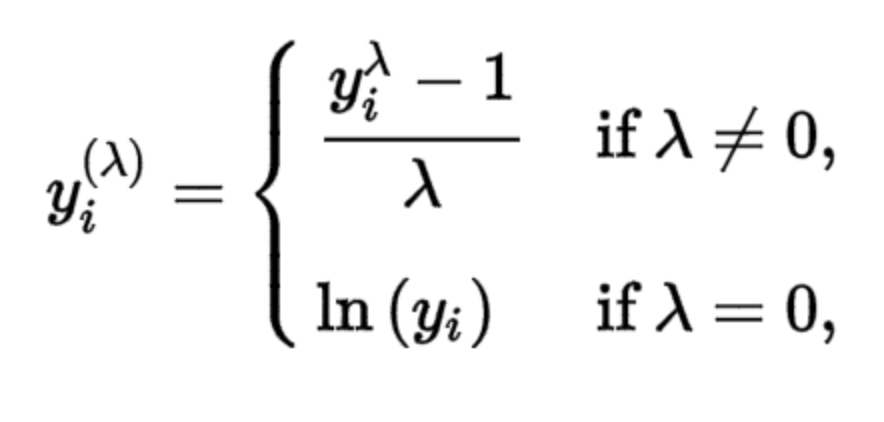
where y is the response variable and λ is the transformation parameter. λ value varies from -5 to 5. During the transformation, all values of λ are considered and the optimal/best value for the variable is selected. log(y) is only applied when λ=0.
cp['price_Boxcox'],parameters=stats.boxcox(cp['price'])
normality(cp,'price_Boxcox')
Box cox transformation technique also gives a good result and normally distributes the Price feature. The data points on the Q-Q plot are almost on the line as well.
From all the transformations discussed above, we can conclude that the Box cox and Reciprocal transformation perform the best on the Price variable and transform it to normal distribution. Any one of the two can be used but as Box cox is more logic-based and involves the λ variable which is chosen as per the best skewness for the data so Box cox will be a better transformation to go with.
I am Deepanshi Dhingra currently working as a Data Science Researcher, and possess knowledge of Analytics, Exploratory Data Analysis, Machine Learning, and Deep Learning. Feel free to content with me on LinkedIn for any feedback and suggestions.
xThe media shown in this article are not owned by Analytics Vidhya and is used at the Author’s discretion.
GPT-4 vs. Llama 3.1 – Which Model is Better?
Llama-3.1-Storm-8B: The 8B LLM Powerhouse Surpa...
A Comprehensive Guide to Building Agentic RAG S...
Top 10 Machine Learning Algorithms in 2026
45 Questions to Test a Data Scientist on Basics...
90+ Python Interview Questions and Answers (202...
8 Easy Ways to Access ChatGPT for Free
Prompt Engineering: Definition, Examples, Tips ...
What is LangChain?
What is Retrieval-Augmented Generation (RAG)?
Is there a way to implement skew normal distribution just like the above transformations without using scipy.stats library.
Edit
Resend OTP
Resend OTP in 45s
.png)
.png)
.png)
.png)
.png)
.png)
.png)
.png)
.png)
.png)
.png)
.png)