|
VOOZH | about |
|
VOOZH | about |
Put this down as one of the most common questions you’ll hear from Python newcomers and data science aspirants. There is a high probability you’ll encounter this question in a data scientist or data analyst interview.
Honestly, even I was confused initially when I started learning Python a few years back. But don’t worry! loc vs. iloc in Pandas might be a tricky question – but the answer is quite simple once you get the hang of it.
And that’s what I aim to help you achieve in this article. We will rely on Pandas, the most popular Python library, to answer the loc vs. iloc question.
The Pandas library contains multiple methods for convenient data filtering – loc and iloc among them. Using these, we can do practically any data selection task on Pandas dataframes.
Do check out our two popular Python courses if you’re new to Python programming. They’re free and a great first step in your machine learning journey:
Right, let’s dive in!
So, what is loc and iloc in the first place? We need to answer this question before we can understand where to use each of these Pandas functions in Python.
loc is label-based, which means that we have to specify the name of the rows and columns that we need to filter out.
For example, let’s say we search for the rows whose index is 1, 2 or 100. We will not get the first, second or the hundredth row here. Instead, we will get the results only if the name of any index is 1, 2 or 100.
So, we can filter the data using the loc function in Pandas even if the indices are not an integer in our dataset.
On the other hand, iloc is integer index-based. So here, we have to specify rows and columns by their integer index.
Let’s say we search for the rows with index 1, 2 or 100. It will return the first, second and hundredth row, regardless of the name or labels we have in the index in our dataset.
We will see multiple examples in this article on how to use loc and iloc for the data selection and data update process in Python.
Time to fire up your Jupyter notebook! We’ll dive straight into the code and understand how and where to use loc vs. iloc in Python.
First, we need a dataset to apply loc and iloc, right? Let’s do that.
We will create a sample student dataset consisting of 5 columns – age, section, city, gender, and favorite color. This dataset will contain both numerical as well as categorical variables:
Python Code:
# importing pandas and numpy
import pandas as pd
import numpy as np

# crete a sample dataframe
data = pd.DataFrame({
 'age' : [ 10, 22, 13, 21, 12, 11, 17],
 'section' : [ 'A', 'B', 'C', 'B', 'B', 'A', 'A'],
 'city' : [ 'Gurgaon', 'Delhi', 'Mumbai', 'Delhi', 'Mumbai', 'Delhi', 'Mumbai'],
 'gender' : [ 'M', 'F', 'F', 'M', 'M', 'M', 'F'],
 'favourite_color' : [ 'red', np.NAN, 'yellow', np.NAN, 'black', 'green', 'red']
})

# view the data
print(data)One thing we use almost always when we’re exploring a dataset – filtering the data based on a given condition. For example, we might need to find all the rows in our dataset where age is more than x years, or the city is Delhi, and so on.
We can solve types of queries with a simple line of code using pandas.DataFrame.loc[]. We just need to pass the condition within the loc statement.
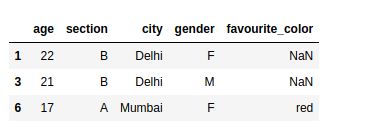
Let’s try to find the rows where the value of age is greater than or equal to 15:
Try out the above code in the live coding window below!!
# importing pandas and numpy
import pandas as pd
import numpy as np

# crete a sample dataframe
data = pd.DataFrame({
 'age' : [ 10, 22, 13, 21, 12, 11, 17],
 'section' : [ 'A', 'B', 'C', 'B', 'B', 'A', 'A'],
 'city' : [ 'Gurgaon', 'Delhi', 'Mumbai', 'Delhi', 'Mumbai', 'Delhi', 'Mumbai'],
 'gender' : [ 'M', 'F', 'F', 'M', 'M', 'M', 'F'],
 'favourite_color' : [ 'red', np.NAN, 'yellow', np.NAN, 'black', 'green', 'red']
})

# view the data
print("Data: \n\n")
print(data)


# select all rows with a condition
print("\n\nData with age greater than 15\n\n")
print(data.loc[data.age >= 15])Similarly, we can also use multiple conditions to filter our data, such as finding all the rows where the age is greater than or equal to 12 and the gender is also male:
Using loc, we can also slice the Pandas dataframe over a range of indices. If the indices are not in the sorted order, it will select only the rows with index 1 and 3 (as you’ll see in the below example). And if the indices are not numbers, then we cannot slice our dataframe.
In that case, we need to use the iloc function to slice our Pandas dataframe.
We can also select the columns that are required of the rows that satisfy our condition.
For example, if our dataset contains hundreds of columns and we want to view only a few of them, then we can add a list of columns after the condition within the loc statement itself:
This is one of my favorite hacks in Python Pandas!
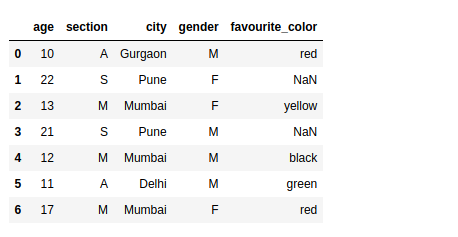
We often have to update values in our dataset based on a certain condition. For example, if the values in age are greater than equal to 12, then we want to update the values of the column section to be “M”.
We can do this by running a for loop as well but if our dataset is big in size, then it would take forever to complete the task. Using loc in Pandas, we can do this within seconds, even on bigger datasets!
We just need to specify the condition followed by the target column and then assign the value with which we want to update:
If we want to update multiple columns with different values, then we can use the below syntax.
In this example, if the value in the column age is greater than 20, then the loc function will update the values in the column section with “S” and the values in the column city with Pune:
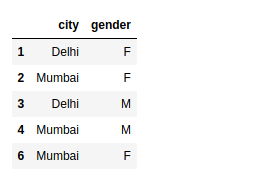
When we are using iloc, we need to specify the rows and columns by their integer index. If we want to select only the first and third row, we simply need to put this into a list in the iloc statement with our dataframe:
Earlier, we selected a few columns from the dataset using the loc function. We can do this using the iloc function. Keep in mind that we need to provide the index number of the column instead of the column name:
We can slice a dataframe using iloc as well. We need to provide the start_index and end_index+1 to slice a given dataframe. If the indices are not the sorted numbers even then it will select the starting_index row number up to the end_index:
Slice the data frame over both rows and columns. In the below example, we selected the rows from (1-2) and columns from (2-3).
loc and iloc are two super useful functions in Pandas that I’ve come to rely on a lot. I’m sure you’ll be using them as well in your machine learning journey. And if you’re an R user switching to Python, I’m sure you’ll find loc and iloc quite intuitive.
I highly recommend taking our Python for Data Science and Pandas for Data Analysis in Python courses if you’re new to Python programming. They’re free and a great first step in your machine learning journey.
In Summary, Learning to use loc and iloc in Pandas is like having superpowers for picking and working with data in Python. loc is about using names, while iloc is about using numbers. We’ve seen practical examples of how to filter, update, and handle data, making Pandas a powerful tool for data manipulation.
The ILOC operator in Python is used to select and access data in a DataFrame by its integer position, allowing you to grab specific rows or columns using numerical indices.
ILOC [: :- 1] is a Python code that reverses the selection order. It’s used with the ILOC operator to fetch data in the reverse order from the last item to the first.
Ideas have always excited me. The fact that we could dream of something and bring it to reality fascinates me. Computer Science provides me a window to do exactly that. I love programming and use it to solve problems and a beginner in the field of Data Science.
GPT-4 vs. Llama 3.1 – Which Model is Better?
Llama-3.1-Storm-8B: The 8B LLM Powerhouse Surpa...
A Comprehensive Guide to Building Agentic RAG S...
Top 10 Machine Learning Algorithms in 2026
45 Questions to Test a Data Scientist on Basics...
90+ Python Interview Questions and Answers (202...
8 Easy Ways to Access ChatGPT for Free
Prompt Engineering: Definition, Examples, Tips ...
What is LangChain?
What is Retrieval-Augmented Generation (RAG)?
Well you are trying to explain the difference between the loc and iloc without a single line of code or example? Theoretical knowledge is not very useful in absence of any example. It would be helpful for the newbies if you explain with simple line of code as example
Hi Ved, I have put plenty of examples in this article. If you are still not able to see it. Please let me know.
The code for below topics won't update the values it simply brings the data . Please correct the code > Update the values of a particular column on selected rows > Update the values of multiple columns on selected rows
Edit
Resend OTP
Resend OTP in 45s