|
VOOZH | about |
|
VOOZH | about |
While working on Agentic AI, developers often find themselves navigating the trade-offs between speed, flexibility, and resource efficiency. I have been exploring the Agentic AI framework and came across Agno (earlier it was Phi-data). Agno is a lightweight framework for building multi-modal Agents. They are claiming to be ~10,000x faster than LangGraph and ~50x less memory than LangGraph. Sound intriguing right?
Agno and LangGraph—offer very different experiences. After going hands-on with Agno and comparing its performance and architecture to LangGraph, here’s a breakdown of how they differ, where each one shines, and what Agno brings to the table.
TL;DR
Agno is designed with a laser focus on performance and minimalism. At its core, Agno is an open-source, model-agnostic agent framework built for multimodal tasks—meaning it handles text, images, audio, and video natively. What makes it unique is how light and fast it is under the hood, even when orchestrating large numbers of agents with added complexity like memory, tools, and vector stores.
Key strengths that stand out:
Using Agno feels refreshingly efficient. You can spin up entire fleets of agents that not only operate in parallel but also share memory, tools, and knowledge bases. These agents can be specialized and grouped into multi-agent teams, and the memory layer supports storing sessions and states in a persistent database.
What’s really impressive is how Agno manages complexity without sacrificing performance. It handles real-world agent orchestration—like tool chaining, RAG-based retrieval, or structured output generation—without becoming a performance bottleneck.
If you’ve worked with LangGraph or similar frameworks, you’ll immediately notice the startup lag and resource consumption that Agno avoids. This becomes a critical differentiator at scale. Let’s build the TriSage Agent.
!pip install -U agno
!pip install duckduckgo-search
!pip install openai
!pip install pycountry
These are shell commands to install the required Python packages:
from agno.agent import Agent
from agno.models.openai import OpenAIChat
from agno.tools.duckduckgo import DuckDuckGoTools
from agno.tools.googlesearch import GoogleSearchTools
from agno.tools.dalle import DalleTools
from agno.team import Team
from textwrap import dedentfrom getpass import getpass
OPENAI_KEY = getpass('Enter Open AI API Key: ')
import os
os.environ['OPENAI_API_KEY'] = OPENAI_KEYagno framework can pick it up when calling OpenAI’s API.web_agent = Agent(
name="Web Agent",
role="Search the web for information on Eiffel tower",
model=OpenAIChat(id="o3-mini"),
tools=[DuckDuckGoTools()],
instructions="Give historical information",
show_tool_calls=True,
markdown=True,
)
writer_agent = Agent(
name="Writer Agent",
role="Write comprehensive article on the provided topic",
model=OpenAIChat(id="o3-mini"),
tools=[GoogleSearchTools()],
instructions="Use outlines to write articles",
show_tool_calls=True,
markdown=True,
)
image_agent = Agent(
model=OpenAIChat(id="gpt-4o"),
tools=[DalleTools()],
description=dedent("""\
You are an experienced AI artist with expertise in various artistic styles,
from photorealism to abstract art. You have a deep understanding of composition,
color theory, and visual storytelling.\
"""),
instructions=dedent("""\
As an AI artist, follow these guidelines:
1. Analyze the user's request carefully to understand the desired style and mood
2. Before generating, enhance the prompt with artistic details like lighting, perspective, and atmosphere
3. Use the `create_image` tool with detailed, well-crafted prompts
4. Provide a brief explanation of the artistic choices made
5. If the request is unclear, ask for clarification about style preferences
Always aim to create visually striking and meaningful images that capture the user's vision!\
"""),
markdown=True,
show_tool_calls=True,
)agent_team = Agent(
team=[web_agent, writer_agent, image_agent],
model=OpenAIChat(id="gpt-4o"),
instructions=["Give historical information", "Use outlines to write articles","Generate Image"],
show_tool_calls=True,
markdown=True,
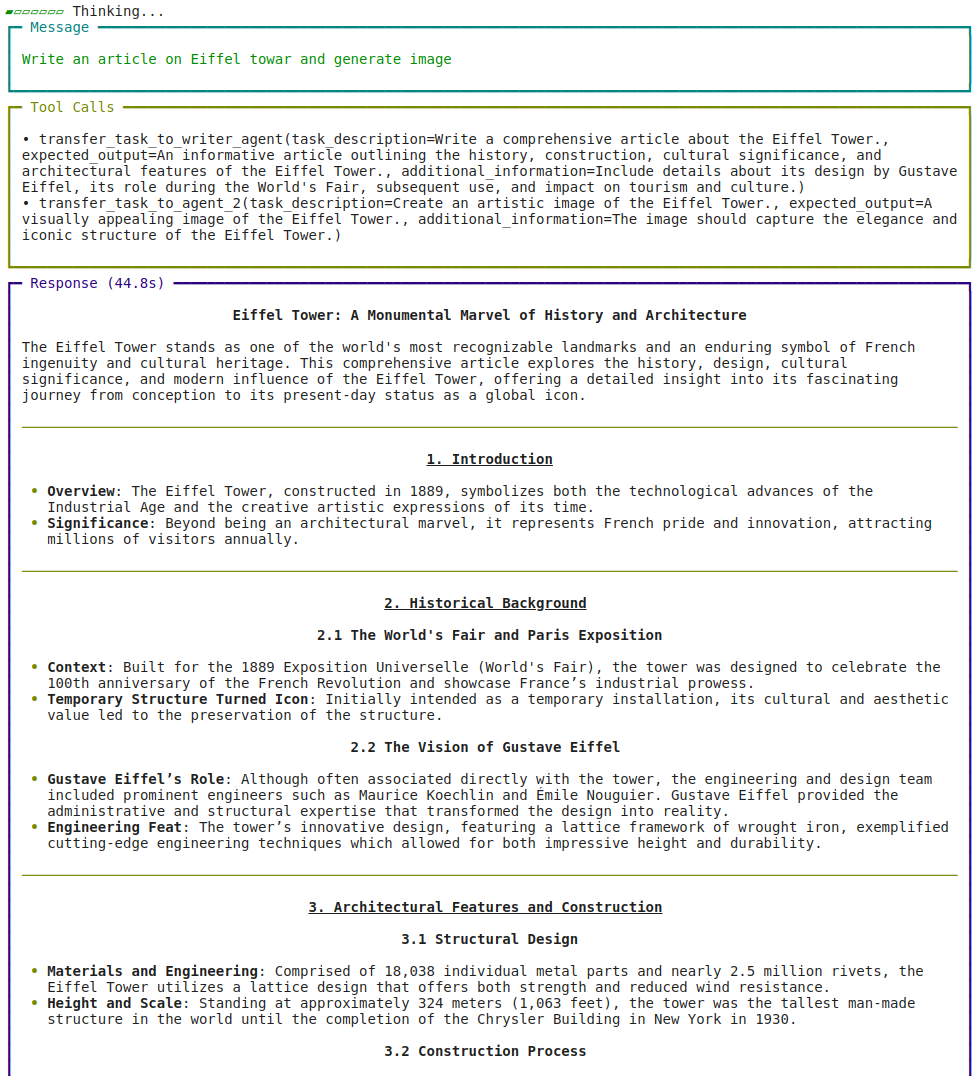
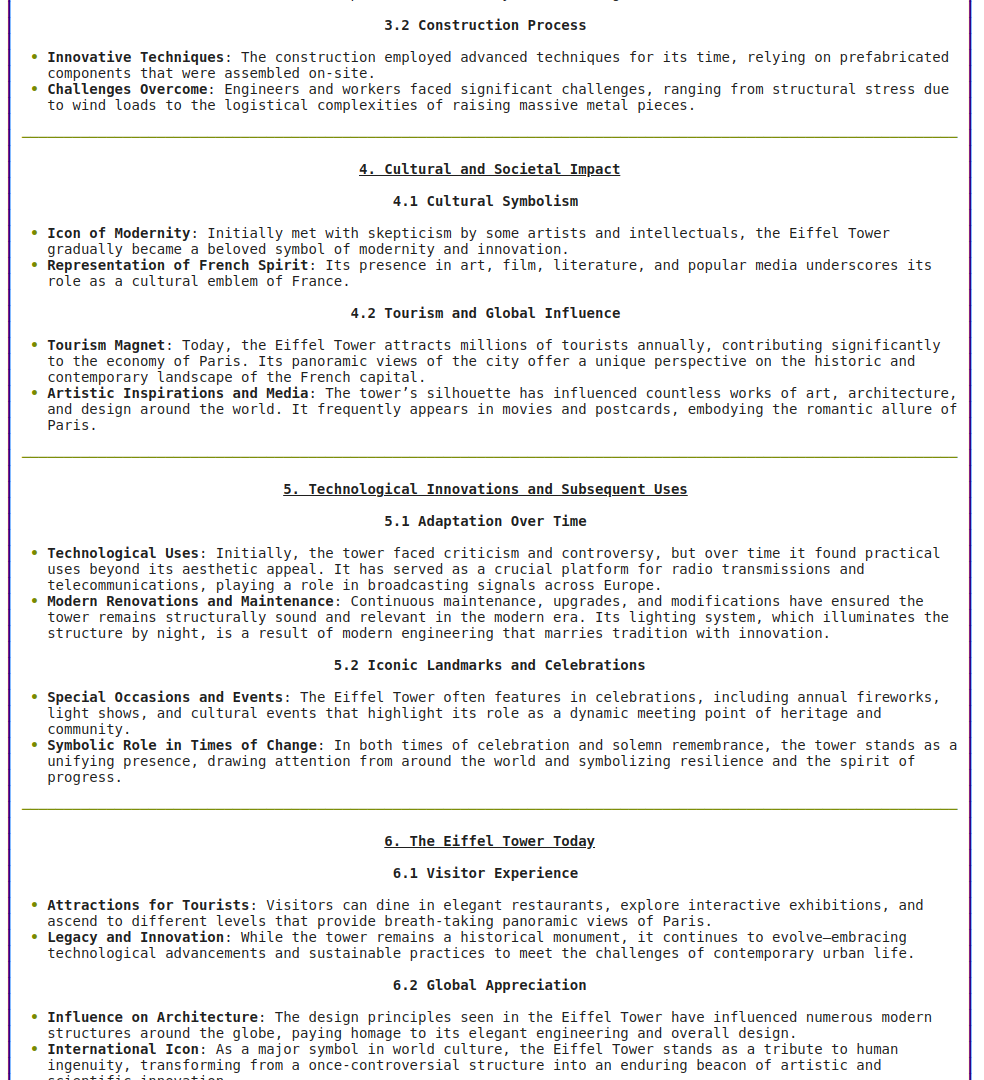
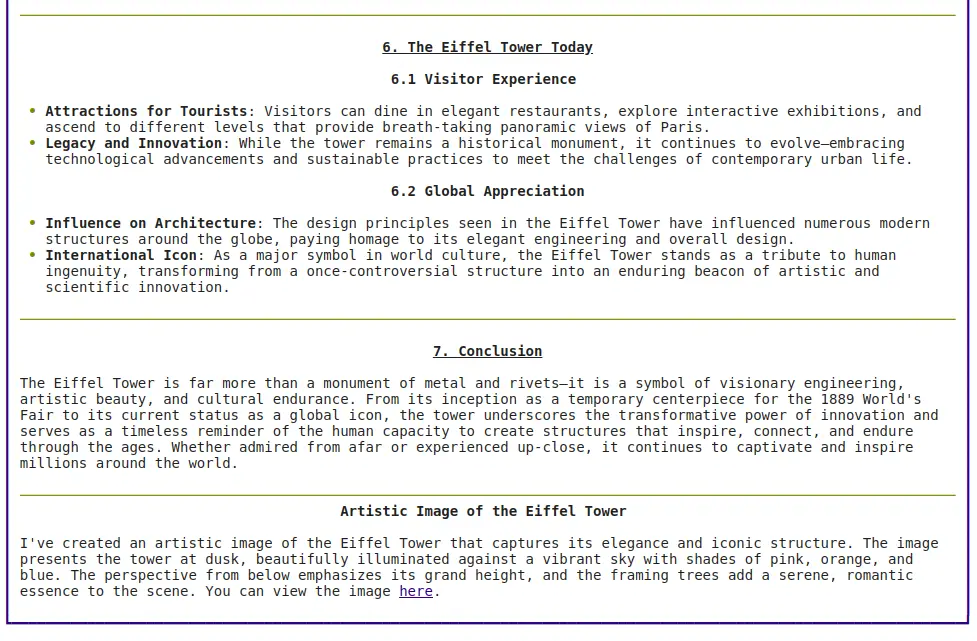
)agent_team.print_response("Write an article on Eiffel towar and generate image", stream=True)I have created a realistic image of the Eiffel Tower. The image captures the
tower's full height and design, ┃
┃ beautifully highlighted by the late afternoon sun. You can view it by
clicking here.
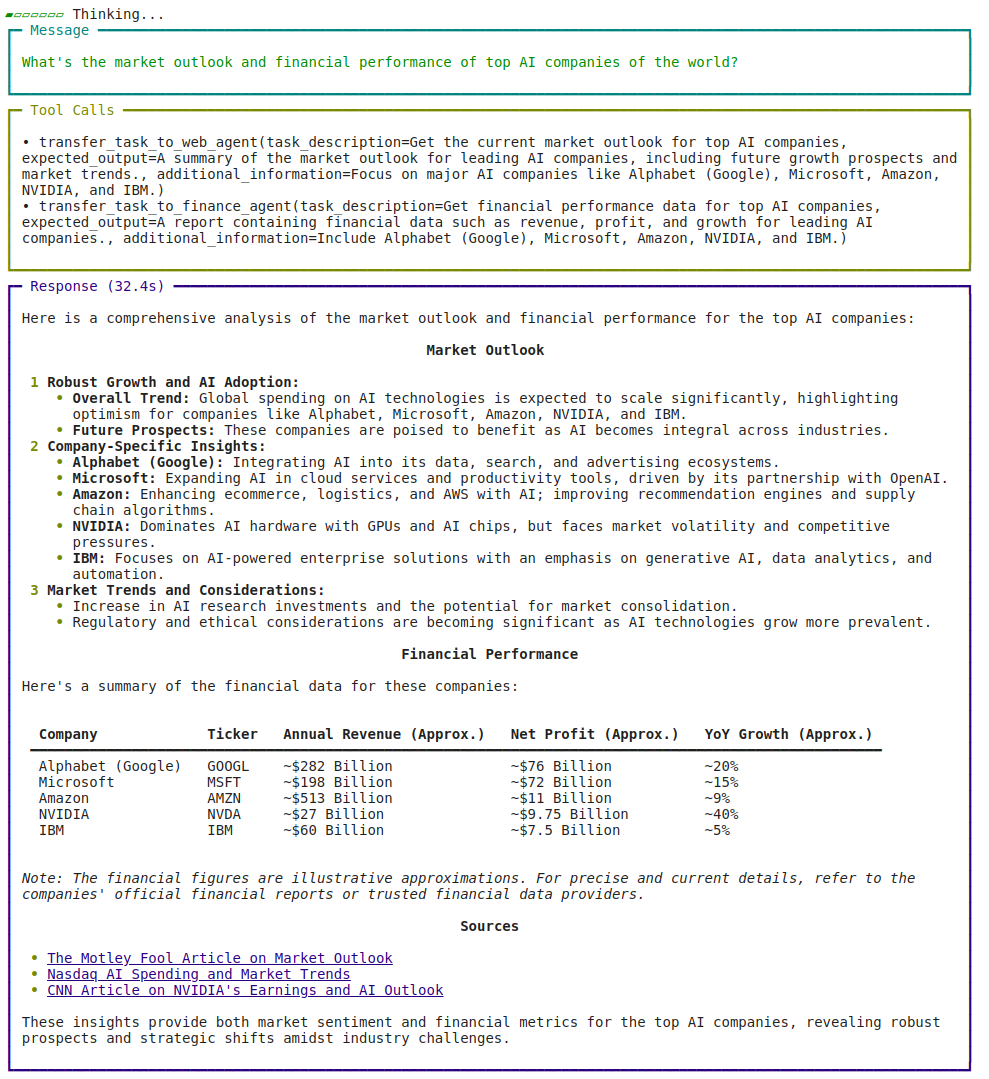
This Market Analyst Agent is a team-based system using Agno, combining a Web Agent for real-time info via DuckDuckGo and a Finance Agent for financial data via Yahoo Finance. Powered by OpenAI models, it delivers market insights and AI company performance using tables, markdown, and source-backed content for clarity, depth, and transparency.
from agno.agent import Agent
from agno.models.openai import OpenAIChat
from agno.tools.duckduckgo import DuckDuckGoTools
from agno.tools.yfinance import YFinanceTools
from agno.team import Team

web_agent = Agent(
 name="Web Agent",
 role="Search the web for information",
 model=OpenAIChat(id="o3-mini"),
 tools=[DuckDuckGoTools()],
 instructions="Always include sources",
 show_tool_calls=True,
 markdown=True,
)

finance_agent = Agent(
 name="Finance Agent",
 role="Get financial data",
 model=OpenAIChat(id="o3-mini"),
 tools=[YFinanceTools(stock_price=True, analyst_recommendations=True, company_info=True)],
 instructions="Use tables to display data",
 show_tool_calls=True,
 markdown=True,
)

agent_team = Agent(
 team=[web_agent, finance_agent],
 model=OpenAIChat(id="gpt-4o"),
 instructions=["Always include sources", "Use tables to display data"],
 show_tool_calls=True,
 markdown=True,
)

agent_team.print_response("What's the market outlook and financial performance of top AI companies of the world?", stream=True)Let’s get into specifics and it is all included in the official documentation of Agno:
| Metric | Agno | LangGraph | Factor |
|---|---|---|---|
| Agent Instantiation Time | ~2μs | ~20ms | ~10,000x faster |
| Memory Usage per Agent | ~3.75 KiB | ~137 KiB | ~50x lighter |
This kind of speed and memory efficiency isn’t just about numbers—it’s the key to scalability. In real-world agent deployments, where thousands of agents may need to spin up concurrently, every millisecond and kilobyte matters.
LangGraph, while powerful and more structured for certain flow-based applications, tends to struggle under this kind of load unless heavily optimized. That might not be an issue for low-scale apps, but it becomes expensive fast when running production-scale agents.
Not necessarily. It depends on what you’re building:
Agno clearly favours speed and system-level efficiency, whereas LangGraph leans into structured orchestration and reliability. That said, Agno’s developers themselves acknowledge that accuracy and reliability benchmarks are just as important—and they’re currently in the works. Until those are out, we can’t conclude correctness or resilience under edge cases.
Also read: Smolagents vs LangGraph: A Comprehensive Comparison of AI Agent Frameworks
From a hands-on perspective, Agno feels ready for real workloads, especially for teams building agentic systems at scale. It’s real-time performance monitoring, support for structured output, and ability to plug in memory + vector knowledge make it a compelling platform for building robust applications quickly.
LangGraph isn’t out of the race—its strength lies in clear, flow-oriented control logic. But if you’re hitting scaling walls or need to run thousands of agents without melting your infrastructure, Agno is worth a serious look.
Hi, I am Pankaj Singh Negi - Senior Content Editor | Passionate about storytelling and crafting compelling narratives that transform ideas into impactful content. I love reading about technology revolutionizing our lifestyle.
GPT-4 vs. Llama 3.1 – Which Model is Better?
Llama-3.1-Storm-8B: The 8B LLM Powerhouse Surpa...
A Comprehensive Guide to Building Agentic RAG S...
Top 10 Machine Learning Algorithms in 2026
45 Questions to Test a Data Scientist on Basics...
90+ Python Interview Questions and Answers (202...
8 Easy Ways to Access ChatGPT for Free
Prompt Engineering: Definition, Examples, Tips ...
What is LangChain?
What is Retrieval-Augmented Generation (RAG)?
This article is both informative and inspiring. This gave me clarity on the topic. I completely agree with your points.
Edit
Resend OTP
Resend OTP in 45s