|
VOOZH | about |
|
VOOZH | about |
Discover the latest reports, data sheets, articles, infographics, and videos on biomedical R&D and AI.
It is tempting to read a long citation list as a sign of thoroughness. Twelve papers drawn from the same subfield show depth in one corner of the question and nothing elsewhere, and several of them may describe the same finding in slightly different words.
When agents can write and run code well, the evidence system can begin at the point of data generation, not only at the point of decision.
The organizational challenge is to make the reasoning process repeatable enough that teams can benefit from that level of judgment even when the expert is not in every room.
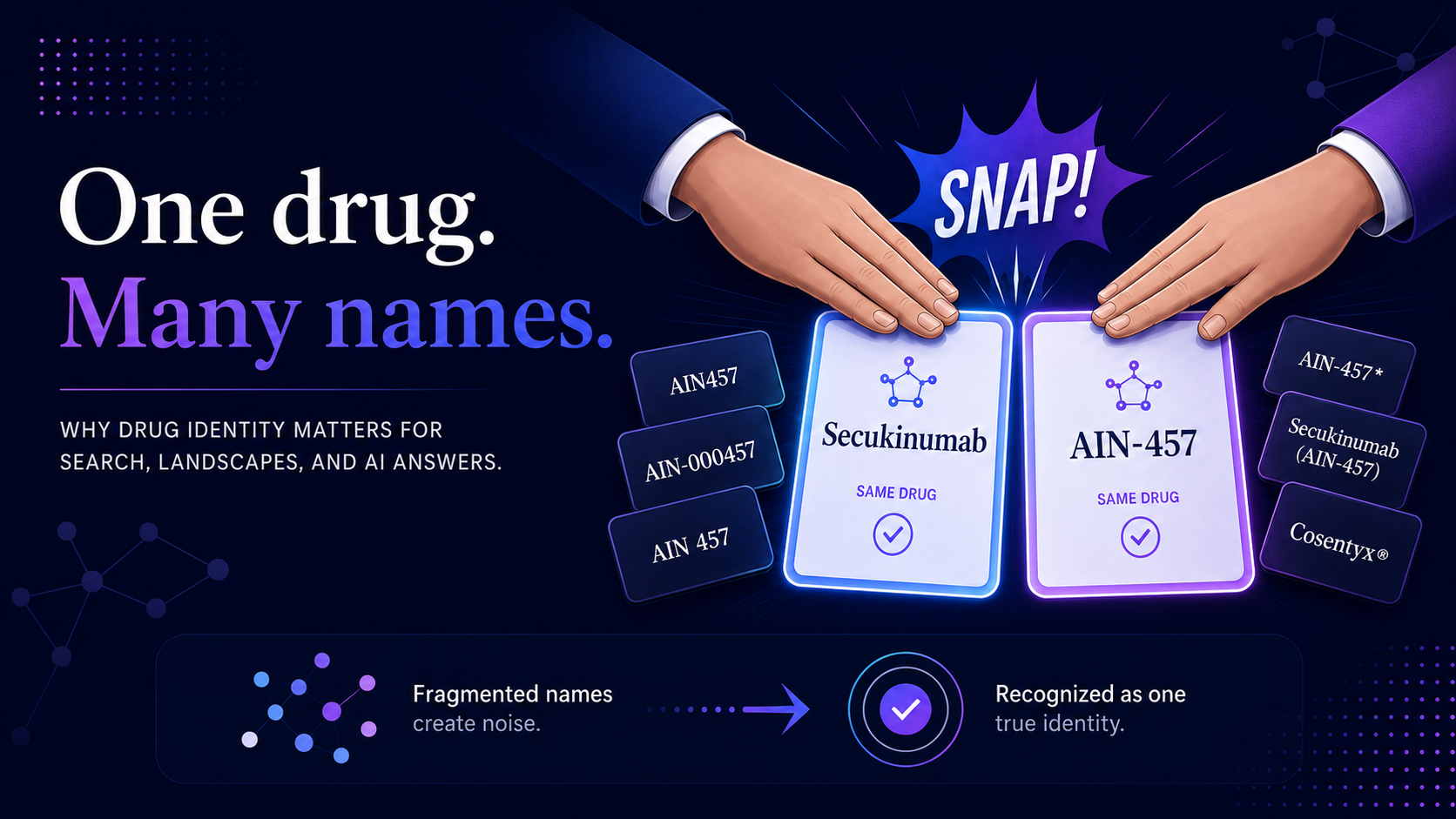
Why drug identity matters for search, landscapes, and AI answers
A workflow that fails to engage the human genetic evidence layer is missing the dimension with the strongest predictive value for human safety outcomes, however thoroughly it may cover the remainder of the literature.
Handing AI tools to individuals improves discrete tasks. The throughput leaders actually want changes only when the operating model around departmental and governance workflows moves with the technology.
AI-supported investigations into disease mechanisms offer a transformative approach to understand complex pathologies. By leveraging AI to unlock disease understanding, researchers can identify novel biomarkers and therapeutic targets with unprecedented precision. This not only accelerates the journey from lab to market but also enhances the efficacy and safety of new treatments.
AI is transforming the analysis of extensive biomedical data, allowing pharma companies to expedite R&D processes, and cut costs. By reaching conclusions quicker, the inclusion of AI in drug development pipelines can inform decision-making, enabling the prioritization of more promising research avenues.
Understanding the pathophysiology of a disease is pivotal in comprehending its cause and progression and facilitating the identification of novel targets for therapeutic intervention. Data-driven strategies are essential in navigating this complexity, facilitating a deeper understanding of disease pathophysiology, which can be leveraged to develop more effective treatments.
The strategic prioritization of drug targets by target class can be used to streamline discovery, enabling efficient resource allocation and time-savings in early drug development, as well as a competitive edge given the variable success rates of different target classes. Prioritization of specific target classes may therefore enable investment optimization in preclinical research.
With 2 publications added to PubMed every minute, identifying therapeutic targets with traditional keyword searching is time-consuming, causes reading fatigue and is subject to bias. By machine-reading the literature, Causaly manages this data overload, extracting scientific insights rather than papers, to enable the exploration of more novel avenues.
Deciphering a drug’s MoA is crucial for making informed decisions in drug development, paving the way for the development of more targeted and effective therapeutic solutions. AI can revolutionize this process by facilitating knowledge discovery without bias, unveiling hidden drug-disease interactions.
In this conversation, Dr. Siddhartha Mukherjee (Manas AI) and Yiannis Kiachopoulos (Causaly) examine how AI is being applied across this entire pipeline, not as a single model, but as a system of interconnected decisions.
ProQR faced challenges with bandwidth, aggressive targets, and the overwhelming growth of biomedical literature. Causaly's AI platform accelerated ProQR’s R&D by enabling faster review of publications and allowing their team to make more informed decisions. Read the case study below to learn how ProQR met their 2024 target ID goal by Q3 and achieved 5x productivity compared to using PubMed.
In contrast to conventional keyword searching techniques, Causaly’s AI can sift through and remove irrelevant data from biomedical searches, offering a more thorough and accurate understanding of entire research landscapes. This not only streamlines knowledge acquisition but ensures accuracy and precision in navigating the biomedical literature.
AI is transforming the analysis of extensive biomedical data, allowing pharma companies to expedite R&D processes, and cut costs. By reaching conclusions quicker, the inclusion of AI in drug development pipelines can inform decision-making, enabling the prioritization of more promising research avenues.
The strategic prioritization of drug targets by target class can be used to streamline discovery, enabling efficient resource allocation and time-savings in early drug development, as well as a competitive edge given the variable success rates of different target classes. Prioritization of specific target classes may therefore enable investment optimization in preclinical research.
With 2 publications added to PubMed every minute, identifying therapeutic targets with traditional keyword searching is time-consuming, causes reading fatigue and is subject to bias. By machine-reading the literature, Causaly manages this data overload, extracting scientific insights rather than papers, to enable the exploration of more novel avenues.
Drug repurposing offers a cost-effective and efficient pathway to discovery new therapeutic uses for existing treatments. AI can advance this process by rapidly analyzing large-scale biomedical data and scientific texts to identify drug-disease relationships, opening up avenues for treatments in unexplored indications.
The identification and utilization of safety biomarkers plays a key role in mitigating toxicity risks and reducing costs in drug development, thereby accelerating the delivery of safe and effective drugs to patients. AI can streamline the identification of relevant biomarkers from the ever-growing biomedical literature, offering insights into drug resistance and toxicity.
Unmanageable toxicity accounts for 30% of clinical drug development failures and can cause severe side effects and potential harm to patients. Download our report to see how AI-powered drug discovery can help mitigate late-stage clinical failures and market withdrawals.
The identification and utilization of safety biomarkers plays a key role in mitigating toxicity risks and reducing costs in drug development, thereby accelerating the delivery of safe and effective drugs to patients. AI can streamline the identification of relevant biomarkers from the ever-growing biomedical literature, offering insights into drug resistance and toxicity.
Traditional keyword searching is highly inefficient, subject to bias and is not always comprehensive, providing limited potential for knowledge discovery and hypothesis generation. This selective approach introduces a bias towards familiar areas of expertise, which can lead to missed opportunities for novel insights and innovations. This is where AI comes in.
Biomarkers serve as objective measures of treatment response to guide patients towards the most appropriate therapies. Yet, in the era of big data, pinpointing promising biomarkers remains a challenging endeavor. AI is revolutionizing translational medicine by improving the efficiency and accuracy of biomarker identification.
Biomarkers are pivotal throughout drug development, from discovery to market, playing key roles in unravelling drug mechanisms, providing prognostic insights and assessing treatment efficacy. Despite the clinical promise, biomarker development is challenging. There are substantial obstacles, from disease heterogeneity and rigorous validation requirements to the inability to extract meaningful biomarker insights from extensive biological data.
Unlock scientific insights from external and internal information at unprecedented levels of precision and efficiency.


.png)

.png)
.png)

.png)

.png)
.png)
.png)
%20(14).png)
.png)
%20(5).png)
.png)
.png)
.png)
%20(1).jpg)
%20no%20logo.jpg)


.jpg)
.png)
.png)


.png)
.png)



.jpg)