

Six Sigma for Process Improvement

Six Sigma for Process Improvement
This course is part of ASQ-Certified Six Sigma Black Belt (CSSBB) Exam Prep Specialization


Instructors: SkillUp
3,714 already enrolled
Included with
Ask Coursera
21 reviews
Recommended experience
21 reviews
Recommended experience
What you'll learn
Explain the core Six Sigma principles, methodologies, and techniques, with the systems and tools and their use for measurable organizational impact.
Explain the core Six Sigma principles, methodologies, techniques, and the systems and tools used for measurable organizational impact.
Discuss the commonly used Design for Six Sigma (DFSS) methodologies and related design constraints.
Describe the key concepts of each phase of the DMAIC framework for process improvement in the organization.
Skills you'll gain
- Business Priorities
- Lean Manufacturing
- Risk Analysis
- Process Analysis
- Lean Methodologies
- Business Process
- Quality Improvement
- Project Risk Management
- Statistical Process Controls
- Process Optimization
- Operational Efficiency
- Business Process Management
- Process Improvement
- Continuous Improvement Process
- Six Sigma Methodology
- Lean Six Sigma
- Project Management
- Continuous Quality Improvement (CQI)
- Process Improvement and Optimization
- Process Capability
Details to know

See how employees at top companies are mastering in-demand skills

Build your subject-matter expertise
- Learn new concepts from industry experts
- Gain a foundational understanding of a subject or tool
- Develop job-relevant skills with hands-on projects
- Earn a shareable career certificate

There are 4 modules in this course
This course will help you prepare for the American Society for Quality (ASQ) Certified Six Sigma Black Belt (CSSBB). This course covers the topics specified in the Six Sigma Black Belt Body of Knowledge (BoK), including the core concepts of Six Sigma, Lean enterprise, and other problem-solving approaches.
By the end of this course, you will be able to -Explain the core Six Sigma principles, methodologies, and techniques, along with the systems and tools and their use for measurable organizational impact. -Apply the basic concepts of Lean enterprise to identify non-value-added elements and activities and use specific tools. -Discuss the commonly used Design for Six Sigma (DFSS) methodologies and related design constraints. -Describe the key concepts of each phase of the DMAIC framework for process improvement in the organization. This course best suits professionals in process improvement teams with significant experience leading and executing Six Sigma, Lean, or other quality improvement projects. It is also suitable for employees working in the quality function who aim to become leaders in process improvement and raise their career standards and credibility.
In this module, you will be introduced to the Six Sigma Black Belt, its relevance in the industry, and how the CSSBB is instrumental in making measurable changes in the organization. You will take a deep dive into the core principles of the Six Sigma philosophy, including the key systems and tools. You will explore some common DfSS methodologies and delve into design constraints.
What's included
7 videos3 readings3 assignments
7 videos•Total 38 minutes
- Specialization introduction•5 minutes
- Course introduction•4 minutes
- Fundamental principles of Six Sigma•6 minutes
- Systems and tools in Six Sigma•6 minutes
- Design for Six Sigma (DFSS) framework: DMADV•8 minutes
- Design for Six Sigma (DFSS) framework: DMADOV•5 minutes
- Design for X (DFX)•5 minutes
3 readings•Total 16 minutes
- Specialization Overview•8 minutes
- Course Overview•5 minutes
- Robust designs•3 minutes
3 assignments•Total 46 minutes
- Graded Quiz: Introduction to ASQ-Certified Six Sigma Black Belt•30 minutes
- Practice Quiz: Introduction to CSSBB•8 minutes
- Practice Quiz: Design for Six Sigma (DFSS) framework and methodologies•8 minutes
In this module, you will be introduced to the basic concepts of Lean enterprise and how to identify non-value-added activities. You will learn when to use Six Sigma instead of alternate problem-solving approaches and identify the screening criteria for selecting Six Sigma projects, Lean initiatives, and other continuous improvement methods. You will learn how to align Six Sigma objectives with organizational goals and the relationships between various systems, processes, and stakeholders. Finally, you will learn the importance of identification and strategic planning for Six Sigma projects.
What's included
7 videos1 reading3 assignments1 discussion prompt
7 videos•Total 38 minutes
- Basic concepts of Lean enterprise•5 minutes
- Identifying non-value-added elements and activities•6 minutes
- Align Lean with Six Sigma•6 minutes
- Choosing a continuous improvement methodology•6 minutes
- Aligning Six Sigma objectives with organizational goals•5 minutes
- Systems, processes, and stakeholders•5 minutes
- Project identification and strategic planning •5 minutes
1 reading•Total 3 minutes
- Necessary non-value-added activities•3 minutes
3 assignments•Total 44 minutes
- Graded Quiz: Six Sigma and Lean principles in the organization•30 minutes
- Practice Quiz: Fundamentals of Lean methodologies•8 minutes
- Practice Quiz: Business systems and processes•6 minutes
1 discussion prompt•Total 15 minutes
- Identifying non-value-added activities•15 minutes
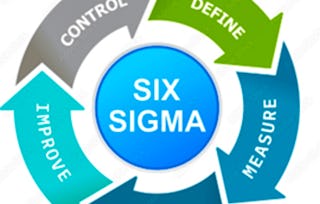
In this module, you will delve deep into key concepts of the DMAIC model in accordance with Six Sigma principles. You will learn about the voice of the customer, building a business case, and the role of the project charter review in the design phase. You will explore the fundamental concepts of data collection, process characteristics, probability, and process capability. In the analyze phase, you will be introduced to risk analysis, management, and other analysis methods. In the improve phase, you will learn the key concepts of design of experiments (DOE) and implementation. Finally, in the control phase, you will get acquainted with the objectives of statistical process control (SPC), other controls, and how you can maintain controls and sustain improvement.
What's included
6 videos1 reading3 assignments1 discussion prompt
6 videos•Total 38 minutes
- Introduction to the DMAIC methodology•6 minutes
- The define phase•6 minutes
- The measure phase•7 minutes
- The analyze phase•7 minutes
- The improve phase•5 minutes
- The control phase•8 minutes
1 reading•Total 6 minutes
- DMAIC versus DMADV: Which process is right for your project?•6 minutes
3 assignments•Total 32 minutes
- Graded Quiz: DMAIC for process improvement•20 minutes
- Practice Quiz: Define and measure •6 minutes
- Practice Quiz: Analyze, improve, and control•6 minutes
1 discussion prompt•Total 15 minutes
- The DMAIC framework•15 minutes
This is a peer-review assignment based on the concepts taught in the Six Sigma for Process Improvement course. In this assignment, you have been provided with a real-life scenario. You need to explain how you can use Six Sigma approaches, techniques, and tools you have learned in the course to improve the efficiency of organizational processes.
What's included
1 video2 readings1 assignment
1 video•Total 4 minutes
- Course wrap-up video•4 minutes
2 readings•Total 3 minutes
- Congratulations and Next steps•2 minutes
- Thanks from the Course Team•1 minute
1 assignment•Total 120 minutes
- Strategic Process Improvement Proposal: From Diagnosis to Design•120 minutes
Earn a career certificate
Add this credential to your LinkedIn profile, resume, or CV. Share it on social media and in your performance review.

Explore more from Data Analysis
- Status: Free TrialS
Simplilearn
Course
- Status: Free Trial
Course
- Status: Free Trial
Course
- Status: Free Trial
Specialization



Why people choose Coursera for their career


Learner reviews
- 5 stars
88.46%
- 4 stars
7.69%
- 3 stars
3.84%
- 2 stars
0%
- 1 star
0%
Showing 3 of 21
Reviewed on Sep 19, 2025
Six Sigma for Process Improvement is a highly recommend course 5/5 Stars!
Reviewed on Apr 8, 2025
Pretty high level course and sometimes was tough to understand structure, you definitely need prior experience and at least a Green Belt to gain value from the course.
Reviewed on Mar 31, 2024
Very effective course with very deep explanation of concepts.
Advance your career with an online degree
Earn a degree from world-class universities - 100% online





Frequently asked questions
To access the course materials, assignments and to earn a Certificate, you will need to purchase the Certificate experience when you enroll in a course. You can try a Free Trial instead, or apply for Financial Aid. The course may offer 'Full Course, No Certificate' instead. This option lets you see all course materials, submit required assessments, and get a final grade. This also means that you will not be able to purchase a Certificate experience.
When you enroll in the course, you get access to all of the courses in the Specialization, and you earn a certificate when you complete the work. Your electronic Certificate will be added to your Accomplishments page - from there, you can print your Certificate or add it to your LinkedIn profile.
Yes. In select learning programs, you can apply for financial aid or a scholarship if you can’t afford the enrollment fee. If fin aid or scholarship is available for your learning program selection, you’ll find a link to apply on the description page.
More questions
Financial aid available,
¹ Some assignments in this course are AI-graded. For these assignments, your data will be used in accordance with Coursera's Privacy Notice.