AI SMS support for ecommerce: how text-message support actually works in 2026


Last edited June 23, 2026
Table of Contents
- Why SMS is its own support channel (and email habits don't transfer)
- How AI SMS support actually works
- What AI can (and can't) handle over text
- The real cost of AI SMS support
- Choosing a tool: layer-on vs all-in-one
- How to set up AI SMS support (without a developer)
- The pitfalls that actually bite
- Try eesel for AI SMS support
Why SMS is its own support channel (and email habits don't transfer)
Email gives you a paragraph and a 24-hour clock. SMS gives you a sentence and a customer who expects a reply before they've put their phone back in their pocket. For ecommerce specifically, the texts skew toward a handful of high-volume, time-sensitive questions: where's my order, can I still change my address, how do I return this, is this back in stock.
That shape is exactly what makes SMS a good fit for AI. The questions are repetitive, the answers live in your order system and help docs, and the customer wants speed over nuance. A human agent copy-pasting tracking links at 9am is the most automatable work in the building.
The catch is that texting carries a different etiquette. A three-paragraph reply that reads fine in email support feels broken over SMS. Whatever AI you point at the channel has to write short, answer the actual question, and know when to stop talking and pull in a person. That's a tone-and-routing problem, not just a "connect a chatbot" problem.
"Finally, AI software that suits our needs. Easy to connect to Shopify, easy to prompt, and it learns from our articles. We're using it as a copilot for our Zendesk agents, with AI live chat next."
Mateusz Golda, Director, Tulipy, in a G2 review

How AI SMS support actually works
Under the hood, an AI text-support flow is four steps, and the second one is where ecommerce tools earn their keep.
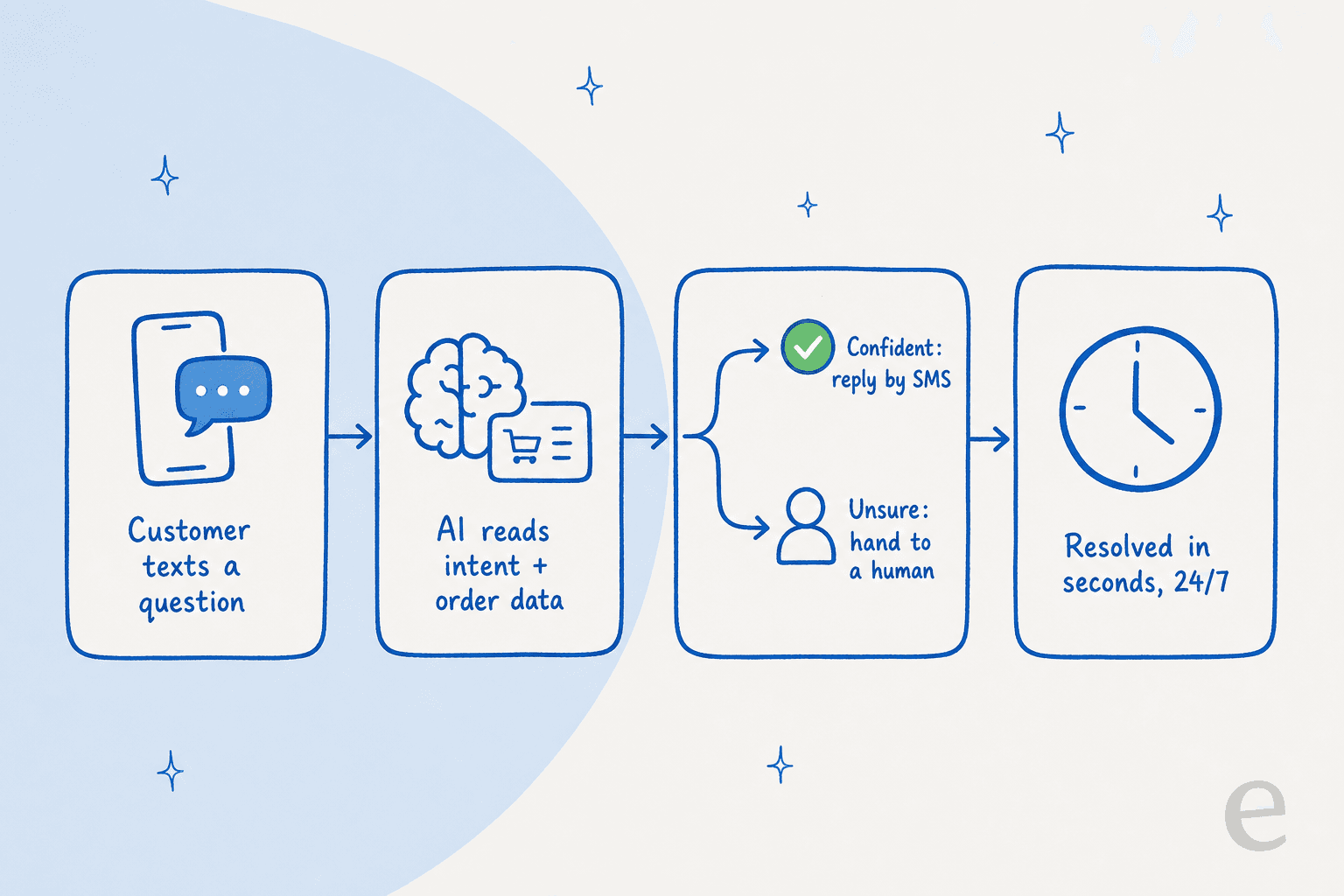
- The customer texts a question. It lands in your helpdesk or messaging platform as a conversation, the same way an email or chat would.
- The AI reads intent and pulls order data. This is the difference between a real answer and a deflection. A generic FAQ bot says "track your order here"; an AI connected to Shopify or WooCommerce reads this customer's order, sees it's stuck in transit, and says so.
- It decides: reply or hand off. On a confident answer, it texts back. On anything uncertain - a damaged item, an angry tone, a question outside its knowledge - it routes to a human instead of guessing.
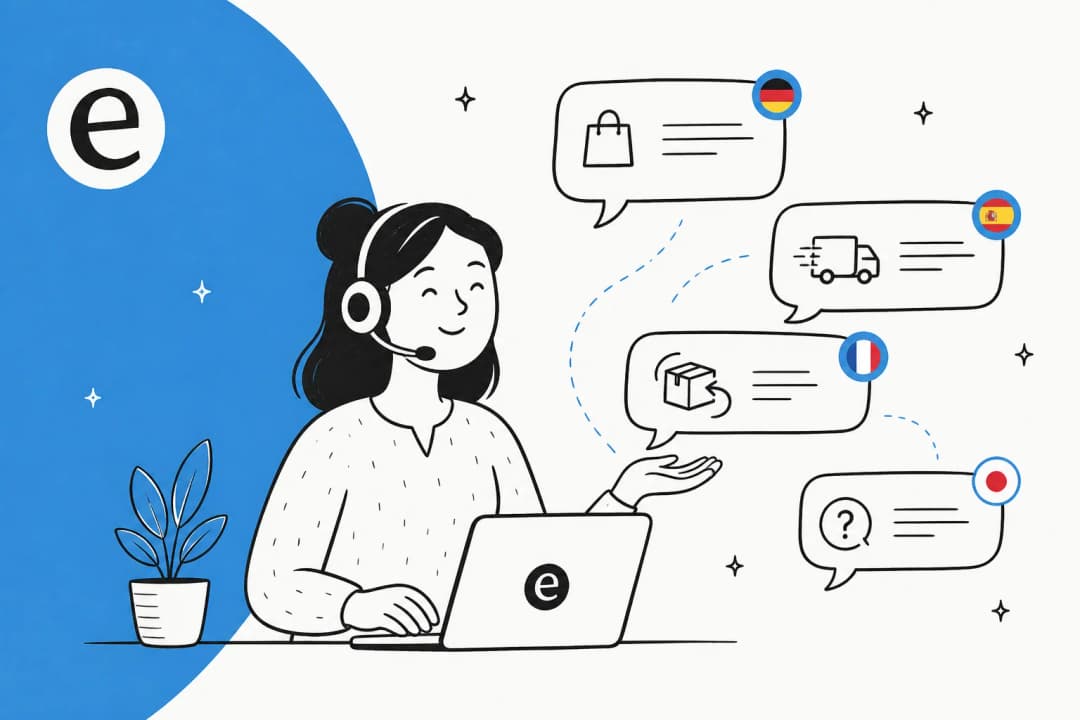
- It resolves, 24/7. The whole loop runs in seconds, at 3am, during a Black Friday spike, in whatever language the customer texted in.
Step 2 is the line between "AI for ecommerce" and "AI bolted onto ecommerce." If a tool can't read live order data, it can't answer the question your customers actually text most, and you're back to canned replies. The richest version of step 2 leans on your store's own events - our walkthrough of Shopify order webhooks covers how that data gets to the agent in the first place.
What AI can (and can't) handle over text
Being specific here matters, because "AI handles your support" is the kind of claim that sets a store up to get burned. From running this on live ecommerce queues, here's the honest split.
| Question type | AI fit over SMS | Why |
|---|---|---|
| Order status / "where is my order" | Excellent | Looks up live tracking, texts the real status. Highest-volume use case. |
| Returns and exchanges | Strong | Walks the customer through policy and starts the return, escalates edge cases. |
| Product, sizing, stock questions | Strong | Pulls from your help docs and product data; consistent answers. |
| Address / order changes (pre-fulfillment) | Good | Can update if your store allows it via API; otherwise routes to a human. |
| Damaged item, "this is the wrong product" | Hand to a human | Needs judgment, photos, and goodwill calls AI shouldn't make unsupervised. |
| Angry / churn-risk customer | Hand to a human | Tone detection should escalate, not attempt to placate over text. |
The pattern: AI owns the volume, humans own the judgment. The teams that get value treat SMS automation as clearing the repetitive 60-70% so agents can spend real time on the 30% that needs a person. Anyone promising 100% text deflection is selling you a future complaint.
A DTC supplements brand's CX lead I spoke with put the principle better than I can: the AI will never answer 100% of questions, so what they actually wanted was an agent that only handles the tickets it's confident about and leaves the rest alone. That's the whole game for SMS: confidence first, coverage second.
The real cost of AI SMS support
This is where ecommerce budgets get ambushed. There isn't one price - there are layers, and the carrier layer is the one that doesn't exist for live chat.
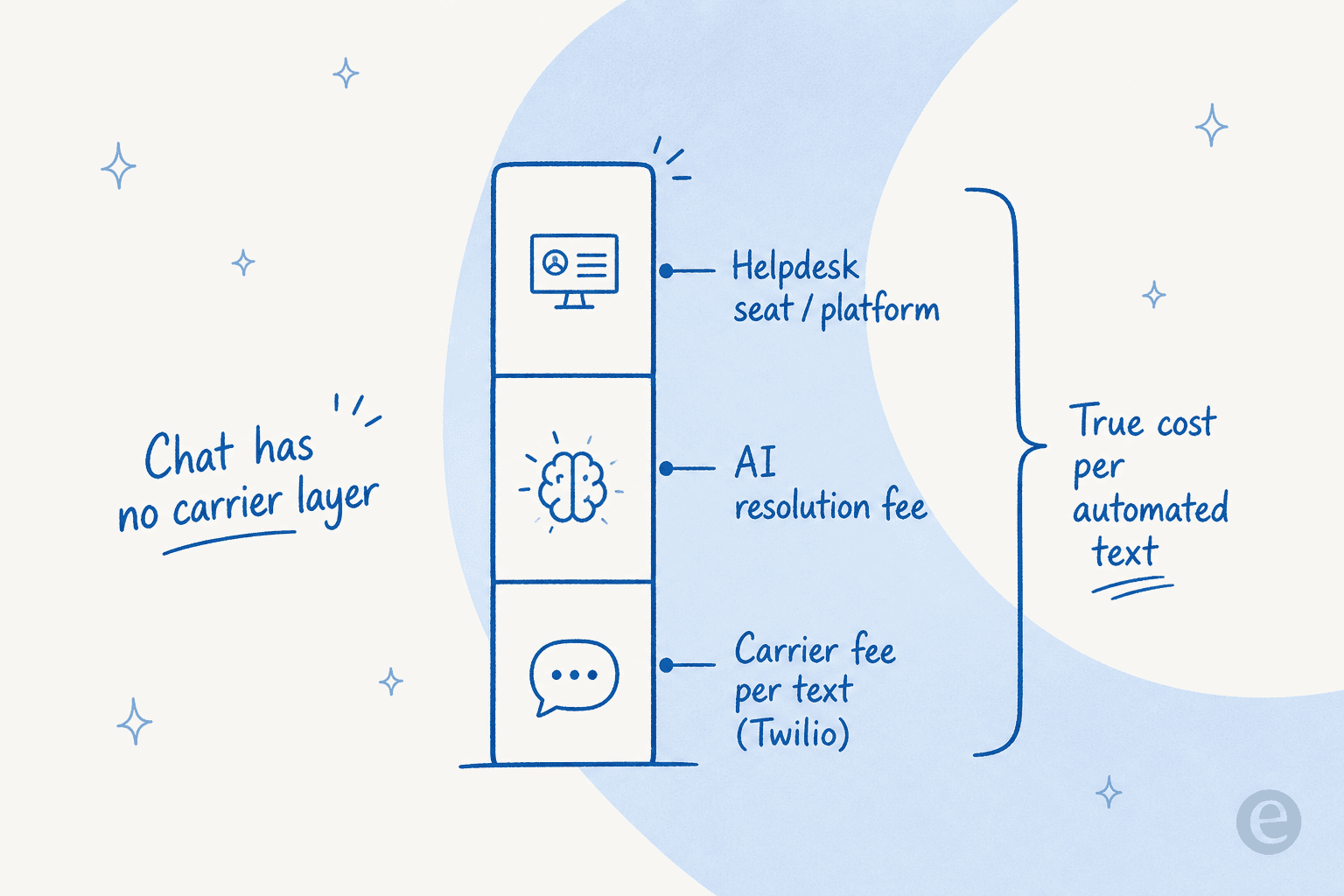
- Carrier fee per text. Every SMS segment costs money through a provider like Twilio - typically a fraction of a cent to a couple of cents per message, depending on country and volume. A back-and-forth conversation is several segments.
- AI resolution fee. What the AI tool charges to actually handle the conversation. This is the layer that varies most by pricing model.
- Platform / seat fee. Some all-in-one platforms charge per agent seat on top, whether or not the AI did the work.
The AI layer is where the pricing model decides your bill. Per-seat pricing punishes you for adding humans; per-interaction pricing punishes you for being busy - every back-and-forth message can tick the meter. I've watched this bite real stores. One e-commerce brand on a $299/mo Team plan doing around 700 tickets a week was effectively paying about $1.07 per ticket, and the model became the thing they argued about internally. Usage-based pricing that bills per resolved conversation - around $0.40 with eesel AI, no per-seat fee - is the model that scales with an ecommerce store instead of against it.
Here's a rough monthly estimate by volume so you can sanity-check a quote. Plug in your own numbers:
Monthly AI SMS support cost estimator
Rough order-of-magnitude only. Assumes ~$0.40 per resolved conversation and ~$0.03 in carrier segments per conversation. Pick your support text volume:
A per-interaction model would multiply these by the number of back-and-forth messages per conversation - often 3-4x. That's the gap to watch in any quote.
Choosing a tool: layer-on vs all-in-one
The market splits along one line: tools that layer onto the helpdesk you already run, and all-in-one platforms that want to be your helpdesk. For ecommerce, that choice usually matters more than any feature checklist.
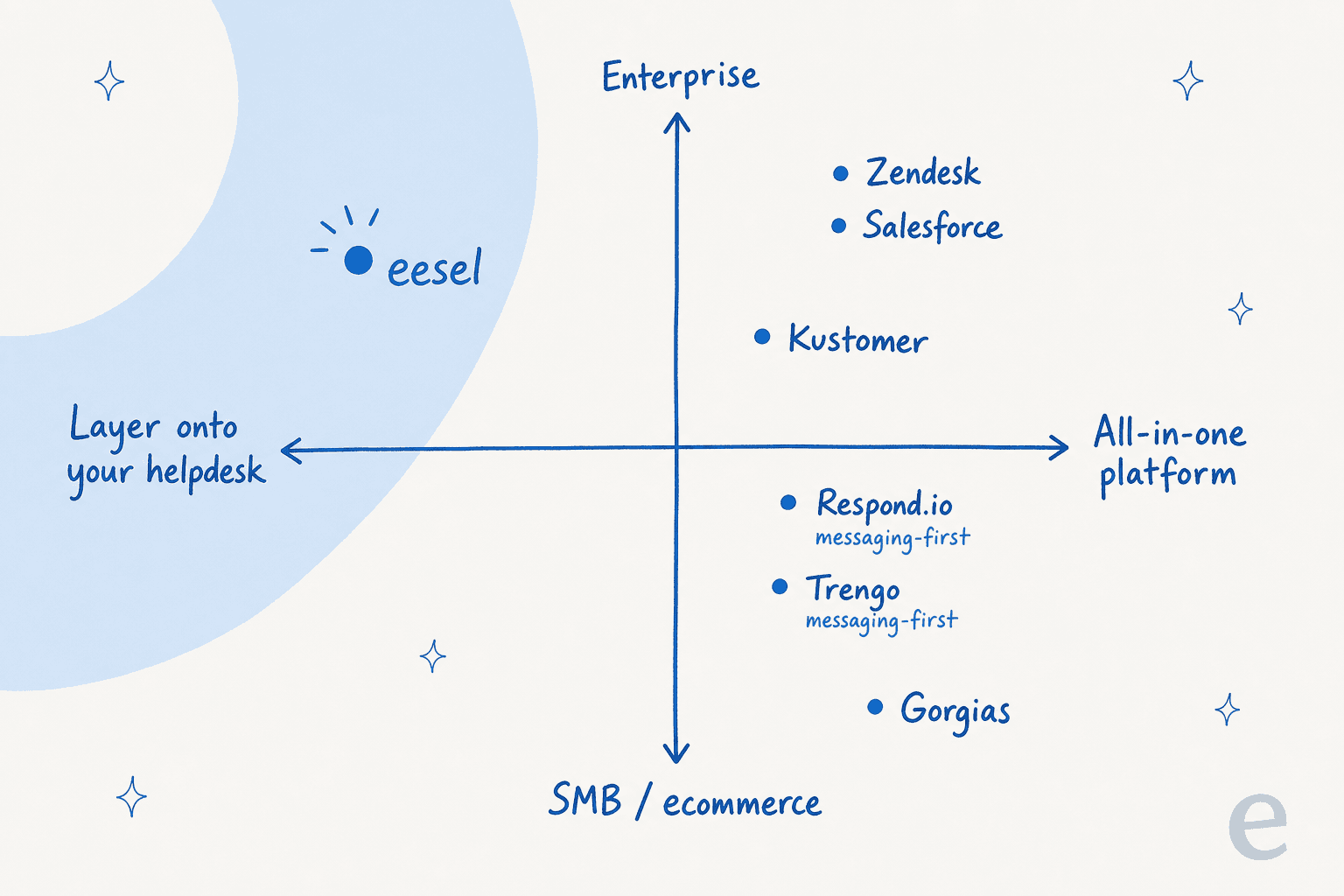
- All-in-one ecommerce platforms like Gorgias bundle SMS, helpdesk, and automation. Great if you're starting fresh; painful if you'd have to migrate off a setup that works. Gorgias even has its own SMS reopen automations for the channel.
- Messaging-first platforms centralize SMS, WhatsApp, and chat in one inbox, then add AI. Strong for omnichannel-heavy stores.
- Layer-on AI agents like eesel AI sit on top of Zendesk, Freshdesk, Front, Gorgias and others, so you keep your inbox and add automation without ripping anything out.
My take: if you already have a helpdesk your team likes, start with a layer-on agent. Switching your entire support stack to get AI on SMS is the kind of project that eats a quarter; adding an AI layer is the kind that takes an afternoon. If you're greenfield with no helpdesk yet, an all-in-one is a reasonable place to begin - just price the per-seat and per-interaction lines carefully before you commit.
| Approach | Best for | Watch out for |
|---|---|---|
| All-in-one platform | New stores, no existing helpdesk | Migration cost, per-seat fees, lock-in |
| Messaging-first inbox | Omnichannel (SMS + WhatsApp + chat) heavy stores | AI often shallower than a dedicated agent |
| Layer-on AI agent | Stores happy with their current helpdesk | Needs a helpdesk that already ingests SMS |
How to set up AI SMS support (without a developer)
You don't need an engineering ticket for this. The setup that's worked for the ecommerce teams I've onboarded is deliberately narrow at the start.

- Connect your SMS channel and store. Point the AI at wherever your texts land (your helpdesk's SMS integration, or a provider like Twilio) and connect Shopify, WooCommerce, or Magento so it can read orders.
- Let it learn from your knowledge. Feed it your help center, past tickets, and policies. Training on your own solved tickets is what makes the answers sound like your store, not a generic bot.
- Simulate before you go live. Run the AI against thousands of your past texts to see what it would have answered and where it would have gone wrong. This is the step that prevents the nightmare of a confident-but-wrong reply going to a real customer.
- Go live on a narrow slice. Turn it on for just order-status texts first, with confidence-based routing sending everything else to humans. Widen the scope as the simulation numbers earn your trust.
- Coach and expand. Every correction your team makes teaches the agent. Review the misses weekly and broaden coverage from there.
The teams that struggle are the ones that skip step 3 and flip everything live at once. The teams that win treat it like hiring: narrow remit, supervised, more responsibility as it proves itself.
The pitfalls that actually bite
A few things I'd flag before you point AI at a live SMS line:
- Channel coverage gaps. If your AI picks up email and chat but quietly misses SMS, customers texting you get silence. Confirm the SMS channel is genuinely wired in - this is a real churn reason I've seen, not a hypothetical.
- Replies that are too long. An AI tuned for email will write paragraphs. Over SMS that reads as broken. Set the tone explicitly for short, plain texts.
- No order-data connection. Without live order lookups, you've built a fancy FAQ bot, and "where is my order" - your highest-volume question - falls back to a deflection.
- Per-interaction pricing at volume. A model that charges per message instead of per resolution can quietly 3-4x your bill on a chatty channel like SMS. Read the meter before you sign.
- Over-automating tone-sensitive tickets. Let the AI escalate angry or damaged-item texts. A bot trying to de-escalate a furious customer over SMS does more damage than a slow human reply.
Try eesel for AI SMS support
If you're adding AI to text-message support for an ecommerce store, eesel AI is built for exactly the layer-on path above: it sits on top of the helpdesk you already run - Zendesk, Freshdesk, Gorgias, Front - reads your Shopify order data, and answers routine texts while routing the rest to your team.
The differentiator that matters most for ecommerce: you can simulate the agent against your real past texts before a single customer sees it, so you know your coverage and your accuracy before going live - and the pricing is usage-based at around $0.40 per resolved conversation, no per-seat fee. One ecommerce team, Gridwise, saw eesel resolve 73% of tier-1 requests in the first month, with results landing during a 7-day trial. It's free to try, and setup is minutes, not a migration.
Frequently Asked Questions

Add AI to your SMS support
Answer texts automatically, escalate the rest - on the helpdesk you already use.
Share this article

Article by
Riellvriany Indriawan
Riell is a designer and writer at eesel AI with about two years of experience researching CX platforms, AI chatbots, and helpdesk software. She combines her design background with a sharp eye for how these tools actually look and feel in practice — making her comparisons unusually visual and user-focused.