AI WhatsApp support for ecommerce: a practical 2026 guide


Last edited June 21, 2026

Table of Contents
- Why WhatsApp is the channel ecommerce can't ignore
- Business app or Business Platform: pick the right WhatsApp first
- The 24-hour window changes the economics
- What an AI agent should actually handle on WhatsApp
- Where to draw the line: confidence and escalation
- How to set it up without a developer
- What it actually costs
- Try eesel on WhatsApp
Why WhatsApp is the channel ecommerce can't ignore
I work the support queue, and the pattern is hard to miss: the more global your store gets, the more of your customers would rather message than email. In Brazil, India, Indonesia, and Mexico, WhatsApp isn't a messaging app, it's the one. Meta now reports more than 3 billion users and over 200 million businesses on its WhatsApp products. For a brand selling across borders, that's not a side channel.
What lands there is also predictable. The bulk of ecommerce contacts are WISMO ("where is my order"), delivery questions, returns, and "do you have this in my size". One DTC supplements team I came across wanted their AI to auto-resolve more than half of 7,000 monthly tickets, almost all of it WISMO, subscription tweaks, and basic product questions. That shape is the whole reason WhatsApp and AI fit together: high volume, low complexity, and a customer who wants a fast answer in a thread they already have open.
If you're weighing WhatsApp against the channels you already run, it slots in next to live chat for ecommerce rather than replacing your helpdesk. The difference is reach: email gets opened when someone gets around to it, a WhatsApp message gets read in minutes.
Business app or Business Platform: pick the right WhatsApp first
Before any AI, there's a fork that trips up a lot of stores. WhatsApp has two business products, and only one of them can be automated.
The WhatsApp Business app is the free mobile app: profiles, a product catalog, quick replies, away messages. It's genuinely fine for a one-person shop, but it runs from a phone and has no real API, so it can't power multi-agent support or an AI layer. The WhatsApp Business Platform, also called the Cloud API, is the programmatic version. It's what every serious automation, helpdesk integration, and AI agent connects to.
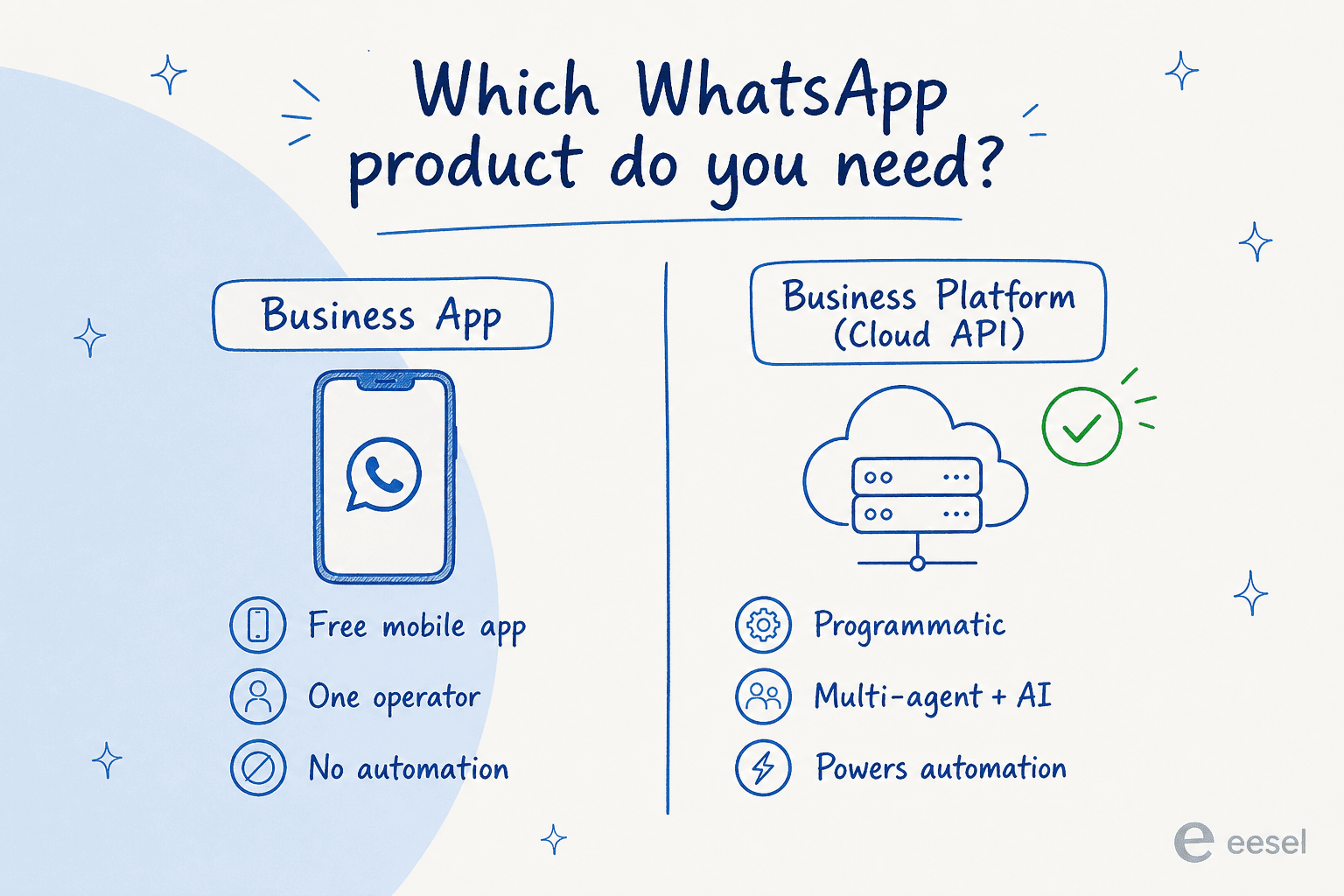
The good news is you rarely touch the API yourself. A tool like eesel or your ecommerce helpdesk handles the Cloud API connection, so the decision is really just "don't try to build your store's support on the free phone app." Once you're on the Platform, the AI part is the easy bit.
The 24-hour window changes the economics
This is the part that reframed how I think about WhatsApp support, so stick with me for a second. WhatsApp's pricing model changed on 1 July 2025 from charging per conversation to charging per message, and the rules that came with it are unusually friendly to support.
Here's how it works in practice. When a customer messages you, a 24-hour customer service window opens. While that window is open, any free-form reply you send (text, images, buttons) is free, and each new customer message resets the clock. You only pay when you send a pre-approved template message, and even utility templates like order updates are free if they go out inside an open window. The thing you pay for is re-engaging a customer after the window has closed.
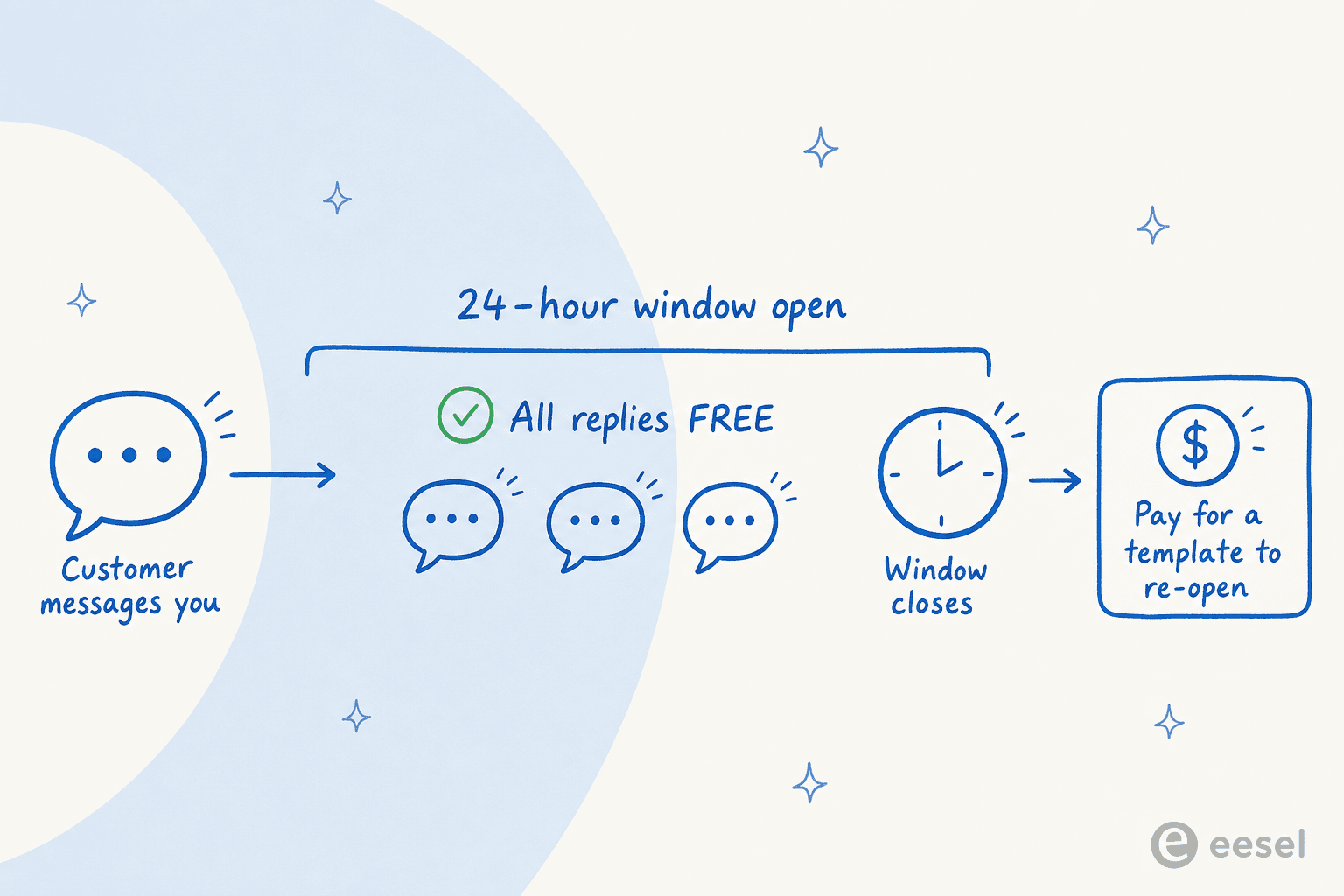
Put an AI agent in that picture and the math gets interesting. A customer asks "where's my order", and the agent answers within seconds, inside the window, for free. The slow, expensive version of WhatsApp support is the one where a question sits for two days, the window lapses, and you're paying for a template just to follow up. Speed isn't only a CX nicety here, it's the cheaper path. If you want the deeper detail on the policy changes, our WhatsApp pricing and policy guide breaks them down.
What an AI agent should actually handle on WhatsApp
The temptation is to switch the bot on and point it at everything. Don't. The agents that work in production are scoped to the questions where being fast and consistent beats being clever.
For an ecommerce store, that's a short, high-value list:
- Order status and tracking. The agent reads the order from Shopify or WooCommerce, pulls live tracking, and answers in the thread.
- Returns and exchanges. It explains your policy, checks eligibility, and starts the return, escalating the messy ones.
- Product and stock questions. Sizing, materials, "is the black one back in stock", straight from your catalog.
- Subscription tweaks. Skips, swaps, and pauses for the brands running them.
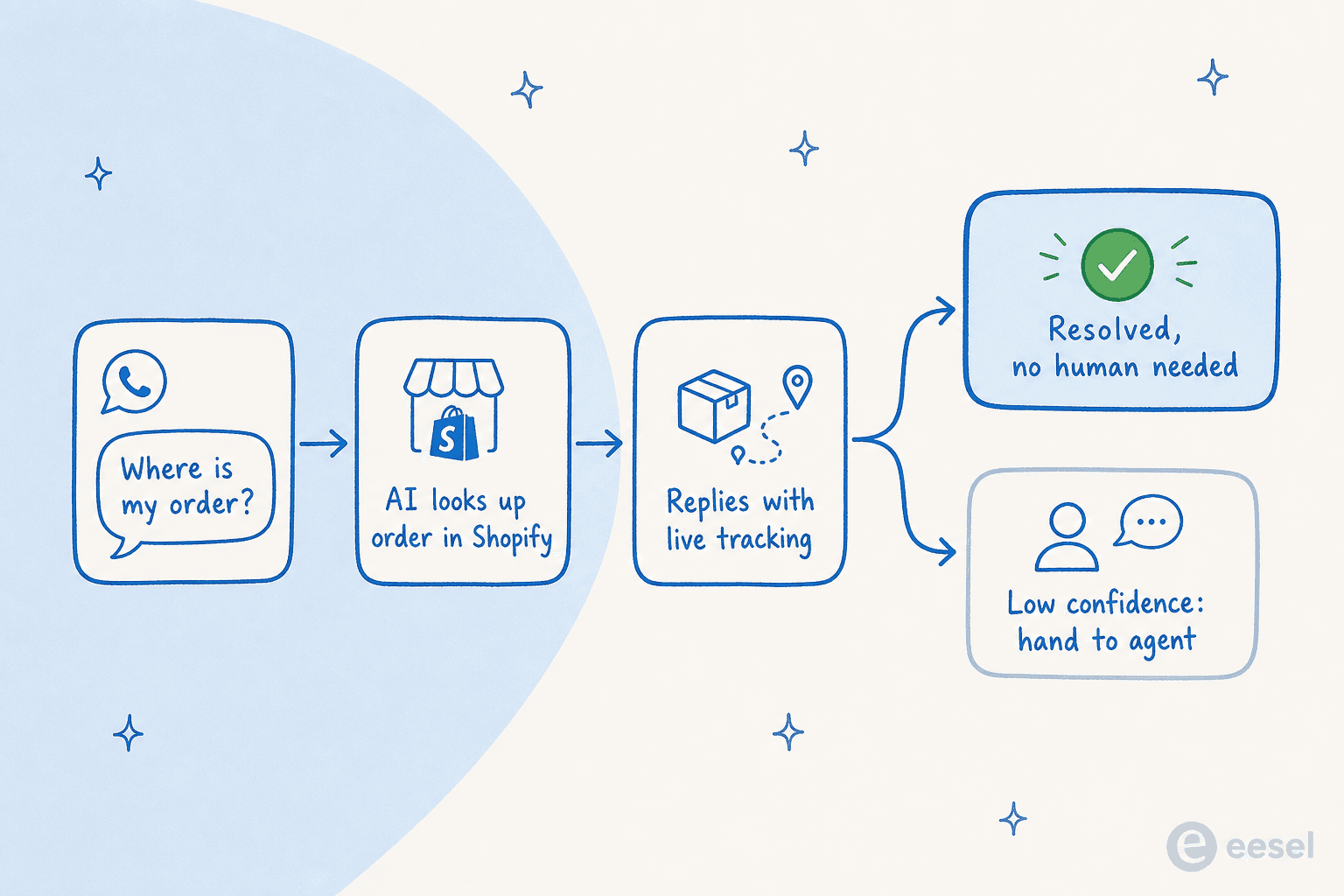
eesel's ecommerce agent is built around exactly this: recommend products, answer product questions, and handle orders and returns with real-time tracking and escalation. Below is the actual product surface, so you can see what "handle the order" looks like rather than take my word for it.
What I'd keep off the list at first: anything involving money out the door without a check, anything legal, and the genuinely ambiguous "this is broken and I'm furious" messages. Those want a human, and a good agent knows to fetch one.
Where to draw the line: confidence and escalation
The single biggest reason teams hesitate to put AI on a customer-facing channel is the fear of a confident wrong answer, and they're right to worry. A CX lead at a DTC supplements brand put the principle better than I could:
"The AI will never be able to answer 100% of the questions... I need an AI who is only handling the tickets that it's confident to handle and all the other ones, leave them alone."
That's the whole design philosophy in two sentences. The agent should reply only when it's confident, and hand over cleanly the moment it isn't. We've watched confident-sounding bots quietly give wrong answers, which is why the rollout I trust runs the agent against your past WhatsApp and helpdesk conversations first, in a simulation, so you see how it would have replied before a single real customer sees it. You tune the gaps, then go live on the easy stuff only.
It's the same deflect-then-handover loop that works on any channel. In one real chat I saw, an AI answered two how-to questions and then escalated to a human the instant the user typed "can I talk to a human", no arguing, no loop. On WhatsApp, where the conversation is personal, that handover discipline matters even more.
How to set it up without a developer
You don't need to touch the WhatsApp Cloud API directly. The practical path looks like this:
- Get on the Business Platform. Either through your ecommerce helpdesk (Gorgias, Zendesk, and Front all own a WhatsApp inbox) or by connecting your WhatsApp Business number to your AI tool.
- Connect your knowledge and store. Point the agent at your help center, FAQs, and your Shopify or WooCommerce data so it can answer with real order info, not guesses.
- Set scope and tone by talking to it. With eesel you configure rules in plain language, like "always escalate to a human if someone mentions a refund".
- Simulate on past conversations. Run it over historical tickets to see coverage and catch gaps before go-live.
- Go live narrow, then widen. Start with order status only, watch it, then add returns and product questions as your confidence grows.
Connecting WhatsApp to eesel takes under five minutes, and the simulation step is what turns "we hope it works" into "we've already seen it work". Here's the WhatsApp connection itself:
If your store already lives in Gorgias, the helpdesk-native route is even tighter: the agent joins as a real teammate inside your existing setup, reads tickets, drafts and sends replies, and pulls Shopify order data into every reply with no separate inbox to babysit.
What it actually costs
There are two bills to think about, and people usually only budget for one.
The first is WhatsApp's own fees, which, as covered above, are minimal for in-window support and only really show up when you send marketing or out-of-window template messages. The second is your AI tool, and this is where pricing models vary a lot. Per-resolution or per-conversation pricing is the honest unit for support, because it tracks the work done; per-seat pricing punishes you for adding agents, and some tools meter per message, which gets unpredictable fast on a chatty channel like WhatsApp.
eesel keeps it flat and usage-based:
| Plan / item | Price | What you get |
|---|---|---|
| Free trial | $0 | $50 of usage + 2 free blog generations, no credit card |
| Pay-as-you-go | from $0.40 / resolution | One ticket or chat session = one task, any number of messages; no per-seat or platform fee |
| Annual commit | 25% off | Commit to $300/month for the year |
| Enterprise | $1,000/month + usage | Dedicated engineer, SSO, HIPAA, BAA, higher knowledge limits |
A worked example, since abstract pricing is useless: a store resolving 500 WhatsApp chats a month pays about $200 with eesel, and you only pay for the conversations you actually route to AI, so a gradual rollout costs gradually. For the full breakdown, see the pricing page. If cost is your main lever, it's worth comparing against the cheapest AI helpdesk apps too.
Try eesel on WhatsApp
If you sell online and your customers message you on WhatsApp, eesel is built for exactly this: connect your WhatsApp Business number, point the agent at your help center and Shopify catalog, and it starts answering orders, returns, and product questions in the customer's language, 80+ of them out of the box. The differentiator I'd flag is the simulation: you run it over your real past conversations and see the resolution rate before it talks to anyone, so going live is a decision backed by data, not a leap of faith. It's free to start and bills $0.40 per resolution.
Frequently Asked Questions

Put AI on your WhatsApp in minutes
Answer orders, returns, and product questions automatically, grounded in your store.
Share this article

Article by
Riellvriany Indriawan
Riell is a designer and writer at eesel AI with about two years of experience researching CX platforms, AI chatbots, and helpdesk software. She combines her design background with a sharp eye for how these tools actually look and feel in practice — making her comparisons unusually visual and user-focused.