AI support for Series A startups: A practical scaling guide

Last edited March 17, 2026
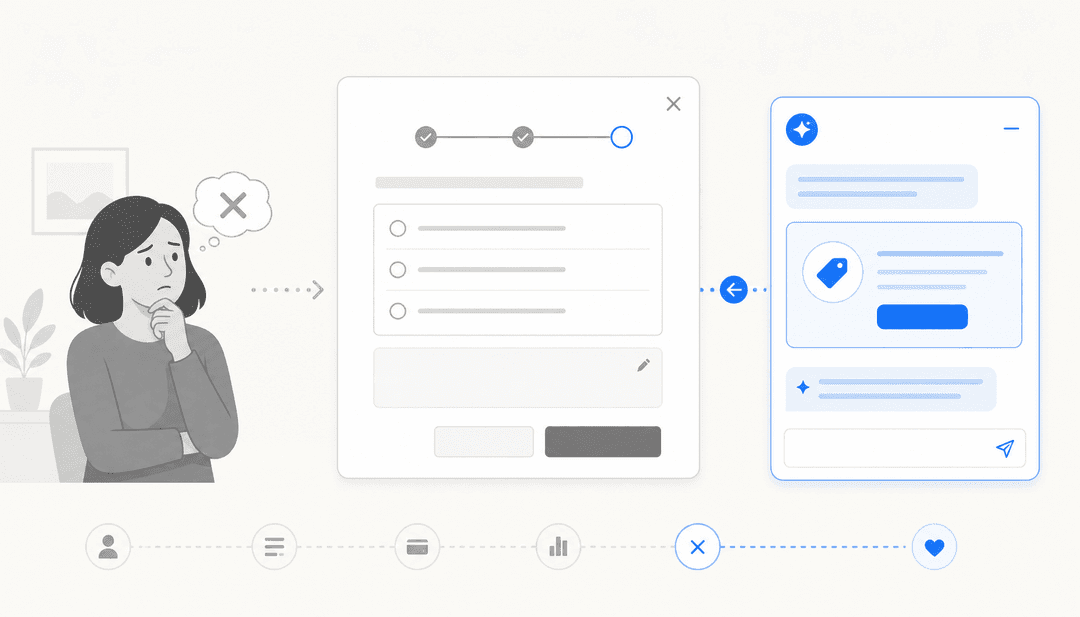
Series A is a pivotal moment. You've proven product-market fit, raised fresh capital, and now you're expected to grow fast. But there's a catch: your customer base is expanding exponentially while your team size grows linearly (if you're lucky). The support queue that was manageable at seed stage now threatens to drown your small team.
AI support offers a practical solution. It isn't a futuristic concept Series A startups are already using it to handle growth without proportional hiring.
The Series A support challenge
Something shifts when you close that Series A round. Suddenly, you're not just building a product; you're building a scalable business. Investors want to see efficient operations, not just growth at any cost.
The math gets brutal quickly. At seed stage, you might have handled 100 tickets per week with two support agents. At Series A, that volume can jump to 1,000+ tickets while your team grows to maybe four or five people. The traditional response, hiring more agents, creates its own problems:
- Each new hire needs 2-4 weeks of training before they're productive
- You're burning runway on salaries before seeing returns
- Quality becomes inconsistent as you scale
- Night and weekend coverage becomes a scheduling nightmare
Meanwhile, your customers expect the same responsive, personalized support they received when you were smaller. The gap between expectations and capacity widens every week.
At eesel AI, we see this pattern all the time. Startups come to us after their first "support emergency" (usually a product launch or viral moment) leaves them with a backlog that takes weeks to clear. The question isn't whether AI can help it's how quickly you can implement it before the next growth spike hits.
Why AI support makes sense for Series A
Here are the numbers. A typical support agent in a Series A startup costs between $50,000-$70,000 annually (salary, benefits, overhead). That agent can handle roughly 40-60 tickets per day once trained.
An AI support solution like eesel AI starts at $239 per month on an annual plan. For the cost of one agent's monthly salary, you get the following:
- Immediate deployment (no training period)
- 24/7 coverage across all time zones
- Consistent quality that doesn't vary with mood or experience
- Handling of unlimited concurrent conversations
The ROI is clear. If your AI handles even 30% of incoming tickets autonomously, you've effectively added capacity equivalent to a full-time agent for a fraction of the cost. Most of our customers at Series A see payback within two months.
Getting value quickly matters at this stage. Traditional enterprise software implementations take months. AI support tools can be connected to your existing help desk in minutes, learning from your past tickets and help center articles immediately. There's no waiting for IT resources or engineering cycles.
Having 24/7 coverage is particularly valuable for Series A startups expanding internationally. You don't need to hire native speakers for every market or maintain expensive night shifts. AI can handle common questions in 80+ languages, escalating only the complex issues that truly need human attention.
The market is already validating this approach. Wonderful, an AI support startup focused on enterprise, recently raised $150 million at a $2 billion valuation. Their customers report up to 60% reduction in handling times and containment rates above 80%. The demand is real and the results are measurable.
Key use cases for AI support at Series A
Not all support tasks are equally suited for AI automation. Here's where we've seen the highest impact for Series A startups:
Frontline ticket resolution
The bulk of most support queues falls into predictable categories: password resets, order status checks, refund requests, feature explanations. These are perfect for AI handling.
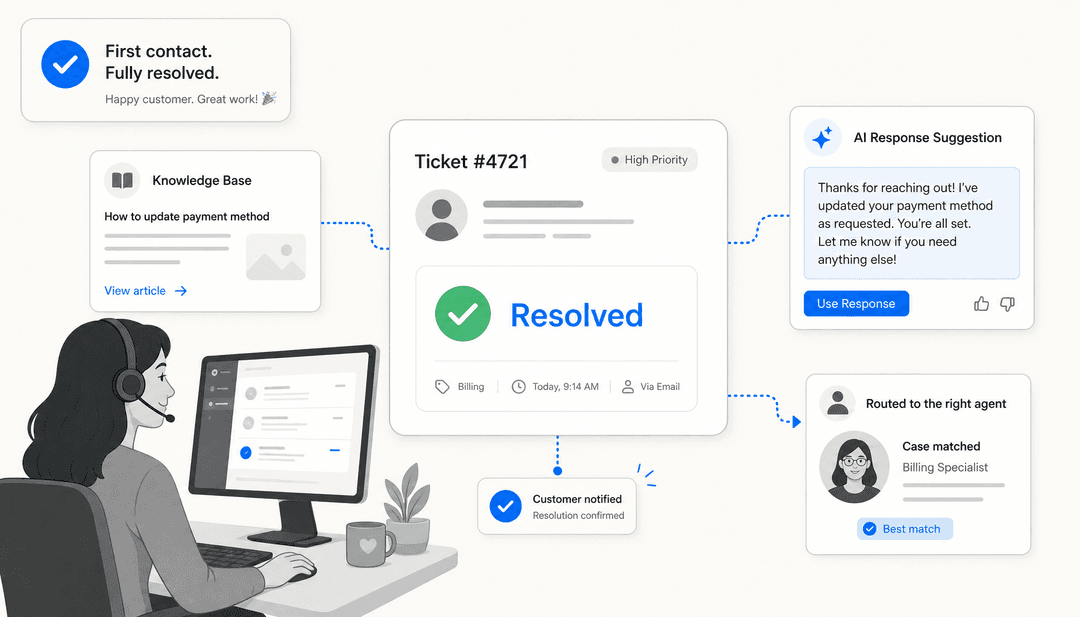
An AI agent can read the incoming ticket, check your knowledge base, and draft a response that matches your team's tone and style. For straightforward issues, it can resolve them completely. For complex ones, it gathers initial information and routes to the right human agent with context.
The key is having clear escalation pathways. You define in plain English when the AI should hand off: "Always escalate billing disputes to a human" or "For VIP customers, CC the account manager." No code required.
Order and account lookups
If you're running an e-commerce or SaaS business, a significant portion of tickets are customers asking about their own data. "Where's my order?" "What's my subscription status?" "Can I change my plan?"
With integrations to Shopify, your help desk, and other systems, AI can look up this information in real time and provide accurate answers. Customers get instant responses instead of waiting for an agent to manually check three different systems.
Multilingual support
Expanding into new markets is a classic Series A growth strategy. But hiring native speakers for every language you want to support is expensive and slow.
AI can handle common questions in virtually any language from day one. This doesn't replace human agents for nuanced conversations, but it does let you offer basic support globally without extra headcount. Companies like Wonderful have built their entire differentiation around non-English markets, proving there's massive demand here.
Internal knowledge access
Your support team isn't the only one with questions. Sales reps need product details. New hires need process guidance. Engineers need documentation.
An AI trained on your internal knowledge base (Confluence, Google Docs, Notion) becomes a 24/7 resource for your entire company. At Series A, when everyone's wearing multiple hats, this kind of instant information access is invaluable.
How to implement AI support progressively
The biggest mistake we see is treating AI support as a binary switch either fully autonomous or not at all. The smarter approach is progressive rollout.
Step 1: Connect your existing help desk
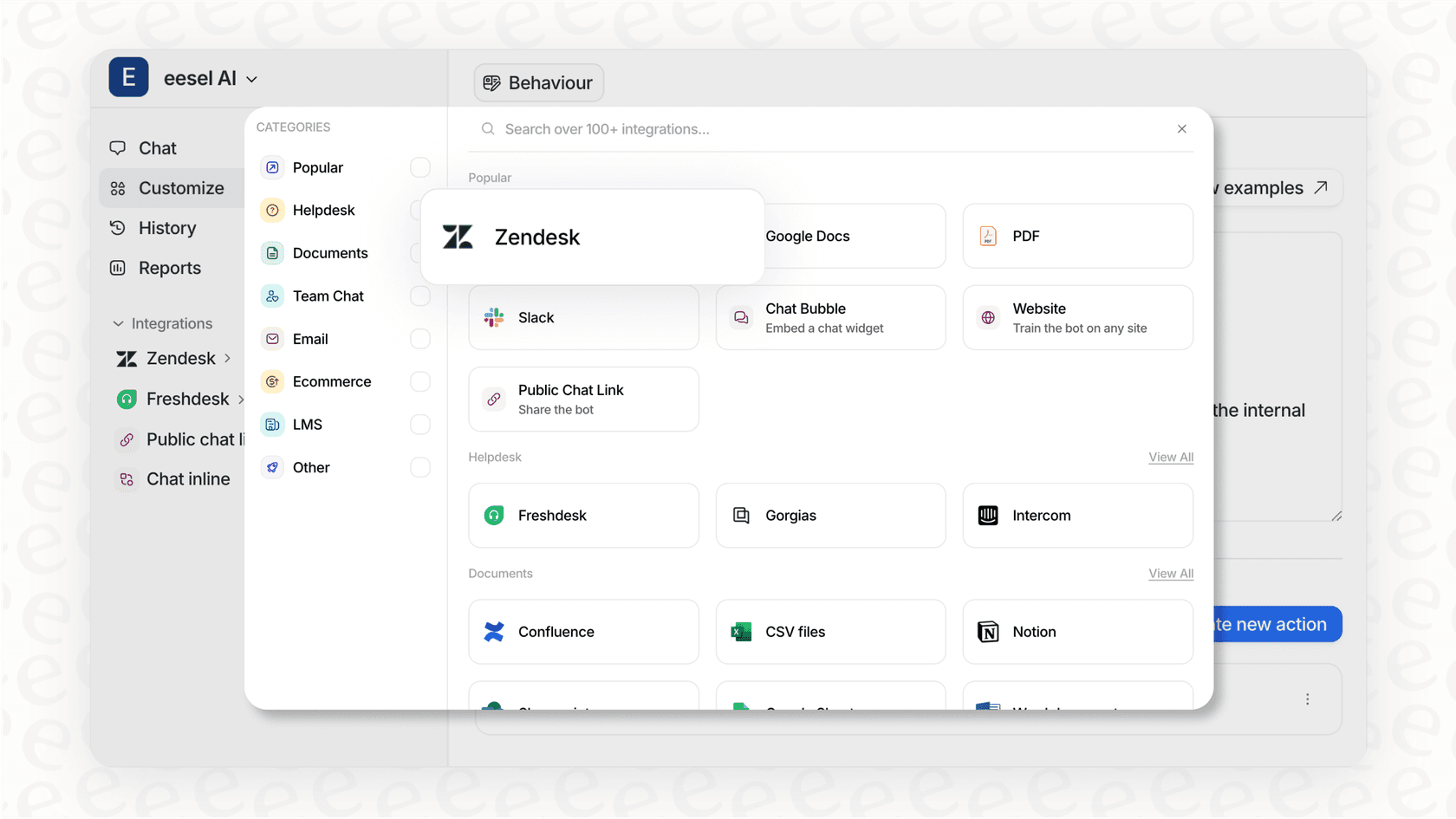
Start by integrating with what you already use. eesel AI connects to Zendesk, Freshdesk, Intercom, Gorgias, Jira, and 100+ other tools in one click.
The AI immediately begins learning from your past tickets, help center articles, macros, and any connected documentation. It studies how your team talks and responds, building an understanding of your business in minutes rather than weeks.
Step 2: Start with guided mode
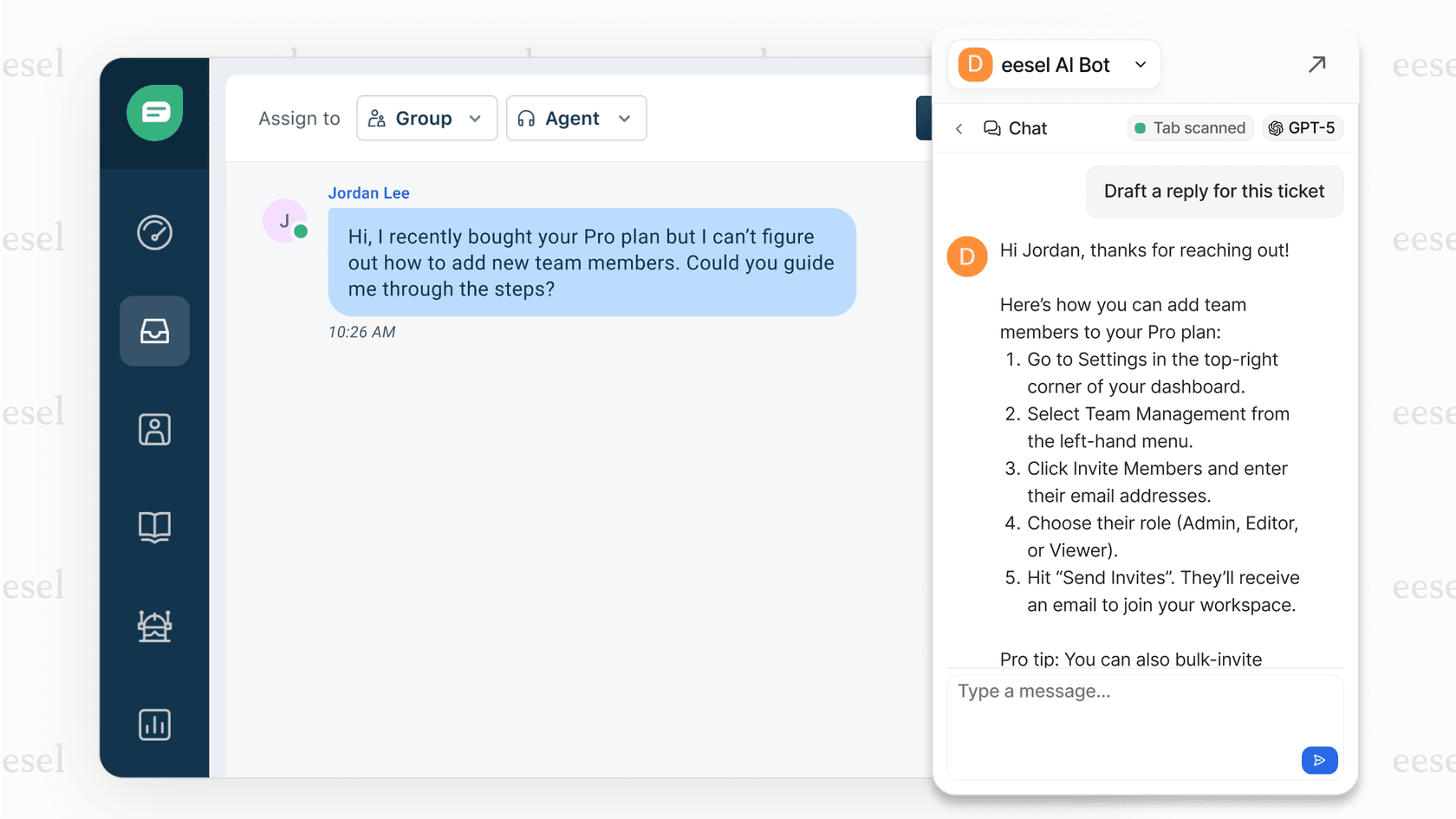
Before letting AI respond directly to customers, use it as a copilot. The AI drafts replies for every incoming ticket, but human agents review and send them.
This builds confidence in the AI's accuracy over time. Agents see the quality improve over days as the AI learns from their edits. They also save significant time, starting from a good draft rather than a blank page.
Step 3: Define escalation rules
Once you're comfortable with draft quality, define when the AI should handle tickets directly versus escalating to humans. This is done in plain English:
- "If the refund request is over 30 days, politely decline and offer store credit"
- "Always escalate billing disputes to a human"
- "For VIP customers, CC the account manager"
No code or complex decision trees required. Natural language instructions that the AI follows.
Step 4: Level up to autonomous
As the AI proves itself, expand its scope. Start with specific ticket types or business hours only. Measure resolution rates, customer satisfaction, and cost per ticket. When metrics look good, expand further.
Most Series A startups reach 50-70% autonomous resolution within their first few months. Some mature deployments achieve up to 81% autonomous resolution.
eesel AI: Built for Series A scaling
We designed eesel AI specifically for the challenges Series A startups face.
The teammate model means you don't "configure" eesel; you hire it. Like any new team member, eesel starts with guidance and levels up to work autonomously. You see how it performs before it's customer-facing by running simulations on past tickets. No surprises or customer complaints revealing problems.
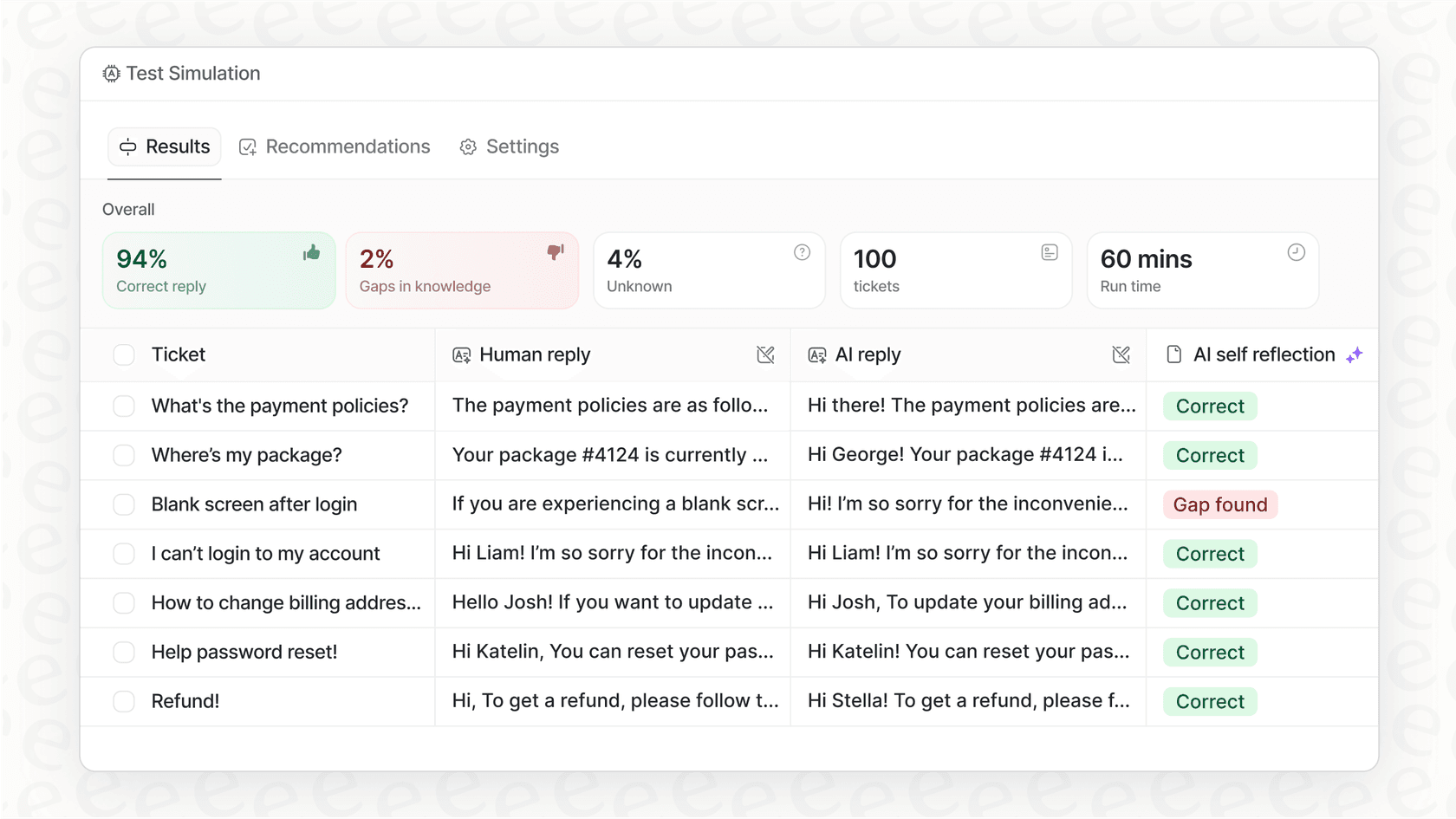
Our simulation feature is particularly valuable at Series A. Before going live, you can run the AI over thousands of past tickets and compare its responses to what humans actually sent. Measure quality, identify gaps, tune prompts. Only when you're confident do you flip the switch.
Pricing scales with usage, not seats. Our Team plan starts at $239 per month (annual) for up to 1,000 AI interactions. The Business plan at $639 per month adds AI Agent capabilities, unlimited bots, and up to 3,000 interactions. No per-seat fees means your costs stay predictable as you grow.
With 100+ integrations, eesel fits into your existing stack without requiring engineering resources. Connect your help desk, knowledge sources, and internal tools in minutes.
Measuring success: KPIs for AI support
How do you know whether your AI support investment is paying off? Track these metrics:
| KPI | What to Measure | Target |
|---|---|---|
| Autonomous resolution rate | % of tickets resolved without human intervention | 50-80% |
| Cost per ticket | Total support costs / tickets handled | Decrease 30-50% |
| Customer satisfaction (CSAT) | Post-resolution satisfaction scores | Maintain or improve |
| Time to first response | Average time before customer gets initial reply | Under 1 minute |
| Agent productivity | Tickets handled per agent per day | Increase 2-3x |
The goal isn't maximizing autonomous resolution at the expense of quality. It's finding the right balance where routine tickets get instant, accurate responses while complex issues receive human attention.
Getting started with AI support for your Series A startup
If you're at Series A and feeling the support crunch, here's a practical path forward:
-
Start with a free trial. Most AI support tools, including eesel AI, offer 7-day trials. Use this to test the integration with your help desk and see initial results.
-
Run simulations on past tickets. Before touching real customers, measure how the AI would have performed on your historical data. This builds the business case for your board.
-
Start small, expand fast. Begin with copilot mode (drafting for review), then gradually expand autonomous handling as confidence builds.
-
Measure everything. Track the KPIs above from day one. Series A investors love data-driven decisions, and you'll want proof that the investment is working.
Companies that get AI support right at Series A don't just save money. They deliver better customer experiences, scale faster, and free their human agents to focus on the complex, high-value conversations that actually move the business forward.
Ready to see how AI support could work for your startup? Try eesel AI free for 7 days and run simulations on your past tickets. No credit card required.
Frequently Asked Questions

Share this article

Article by
Stevia Putri
Stevia Putri is a marketing generalist at eesel AI, where she helps turn powerful AI tools into stories that resonate. She’s driven by curiosity, clarity, and the human side of technology.