The top 7 Baseten alternatives for AI/ML model deployment in 2025


Last edited November 14, 2025
Table of Contents
Getting your AI model out of a cozy Jupyter notebook and into a live, production environment is where things get real. It’s the part of the project that can quickly spiral into a mess of managing servers, untangling dependencies, and praying your scaling setup holds up.
Platforms like Baseten popped up to make this whole process less painful. But let’s be real, their solution isn't the perfect fit for everyone. Plenty of teams start hunting for Baseten alternatives because they’re getting hit with high costs, need more control over their stack, or are looking for specific features Baseten just doesn't have.
This guide will give you a straight-up, practical comparison of the best Baseten alternatives out there in 2025, so you can pick the right tool for your project without the headache.
And while these platforms are fantastic for ML engineers building out custom infrastructure, it’s worth remembering that many teams (especially in customer support) can get amazing AI automation without ever touching this level of complexity. More on that later.
What is Baseten?
Baseten is a platform built to help teams get their machine learning models served, monitored, and updated quickly. Its big promise is to shorten the road from a trained model to a live API that people can actually use.
It’s known for its Truss packaging framework, which helps keep deployments consistent, and its simple UI components for spinning up basic frontends. It's a decent pick for developers and smaller teams who want to get to production without hiring a dedicated DevOps crew.
So why is everyone looking for an alternative? It usually boils down to a few familiar frustrations:
-
Surprise bills: Pricing based on compute usage can get out of hand, especially when traffic starts to ramp up.
-
Feeling boxed in: Baseten's managed environment can feel a bit restrictive if you need to install custom dependencies or run services that aren't written in Python.
-
Lack of control: Sometimes you just want to self-host or get deeper integrations with your existing CI/CD pipelines, which can be a tough ask on a fully managed platform.
How we picked the best Baseten alternatives
This isn't just a random list we threw together. We picked these platforms based on what actually matters when you're trying to get a model off the ground today.
Here’s what we looked for:
-
Speed and scale: How fast can it handle requests (think inference speed and those dreaded cold starts)? And how does it cope when a sudden flood of traffic hits?
-
Developer experience: How much of a pain is it to get a model live? Does it let you bring your own custom containers for flexibility, and does it play nice with standard tools like Git?
-
Cost: Is the pricing clear and predictable? You shouldn't need a PhD in spreadsheetology to figure out what your bill is going to be.
-
The right tool for the job: Is the platform built for quick demos, heavy-duty production workflows, or massive enterprise apps?
A quick comparison of the top Baseten alternatives
Here’s a simple table to give you the lay of the land before we jump into the details.
| Platform | Best For | Pricing Model | Key Feature | Runtime Control |
|---|---|---|---|---|
| Runpod | Low-cost, flexible GPU compute | Pay-as-you-go (per hour/sec) | Secure & Community Cloud GPUs | High (Bring Your Own Container) |
| Modal | Serverless Python workflows | Pay-as-you-go (compute time) | Python-native infrastructure | Medium (Python environments) |
| Northflank | Production AI apps with DevOps control | Usage-based containers | Git-based CI/CD & full-stack support | High (Bring Your Own Docker image) |
| Replicate | Public generative model demos | Pay-as-you-go (per second) | Simple API for community models | Low (Uses Cog packaging) |
| Hugging Face | Community-driven open-source development | Tiered (Free, Pro, Enterprise) | Inference Endpoints & Model Hub | Medium (Managed endpoints) |
| AWS SageMaker | Enterprise MLOps on AWS | Pay-as-you-go (complex) | End-to-end ML lifecycle tools | High (Deep AWS integration) |
| Google Vertex AI | Integration with the Google Cloud ecosystem | Pay-as-you-go (complex) | Access to Gemini & Model Garden | High (Deep GCP integration) |
The 7 best Baseten alternatives for your AI/ML stack in 2025
Alright, let's get into it. Here are the top platforms that are giving Baseten a serious run for its money.
1. Runpod
Runpod is all about giving you cheap and scalable GPU power without the extra fluff. It's less of a hand-holding, fully managed platform and more of an infrastructure provider that gives you the raw horsepower and freedom to build what you want.
Pros:
-
Cheap GPUs: Runpod has some of the best GPU prices you'll find, especially if you explore its Community Cloud options.
-
Total control: You can bring your own container (BYOC), which means you have complete say over your environment, libraries, and dependencies.
-
Scales to zero: Its serverless option is great for workloads that aren't always running, saving you cash when things are quiet.
Cons:
-
More hands-on: You'll need more technical chops to get set up and manage it compared to Baseten. You’re definitely closer to the metal here.
-
Lacks MLOps extras: It doesn't have the fancy built-in governance, monitoring, or end-to-end MLOps features you'd see on more enterprise-focused platforms.
Pricing: Runpod is a pay-as-you-go service. You can rent GPU instances by the hour or use their serverless compute, which bills you by the second.
| Compute Type | Example GPU | Price (Secure Cloud) |
|---|---|---|
| GPU Pods | RTX A6000 (48GB) | ~$0.33/hr |
| GPU Pods | A100 (80GB) | ~$1.19/hr |
| GPU Pods | H100 (80GB) | ~$1.99/hr |
| Serverless | L40S (48GB) | ~$0.00053/sec |
Who it's for: Developers and researchers who are comfortable in a Docker environment and want to get the most performance for their money.
2. Modal
Modal has a unique and, honestly, pretty magical way of doing things. It makes deploying complex Python code feel like you're just importing another library. You define your infrastructure right inside your Python script with decorators, and Modal handles the ugly parts like packaging, scaling, and serving.
Pros:
-
Incredible developer experience: If you live and breathe Python, Modal just clicks. No YAML, no Dockerfiles, just Python.
-
Super fast: It claims sub-second cold starts and can spin up thousands of containers almost instantly.
-
Cost-effective: You only pay for the exact compute time you use, which is ideal for tasks that run in short bursts or infrequently.
Cons:
-
Python-only: Its greatest strength is also its biggest weakness. If you have non-Python parts of your app (like a Node.js frontend), you'll need to host them somewhere else.
-
Less direct control: You're playing in Modal's Python sandbox, so you don't get the same fine-grained container control as you would with Runpod or Northflank.
Pricing: Modal has a pretty solid free tier, and then it's pay-as-you-go from there.
| Plan | Price | Included |
|---|---|---|
| Starter | $0/month | $30 in free compute credits per month. |
| Team | $250/month + compute | $100 in free compute credits, unlimited seats, higher concurrency. |
| Enterprise | Custom | Volume discounts, private support, advanced security features. |
GPU jobs are billed by the second, with an Nvidia A10G running about $0.000306/sec and an H100 at $0.001097/sec.
Who it's for: ML engineers and data scientists who want to deploy Python functions, batch jobs, or APIs without ever having to think about servers again.
3. Northflank
Northflank gets that you’re not just deploying a model; you’re building a whole product. It blends the ease of a Platform-as-a-Service (PaaS) with the power of containers, GPU support, and a proper CI/CD workflow.
Pros:
-
Full-stack friendly: You can deploy your frontend, backend, databases, and cron jobs all in the same place as your AI models.
-
Real DevOps control: It offers a Git-based workflow, creates preview environments for your pull requests, and lets you bring your own Docker image for total control.
-
Clear pricing: The usage-based pricing is easy to understand and forecast, and it comes with strong security features like SOC 2 readiness.
Cons:
-
A bit of a learning curve: Because it does more, there might be a bit more to learn upfront compared to a simpler, model-only platform.
-
Not a specialized tuner: It's a general-purpose deployment platform, so it doesn't offer built-in optimizations for specific model architectures.
Pricing: Northflank has a pay-as-you-go model based on the resources you use, with a free tier to kick the tires. You pay for CPU, memory, and GPU usage by the hour or month.
| Resource | Price |
|---|---|
| CPU | $0.01667/vCPU/hour |
| Memory | $0.00833/GB/hour |
| NVIDIA H100 GPU | $2.74/hour |
| NVIDIA B200 GPU | $5.87/hour |
Who it's for: Teams building actual, production-ready AI products who need a modern DevOps workflow, full-stack capabilities, and solid CI/CD.
4. Replicate
Replicate has become the go-to spot for running and sharing public AI models, especially all the cool generative stuff (think images, video, and audio). It makes turning a popular open-source model into a production API almost laughably simple.
Pros:
-
Super easy to get started: You can run thousands of community models with a quick API call, no setup required.
-
Giant model library: It has a huge, active community that's always adding and updating the latest and greatest open-source models.
-
Pay only for what you use: It's serverless and scales to zero automatically, so you're only billed for the exact time your model is running.
Cons:
-
Not for private stuff: It’s built for public models. If you're trying to deploy a proprietary, business-critical model, this isn't the place.
-
Light on enterprise features: You won’t find advanced CI/CD, strict security controls, or dedicated support here.
Pricing: Replicate is purely pay-as-you-go, billed by the second for whatever GPU your model needs. It can get pricey for high-traffic apps, but it’s perfect for experiments and demos.
| Hardware | Price per Second |
|---|---|
| CPU | $0.000100 |
| Nvidia T4 GPU | $0.000225 |
| Nvidia L40S GPU | $0.000975 |
| Nvidia A100 (80GB) GPU | $0.001400 |
Who it's for: Developers, artists, and researchers who want to quickly play with, build demos on, or integrate public generative AI models into their apps.
5. Hugging Face
Hugging Face is basically the GitHub for AI. It’s the central hub where everyone collaborates on models, datasets, and apps. Their Inference Endpoints product is a managed way to grab any model from the Hub and deploy it as a production API.
Pros:
-
Access to everything: You get a direct line to over a million open-source models and datasets. It's an incredible resource.
-
Simple deployment: Taking a model from the Hub to a live endpoint is just a few clicks.
-
Amazing community: The documentation, tutorials, and community support are top-notch.
Cons:
-
Can get expensive: The community resources are free, but running a dedicated Inference Endpoint on a GPU can cost more than just renting one from a provider like Runpod.
-
Not a full-stack platform: It's focused on models, not deploying entire applications or handling the complex governance needs of big companies.
Pricing: Hugging Face has plans for organizations and pay-as-you-go pricing for compute.
| Plan/Service | Price | Details |
|---|---|---|
| Pro Account | $9/month | A boost for your personal account. |
| Team | $20/user/month | For growing teams, includes SSO and audit logs. |
| Spaces Hardware | From $0/hr (CPU) to $4.50/hr (H100) | On-demand hardware for hosting demos. |
| Inference Endpoints | From $0.50/hr (T4) to $4.50/hr (H100) | Dedicated, autoscaling infrastructure for production. |
Who it's for: AI researchers and developers who are all-in on the open-source ecosystem and want an easy way to deploy models straight from the Hugging Face Hub.
6. AWS SageMaker
SageMaker is Amazon's beast of an MLOps platform. It’s a massive, end-to-end solution for everything from data labeling and training to deployment and monitoring, all tightly integrated with the rest of the sprawling AWS universe.
Pros:
-
Enterprise-ready: It's loaded with features for governance, security, and compliance, making it a safe bet for large, regulated companies.
-
Serious automation: Its MLOps tools are built to manage hundreds or even thousands of models at scale.
-
Deep AWS integration: If your company already runs on AWS, it connects perfectly with services like S3, IAM, and Redshift.
Cons:
-
Wildly complex: The learning curve is steep, and just figuring out which of its countless features you need can be a full-time job.
-
Confusing pricing: AWS pricing is notoriously hard to predict. SageMaker bills you for dozens of different things, making it almost impossible to guess your costs.
Pricing: SageMaker uses a complex pay-as-you-go model where you're billed separately for notebook hours, training hours, inference hours, storage, and more. For instance, a "ml.g5.xlarge" inference instance costs about $1.43/hour. You pay for what you use, but good luck figuring out what you'll actually use.
Who it's for: Big companies with dedicated MLOps teams and a deep commitment to the AWS ecosystem. For almost everyone else, it’s total overkill.
7. Google Vertex AI
Vertex AI is Google Cloud's answer to SageMaker. It's a unified AI platform that gives you access to Google's own top-tier models (like Gemini), AutoML tools, and all the infrastructure for custom model training and deployment.
Pros:
-
Access to Google's models: You can easily tap into powerful models like Gemini and Imagen without leaving the platform.
-
All-in-one platform: It gives you a single place to manage both pre-trained and custom models, which can simplify your workflow.
-
Solid MLOps tools: Like SageMaker, it has a whole suite of tools for automating the machine learning lifecycle.
Cons:
-
GCP lock-in: It's really designed for teams that are already bought into the Google Cloud Platform.
-
Complex pricing: Just like AWS, its pay-as-you-go pricing is spread across a bunch of different services, which can be a pain to track.
Pricing: Vertex AI gives new customers a $300 free credit, then moves to a pay-as-you-go model. For example, training a custom model on an "n1-standard-4" machine is about $0.22/hour, while running predictions on that same machine is around $0.219/hour. Adding an "NVIDIA_TESLA_T4" GPU for training costs an extra $0.40/hour. Prices vary a lot by region and machine type.
Who it's for: Enterprises and developers who are building on GCP and want to use Google's powerful AI models and scalable infrastructure.
How to choose the right Baseten alternatives for you
Okay, that was a lot. So how do you actually pick one? It really comes down to what you and your team need most.
What’s your main priority: Cost, control, or convenience?
-
For the absolute cheapest GPU time, and you don't mind getting your hands dirty, check out Runpod.
-
For maximum control, a full DevOps workflow, and CI/CD, Northflank is your best bet.
-
For the most convenient, "it just works" experience for Python developers, you can't beat Modal.
Are you deploying just a model or a full product?
If you're building a whole application with a frontend, backend, and database, a platform like Northflank is designed for exactly that. If you just need a single model API and nothing else, one of the other options might be a simpler choice.
How much infrastructure do you actually want to manage?
If the answer is "as little as humanly possible," then Modal and Replicate are your friends. If you want full container-level control to tweak everything, Runpod and Northflank will feel right at home.
Are you already tied to an ecosystem?
If your whole company runs on AWS or GCP, the deep integrations from SageMaker or Vertex AI can be a big plus, even with their complexity.
But are you sure you even need a model deployment platform?
Here’s maybe the most important question of all. Platforms like Baseten and its alternatives are built for developers who are managing AI infrastructure. That work is often slow, expensive, and completely unnecessary if your real goal is to solve a business problem, like cutting down on customer support tickets.
For a job like customer support, you don't need to deploy a model; you need to resolve tickets. This is where a specialized, self-serve AI platform changes everything.
This is exactly what a tool like eesel AI does. It's an AI agent platform that connects directly to the tools your support team already uses, like Zendesk, Intercom, and your knowledge bases.
-
Go live in minutes, not months. You can forget about engineering sprints. With one-click integrations and a truly self-serve setup, you can get eesel AI running on your own time, without ever having to talk to a salesperson.
-
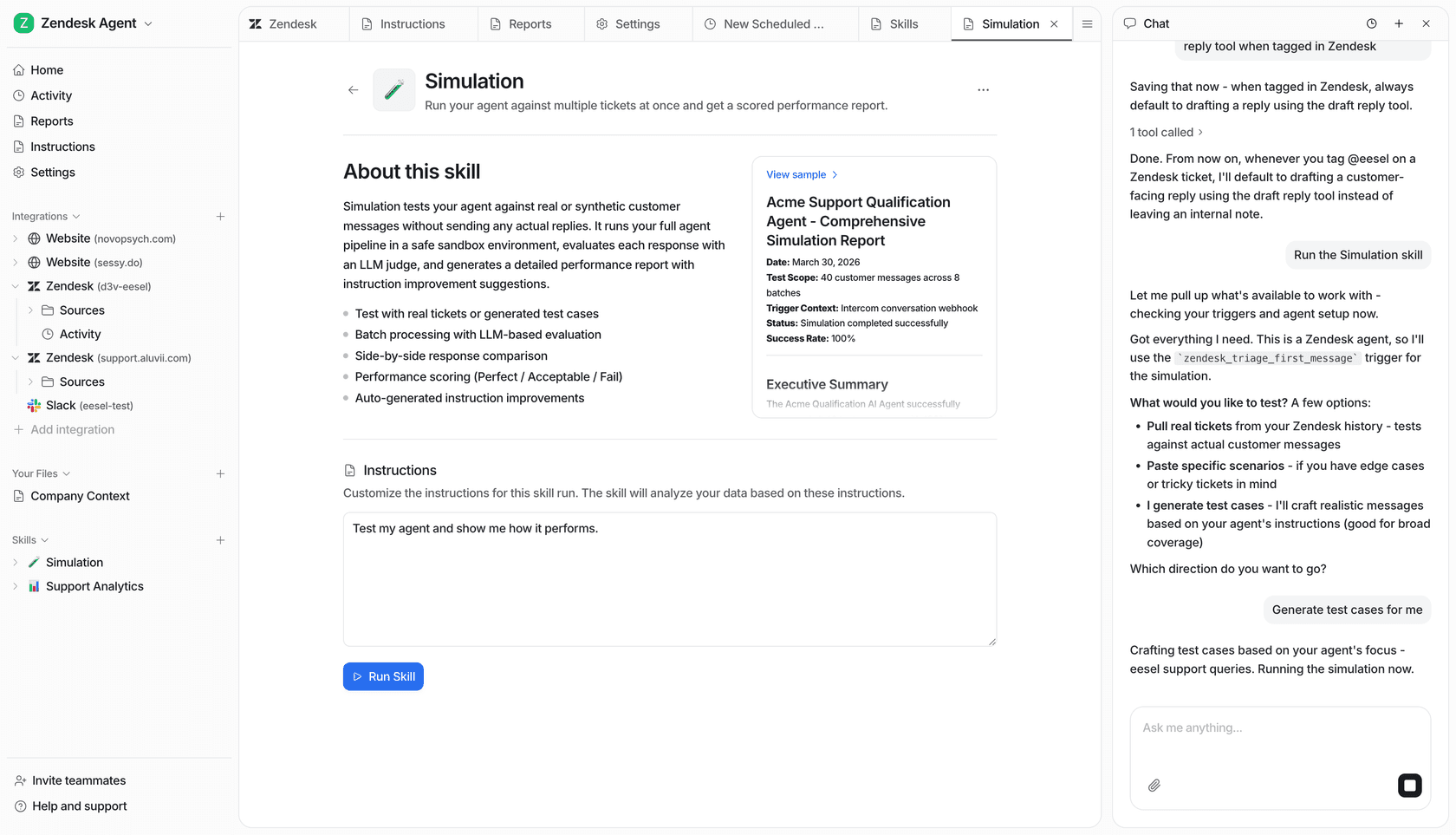
Test with zero risk. eesel AI has a powerful simulation mode that shows you precisely how the AI would have handled thousands of your past tickets before it ever interacts with a live customer. This takes all the guesswork out of the equation.
-
Get full control without writing code. You get fine-grained controls to decide exactly which tickets to automate and an easy-to-use prompt editor to shape the AI's personality and actions. It can pull knowledge from places like Google Docs and Confluence.
-
Pricing that makes sense. eesel AI’s pricing is based on a set number of AI interactions, not confusing compute hours or fees per resolution. Your costs are always predictable, so you’re never punished for being successful.
Final thoughts
The world of AI deployment is packed with great Baseten alternatives, each built for a different kind of job. Whether you need the raw, cheap GPU power of Runpod, the slick Python experience of Modal, or an enterprise goliath like AWS SageMaker, there’s a tool out there for you.
The right choice depends on your team's skills, budget, and what you’re ultimately trying to build.
But if your goal is to deliver fantastic customer support with AI, you don't need to become an MLOps expert. You just need a solution that understands your team's workflow from day one.
Start your free eesel AI trial and see for yourself how quickly you can automate your frontline support.
Frequently asked questions

Share this article

Article by
Kenneth Pangan
Writer and marketer for over ten years, Kenneth Pangan splits his time between history, politics, and art with plenty of interruptions from his dogs demanding attention.