What is Hugging Face? A 2026 guide for business teams


Last edited November 6, 2025
Spend five minutes in any AI-focused corner of the internet, and you'll probably bump into the name Hugging Face. It gets called the "GitHub for machine learning" so often it’s practically its official nickname, and for good reason. It’s a huge, collaborative space where the global AI community builds, shares, and works on the latest models and tools. It's played a huge part in making powerful AI, especially for understanding language, available to developers everywhere.
But while engineers love it, what does Hugging Face actually mean for a business that just wants to use AI to improve something like customer support? This guide will break down what Hugging Face is, its key parts, how businesses are using it, and, most importantly, the real costs of turning its powerful tech into a practical tool for your team.
What is Hugging Face?
At its heart, Hugging Face is both a company and an open-source platform that gives people the tools to build, train, and launch advanced machine learning models. It’s not just one thing, but a mix of three key parts that work together:
-
A community hub: Think of it as a massive online library with over a million models, hundreds of thousands of datasets, and even AI apps (called Spaces) that you can try out. It’s the first stop for anyone looking for pre-built AI components.
-
A set of tools: It’s best known for its Transformers library, a bit of software that makes it much, much easier to use incredibly complex models like Google’s BERT or Meta’s Llama 3.
-
An infrastructure provider: For companies that want to use these models in their own applications, Hugging Face offers paid services to host and run them.
Here's a simple way to think about it: Hugging Face provides developers with the raw ingredients (models and datasets) and the kitchen tools (libraries) to create their own custom AI applications.
The Hugging Face ecosystem explained
To really get what Hugging Face is about, it helps to understand its main components. They all fit together to support a machine learning project from start to finish, from finding a model to getting it running in a live app.
The Hugging Face Hub: A marketplace for models, datasets, and spaces
The Hub is the core of the whole platform. It’s where everything is shared, found, and tested.
-
Models: This is where you can find thousands of pre-trained models for almost any task you can think of, from writing text and translating languages to identifying images and processing audio. Big tech companies like Google, Meta, and Microsoft all share their models here.
-
Datasets: This is a huge collection of data used to train or fine-tune models. If you want a model to do something specific, like understand legal documents or medical notes, you’ll need a specialized dataset to teach it.
-
Spaces: These are simple, interactive web apps that let you play around with a model right in your browser. It’s a fantastic way to see what a model can do without having to write a single line of code.
Hugging Face core libraries: Transformers, diffusers, and more
The models on the Hub would just be static files if it weren't for the software libraries that bring them to life.
-
Transformers: This is the library that really put Hugging Face on the map. It offers a simple, standard way to download and use thousands of different models for text and speech. A task that used to be a complicated research project can now be done with just a few lines of code because of this library.
-
Other Libraries: Hugging Face also supports other popular libraries, like "Diffusers" for working with image generation models (like Stable Diffusion) and "Datasets" for loading and preparing data for training.
How businesses use Hugging Face (and the challenges they run into)
Businesses can tap into the Hugging Face ecosystem to build their own powerful, custom AI tools from the ground up. Here are a few common ways they’re putting it to work.
Common business use cases
-
Chatbots and virtual assistants: Using powerful language models like Llama 3 or Mistral to build conversational bots for customer support or internal help desks.
-
Content generation and summarization: Automating the creation of marketing emails, blog posts, or social media updates, and quickly summarizing long reports or meeting notes.
-
Code generation: Using models like StarCoder to help developers write code more quickly and with fewer mistakes.
-
Semantic search: Building internal search tools that understand the meaning of a question, not just the keywords. This is a popular way to create more helpful internal knowledge bases.
The reality check: It’s not plug-and-play
Okay, so here's the catch. While the building blocks on Hugging Face are free and easy to access, assembling them into a dependable business tool is a serious project.
Using Hugging Face properly means having a dedicated team of machine learning engineers and data scientists. Getting a model up and running isn't a one-click affair; it involves writing Python code, managing cloud services on platforms like AWS or Azure, and sorting out complex problems like memory errors and conflicting software versions.
There’s also a huge gap between a generic model you download and a functional business tool. A raw language model knows nothing about your company's products, internal policies, or past customer conversations. To be useful, it needs to be connected to your knowledge sources like Zendesk, Confluence, and your internal docs. It also has to be programmed with your company’s logic, like when to hand a conversation over to a human agent or how to check an order status.
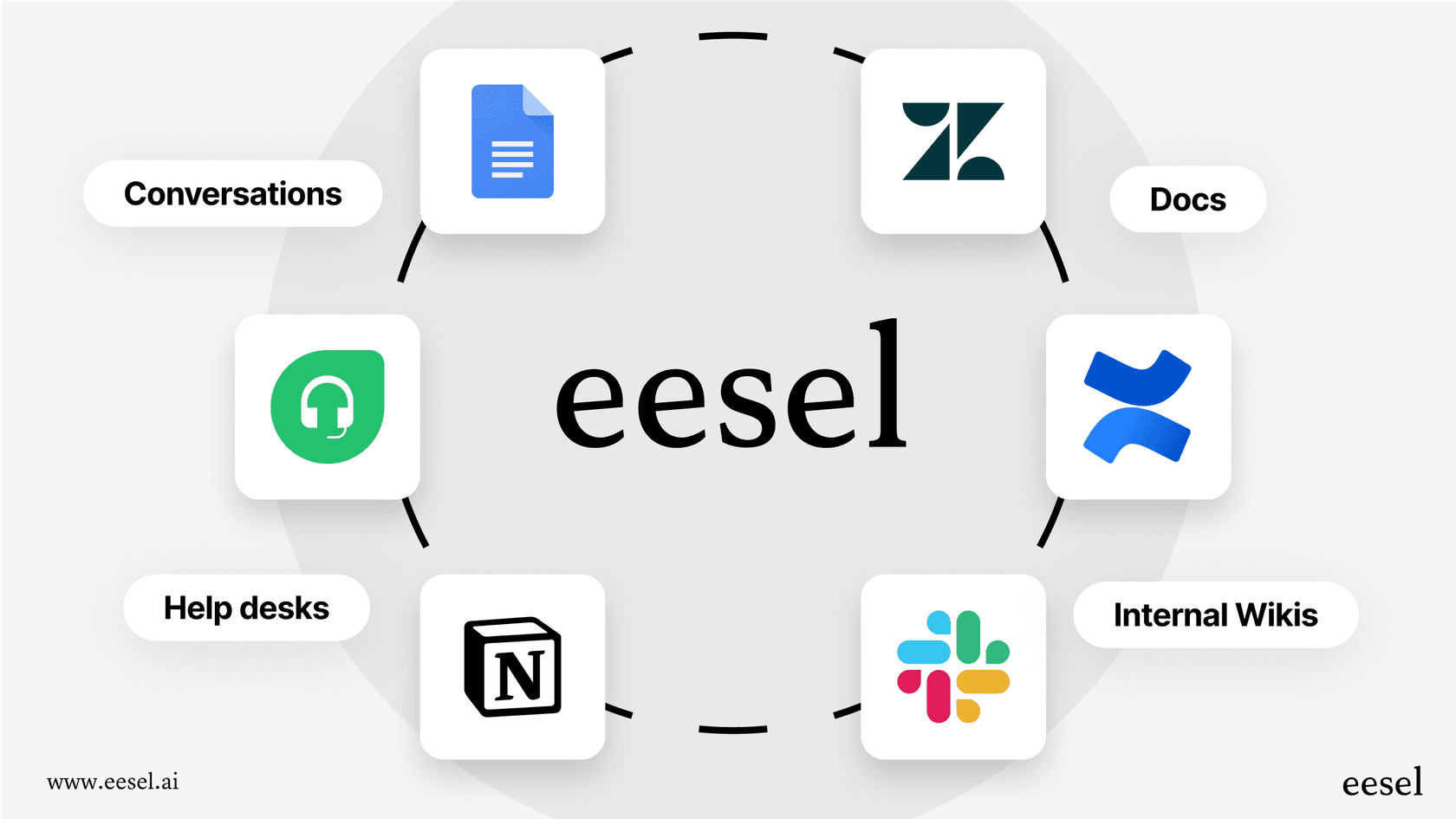
This is where the DIY approach starts to show its limits. Building a support automation tool from scratch can take months of engineering time and effort. In contrast, platforms like eesel AI are built to handle this exact problem. You can connect your knowledge sources with a single click and launch a fully functional AI agent in minutes, not months, without ever needing to write code.
Understanding Hugging Face pricing and the true cost of DIY AI
While a lot of the Hugging Face ecosystem is open-source and free, using its models for a real business involves costs that go way beyond a monthly subscription.
Subscription plans
First, let's look at the platform's own subscription tiers, which are mainly for team collaboration and hosting models.
| Plan | Price | Key Features |
|---|---|---|
| Free | $0 | Public repositories, access to community models and datasets. |
| PRO | $9/month | Increased private storage, higher priority for free GPU usage, private dataset viewer. |
| Team | $20/user/month | Centralized billing, SSO support, audit logs, resource groups for collaboration. |
| Enterprise | Custom (Starts at $50/user/month) | All Team features plus dedicated support, managed billing, and advanced security. |
Compute costs: Inference endpoints and spaces
The subscription is just the tip of the iceberg. The real expense is paying for the computing power (CPU and GPU instances) needed to actually run the models. Services like Inference Endpoints and Spaces Hardware are billed by the hour, with prices starting at a few cents for a basic CPU and going up to over $36 per hour for a single high-end GPU machine.
The hidden costs: Your team, time, and upkeep
The biggest cost of a DIY AI project won't show up on your Hugging Face bill. It's the combined salaries of the machine learning engineers and data scientists you’ll need to hire to build, launch, and maintain the system.
On top of that, compute costs can be very unpredictable. A sudden spike in customer questions means you have to start up more expensive GPU instances to handle the demand, which can lead to a surprise bill at the end of the month.
This kind of variable, multi-layered cost structure can be a real headache for businesses. For more predictable budgeting, an all-in-one platform is often a much better fit. eesel AI offers clear, fixed-fee plans that don't charge you per customer resolution. This means your costs stay the same even during your busiest months, and you get a fully managed solution without needing an in-house AI team.
Hugging Face: A powerful toolkit that needs a skilled builder
Hugging Face is an amazing and vital resource for the AI community. It gives people incredible access to models and tools, which helps drive innovation everywhere.
For businesses, though, it’s important to remember that it provides the low-level building blocks, not a finished product. You're responsible for putting those blocks together into something that’s reliable, secure, and ready for your customers. This DIY path requires a big, ongoing investment in specialized talent, pricey infrastructure, and a whole lot of time.
Your next step: From DIY complexity to a ready-made solution
You really have two choices: build from scratch, with all the costs and headaches that come with it, or adopt a solution that was designed from day one for your business needs.
If you’re looking to use the power of advanced AI for customer support without the engineering overhead, eesel AI offers a much smarter way forward. Just connect your knowledge, define your workflows, and launch a powerful AI agent that’s trained on your business data from the start. Start your free trial today and see how easy it can be to automate support when you have the right tool for the job.
Frequently asked questions

Share this article

Article by
Kenneth Pangan
Writer and marketer for over ten years, Kenneth Pangan splits his time between history, politics, and art with plenty of interruptions from his dogs demanding attention.