OpenEvidence AI: What it is & what it means for support teams in 2026


Last edited June 24, 2026

It feels like a new AI tool pops up every single day, right? But every now and then, one comes along that really makes you sit up and take notice. For me, that’s OpenEvidence AI. It’s a tool built for doctors, but its wild success is a masterclass in how to build AI that people actually trust and use in a high-stakes job.
So, what exactly is OpenEvidence AI, and why should a customer support leader care?
What is OpenEvidence AI?
At its heart, OpenEvidence is an AI assistant designed to help healthcare professionals make better clinical decisions. It lets verified clinicians ask complicated medical questions in plain English and get back accurate, evidence-backed answers almost instantly. Think of it as having a brilliant medical consultant on call 24/7.
The platform’s real magic isn’t just its AI model, but where it gets its information. Every answer comes from trusted, peer-reviewed medical sources like The New England Journal of Medicine (NEJM), JAMA, and the NCCN Guidelines®. This focus on reliable sources means doctors can feel confident using the information when making important decisions about patient care.
To keep the quality high, OpenEvidence is only available to verified healthcare professionals who have a National Provider Identifier (NPI) number. This gatekeeping has clearly worked. By OpenEvidence's own count, the platform is used across more than 10,000 hospitals and by over 40% of U.S. physicians, and on March 10, 2026 it logged a million clinical consultations in a single day. That kind of growth, driven by a "Direct to Clinician" approach, shows that when you give professionals a tool that’s both powerful and easy to use, they’ll actually use it. A lot.
Key lessons from OpenEvidence AI's success for support teams
Okay, so OpenEvidence AI has clearly figured out its niche. But the reasons it works so well are universal and have everything to do with the world of customer support. The platform gives us a blueprint for moving away from clunky, generic chatbots and toward genuinely intelligent AI agents for support.
Lesson 1: Generic AI isn't enough, context is king
The secret sauce for OpenEvidence AI is its highly curated, domain-specific knowledge. It gives reliable answers because it's trained on expert medical literature, not the entire, chaotic internet. It gets the nuances of medicine because its entire world is medicine.
This is a painful lesson many support teams have already learned. Generic AI assistants often fall flat because they have zero business context. They don’t know your specific return policy, the five steps to troubleshoot your main product, or the friendly brand voice you’ve spent years building. This just leads to frustrated customers and more work for your human agents who have to jump in and fix the mess.
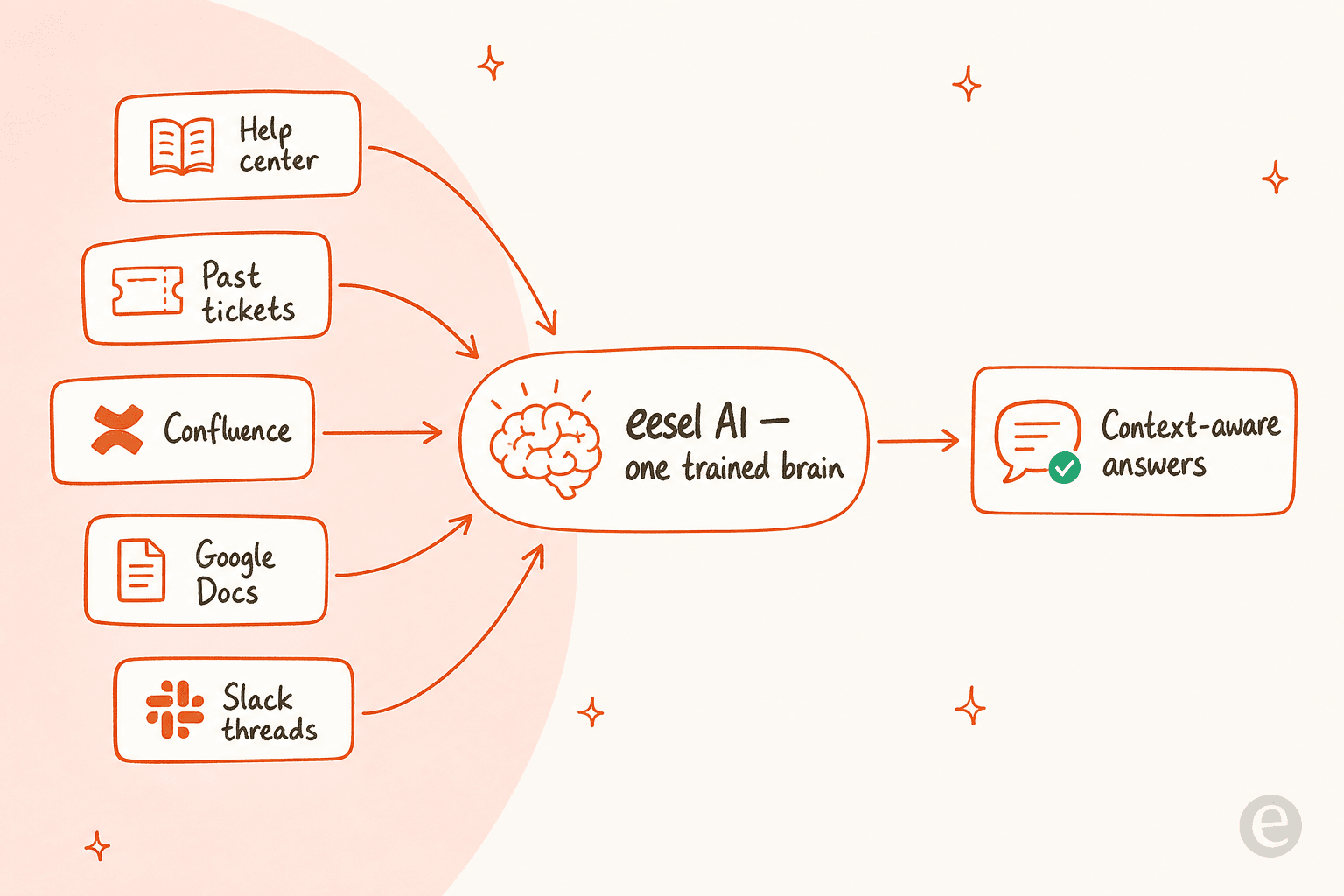
This is exactly why a specialized platform like eesel AI is so much more effective for support teams. It’s built to learn from your company’s unique knowledge. It doesn't just know about customer service automation in general; it knows how your team handles support. By connecting directly to your past support tickets, internal wikis in Confluence, and docs in Google Docs, it can provide answers with the same kind of contextual accuracy that doctors get from OpenEvidence.
Lesson 2: Trust is built on evidence and accuracy
In medicine, you can't mess around with trust. A wrong answer can have serious consequences. OpenEvidence AI builds confidence by citing its sources for every single answer, letting doctors quickly check the information and see the evidence for themselves.
Customer trust is also incredibly fragile. An AI that "hallucinates" a wrong answer or makes up a company policy can destroy a customer relationship in seconds. You can't afford to gamble with a tool that might confidently steer a customer in the wrong direction.
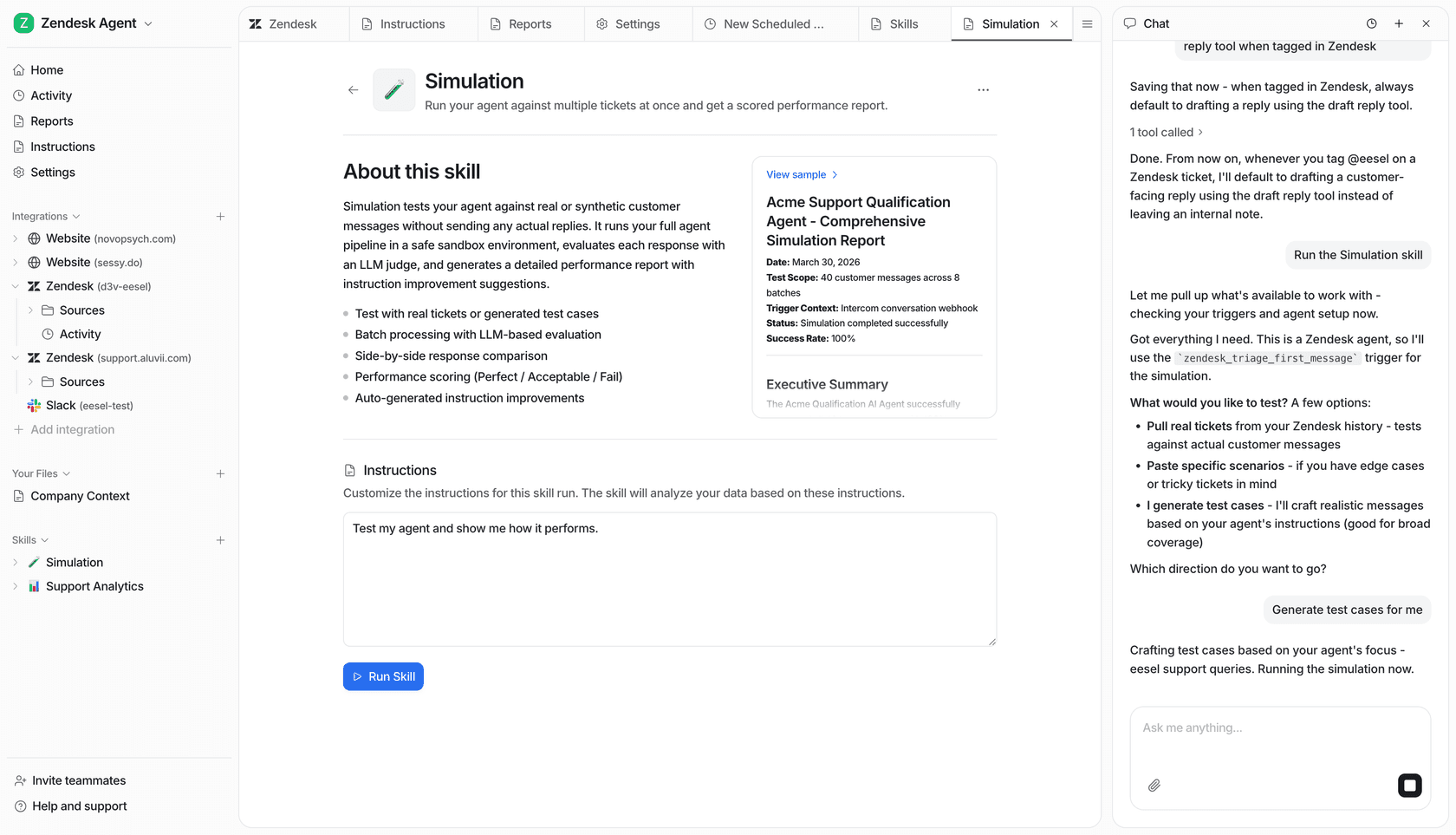
Building that trust is a core part of the eesel AI platform. Before your AI agent even thinks about talking to a customer, you can use its simulation mode to test it on thousands of your own past tickets. You can see exactly how it would have answered real questions from your customers, check its work, and tweak its behavior. This gives you a clear picture of how it will perform and the confidence that it’s a reliable part of your team, not a loose cannon.
Lesson 3: Seamless integration drives adoption
Part of what made OpenEvidence AI take off is how easy it was for doctors to start using it. It's a free, simple app that fits right into their workflow. There was no need for a long sales process or getting the whole hospital to sign off on it; doctors could just download it and get going.
This is a huge contrast to the headaches many support teams face with new tools. Too many platforms require you to ditch your existing helpdesk, spend months on a complicated setup, or force your team to learn a whole new way of working. All that friction is a massive barrier, and you might not see any real benefit for months.
eesel AI is built on that same idea of easy integration. It offers one-click connections to the helpdesks your team already uses every day, like Zendesk, Freshdesk, and Intercom. Instead of making you change your tools, eesel AI works with them. You can be up and running in minutes, not months, and start seeing results right away.
How to build your own OpenEvidence AI for customer support
The success of OpenEvidence AI isn't just a cool story; it's a practical guide. By following these same principles, you can build a powerful, context-aware AI helpdesk for your own support team. Here’s how you can get started.
Unify your scattered knowledge sources
Let's be honest: for most companies, the "knowledge base" is a bit of a disaster. Information is spread out everywhere, help center articles, internal engineering wikis, random Google Docs, important Slack threads, and all the wisdom locked away in years of old support tickets.
The first step toward a brilliant AI is to pull all those scattered sources into one brain. With eesel AI, this isn't some manual, multi-month data project. You can connect to over 100 sources with just a few clicks and train the AI on your knowledge base from day one. For example, you can point it at your official Zendesk help center, your internal product docs in Confluence, and your team's best-practice guides in Google Docs. This creates a single source of truth, giving your AI the context it needs to be genuinely helpful.
Define clear rules and custom actions
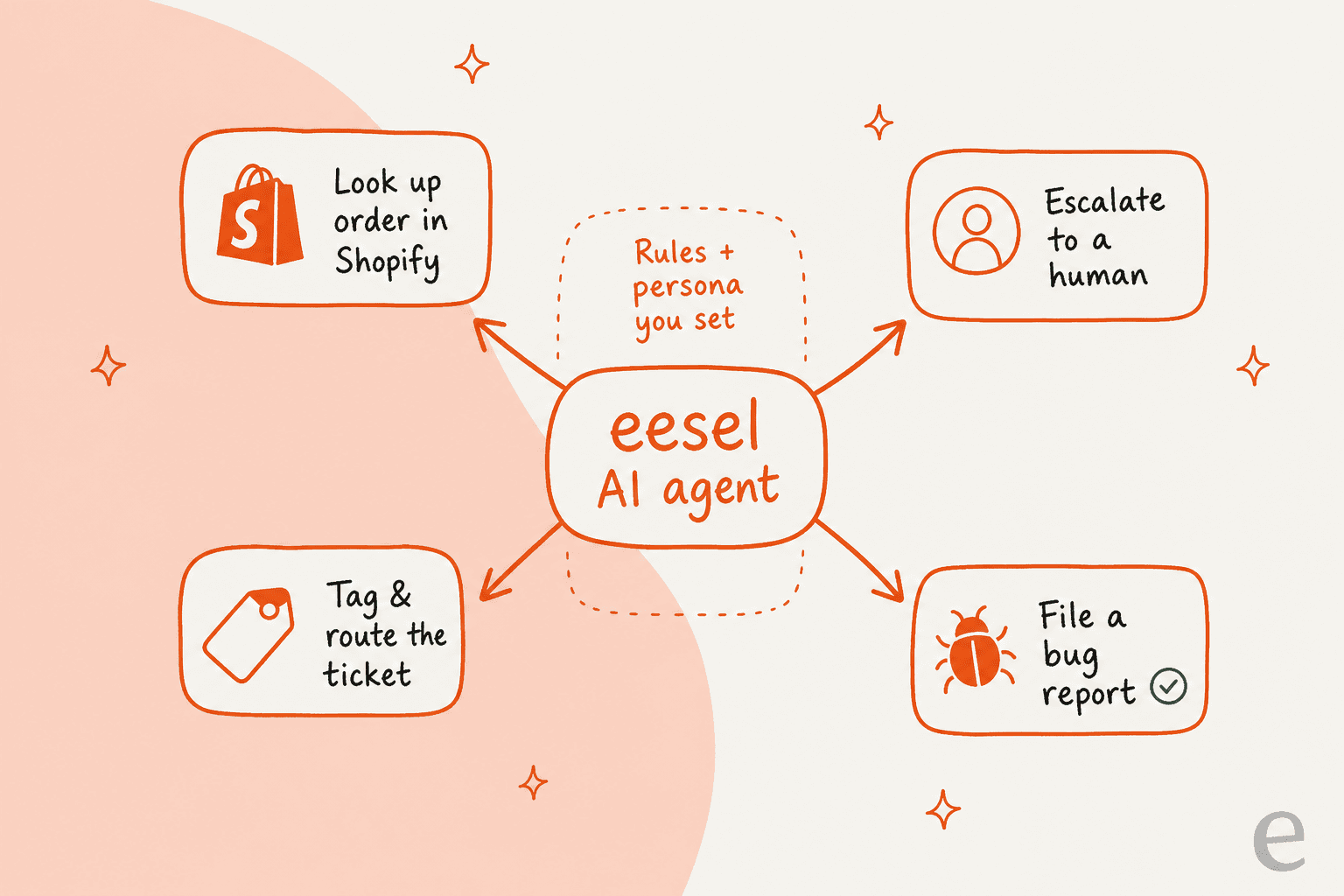
A great support AI needs to do more than just find answers. It needs to be an active part of your workflow. It should be able to do things like escalate a ticket to a senior agent, look up a customer's order, or tag an issue for the product team.
To make that happen, you need to be in the driver's seat. The eesel AI prompt editor lets you define your AI’s exact persona, tone of voice, and rules for escalation. You can tell it when to answer, when to loop in a human, and how to talk to customers.
Even better, you can create custom actions that let your AI interact with your other tools. It can check live order information from Shopify, create a new bug report in Jira, or correctly tag and route a ticket in Freshdesk, all on its own. This turns your AI from a simple Q&A bot into a true automated agent that handles real ticket automation.
Test, simulate, and roll out with confidence
Launching a new customer-facing AI can be nerve-wracking. How can you be sure it's ready? How do you know what impact it will have before you flip the switch?
This is where a solid simulation tool is a lifesaver. Before going live, eesel AI lets you run your new agent against thousands of your historical support tickets in a safe environment. The dashboard then gives you a clear report showing which tickets it would have solved, what its answers would have been, and your estimated automation rate and cost savings. This data-first approach lets you make smart decisions, fine-tune the AI, and roll it out gradually with total confidence.
OpenEvidence AI pricing vs. a support AI platform
A big reason for OpenEvidence AI's explosive growth is its price: it's free for verified U.S. healthcare professionals. This was a smart move that removed any barrier for individual doctors to give it a try.
While that's great for their market, AI platforms for business need a model that scales with your support volume. In the support world, the trick is to find a provider with clear, predictable pricing that doesn't punish you for doing well. A lot of AI tools charge you per resolution, meaning your bill goes up as the AI gets better at its job.
eesel AI keeps it simple: you pay a flat 40¢ per ticket (or chat conversation) the AI actually handles. There’s no platform fee, no per-seat charge, and no monthly minimum, so your costs stay predictable even in a busy month, and you’re never charged for the tickets your human agents take.
| Plan | What you pay | Best for |
|---|---|---|
| Free trial | $50 of free usage + 2 free blog generations, no credit card | Trying it on your own tickets |
| Pay-as-you-go | 40¢ per ticket/conversation handled — no platform fee, no per-seat | Most support teams |
| Annual commit | Commit to $300/mo for the year and pay 25% less | Predictable, higher-volume teams |
| Enterprise | $1,000/mo platform fee + usage; HIPAA, BAA, SSO, dedicated SE + AM | Regulated or large support orgs |
In practice that means 100 tickets a month costs $40, 500 costs $200, and 1,000 costs $400 — and if you only route 200 of your 1,000 tickets to the AI during a gradual rollout, you only pay for those 200. You can check the live numbers on the eesel AI pricing page.
The future is specialized AI
OpenEvidence AI proves a simple but powerful point: the future of useful AI is specialized. Generic, one-size-fits-all tools just don't cut it anymore. Just like modern medicine needs an AI with deep clinical knowledge, world-class customer service AI needs an AI that deeply understands your business, your products, and your customers.
Your team deserves its own "OpenEvidence", an AI that’s accurate, trustworthy, and fits right into the tools you already use every day. An AI that doesn't just answer questions, but actually solves problems.
Ready to build an AI that’s as smart about your support as OpenEvidence is about medicine? It trains on your past tickets and help center, deploys in your existing helpdesk in minutes, and you can prove it on your own data before it ever talks to a customer. Try eesel free and deploy a context-aware AI agent in minutes.
Frequently asked questions

Share this article

Article by
Alicia Kirana Utomo
Kira is a writer at eesel AI with a Computer Science background and over a year of hands-on experience evaluating AI-powered customer service tools. She focuses on breaking down how helpdesk platforms and AI agents actually work so that support teams can make better buying decisions.