RAG vs vector database vs hybrid search: What’s best for support AI?


Last edited November 14, 2025
Table of Contents
- Understanding RAG vs vector database vs hybrid search for support AI: A quick breakdown
- How RAG, vector databases, and hybrid search work in a support context
- RAG vs vector database vs hybrid search for support AI: A direct comparison
- The build vs. buy decision
- The bottom line for RAG vs vector database vs hybrid search for support AI: Focus on relevance, not retrieval methods
If you’re trying to sort out the world of support AI, you’ve probably noticed it’s full of acronyms and tech-speak. You hear terms like RAG, vector databases, and hybrid search, and it’s easy to get tangled up in the details. All you really want is to give your customers fast, correct answers and make life a little easier for your support team.
Let’s cut through the noise. This guide will break down what RAG vs vector database vs hybrid search actually means for your support AI. We'll look at how they perform in the real world and give you a straightforward way to decide what’s right for you. Because at the end of the day, the tech should just work, right? You shouldn't need an engineering degree to figure it out.
Understanding RAG vs vector database vs hybrid search for support AI: A quick breakdown
Before we start comparing, let's make sure we're on the same page about what these terms mean.
What is retrieval-augmented generation (RAG)?
Retrieval-Augmented Generation (RAG) is a really smart way to make Large Language Models (LLMs) like GPT-4 more accurate and genuinely useful for your business. It works in two simple steps.
First, there’s Retrieval. When a customer asks something, the system doesn’t just pull an answer out of thin air. It first digs through your company’s own knowledge, your help center, old support tickets, internal wikis on Confluence, and so on, to find the most relevant, up-to-date information.
Second comes the Generation. The system takes those relevant snippets of info and hands them to the LLM, along with the original question. The LLM then uses this context to craft a precise answer that’s grounded in your company's reality, not just general internet knowledge.
Think of it like giving a brilliant but slightly forgetful expert an open-book test. With all the right notes in front of them, they're set up to give the correct answer every time. This whole process helps ensure the AI provides answers you can trust because they’re based on your own data.
graph TD A[Customer Question] --> B{Retrieval}; B --> C[Find Relevant Info in Knowledge Base]; C --> D{Generation}; A --> D; D --> E[LLM Crafts Precise Answer]; E --> F[Answer Delivered to Customer];
What is a vector database?
A vector database is a common tool for handling the "Retrieval" part of RAG. Here's a simple look at how it works.
It starts by converting all of your text, every help article, every ticket, into a string of numbers called a "vector embedding." This isn't just random; it's a mathematical snapshot that captures the meaning and context of the text.
When a user asks a question, their query gets turned into a vector, too. The database then uses "vector search" (sometimes called "semantic search") to find the documents with vectors that are mathematically closest to the query's vector.
The great thing about this is that vector search is fantastic at understanding what a user is really asking. If someone types "my laptop screen went black," it knows to look for documents about "display issues" or "blank monitors," even if the words don't match exactly. The flip side is that it can be a little fuzzy. It might overlook an important keyword like a specific product model, an error code, or a customer's name, which can lead to answers that are missing key details.
What is hybrid search?
Hybrid search is an approach that tries to get the best of both worlds for the retrieval step in RAG. It uses two methods at once:
-
Vector Search: This is for understanding the overall meaning and intent behind a question.
-
Keyword Search: This is for nailing down specific, exact terms like product names, error codes, or acronyms.
By mixing the conceptual understanding of vector search with the pinpoint accuracy of keyword search, hybrid search makes sure nothing gets missed. It can find the help article titled "Fix for error code GFX-108" and, at the same time, pull up forum posts where people describe the issue as their "screen going black." This well-rounded method is quickly becoming the standard for high-quality RAG systems, especially in customer support, where you need both the general context and the specific details to be helpful.
How RAG, vector databases, and hybrid search work in a support context
The theory is interesting, but what really matters is how these methods handle the messy, unpredictable questions customers throw at you every day. Let's walk through a couple of scenarios.
RAG with a pure vector database approach
Picture a customer asking: "My new laptop's screen keeps going black after the latest software patch."
Vector search is pretty good at this. It gets the general idea and will pull up internal tickets and help docs about "display issues," "blank monitors," and "unstable graphics drivers." It casts a wide, intelligent net.
But what if the most important troubleshooting guide is titled "Fix for error code GFX-108"? If the customer doesn't happen to use that exact code, a pure vector search might rank that article lower on the list or miss it completely. The semantic link between "screen going black" and "GFX-108" just might not be strong enough in the data for the system to connect them. This is where the "fuzziness" of vector search can cause problems.
RAG with a keyword search approach
Now, imagine the customer is a bit more technical and asks: "I'm getting error code GFX-108."
A classic keyword search is perfect for this. It will immediately find every single document in your knowledge base that contains the exact phrase "GFX-108." It’s incredibly precise for these types of questions.
The problem, of course, is that it would be totally lost with the first query ("My screen keeps going black"). If those exact words don't appear in the main help article, keyword search will never find it. It doesn't understand concepts at all, which means it will fail to help on a huge number of customer issues.
RAG with a hybrid search approach
This is where it all clicks. A hybrid search approach handles both of these questions without breaking a sweat.
For the "GFX-108" query, the keyword part of the search ensures the definitive guide is pulled up right away. For the "screen going black" query, the vector component finds all the conceptually related documents. The system then blends these results, giving the LLM the richest and most complete context possible.
This lets the AI generate an incredibly helpful and accurate answer, referencing both the specific error code fix and the broader troubleshooting steps for display issues. For the complex and varied world of customer support, hybrid search is pretty clearly the best tool for the job.
RAG vs vector database vs hybrid search for support AI: A direct comparison
Here’s a simple table to sum up the key differences and help you see the trade-offs at a glance.
| Feature | Vector Database (Semantic) | Keyword Search (Lexical) | Hybrid Search |
|---|---|---|---|
| Precision | Moderate (can be "fuzzy") | High (for exact matches) | High (Best of both) |
| Contextual Understanding | High | Low | High |
| Use Case | General, concept-based queries | Specific codes, names, SKUs | All support queries |
| Implementation | Moderately Complex | Simple | Very Complex (DIY) |
As you can see, hybrid search delivers the best performance pretty much across the board. But there's a catch, and it’s a big one: actually building it.
While hybrid search is the superior method, building, managing, and fine-tuning it yourself is a huge engineering project. You have to set up and maintain two separate systems for indexing and retrieval, then figure out a smart way to merge their results (a process called reranking) to get the best outcome. It’s a full-time job for a team of specialists.
This is where a managed platform can make all the difference. A solution like eesel AI handles all that complexity for you. It provides a state-of-the-art hybrid retrieval system out of the box that instantly connects to and learns from all your knowledge sources, like past Zendesk tickets and internal wikis. You get top-tier results without having to write a single line of code.
The build vs. buy decision
When you think about setting up a RAG system, it’s easy to get focused on the tools. But it's more productive to think about the total cost and the practical side of getting it done.
The true cost of a DIY RAG setup
If you decide to build your own RAG system from scratch using a vector database and other parts, the subscription fees for those tools are just the beginning. The real costs are often hidden.
-
Engineering Time: You’re looking at months of development work just to build the basic data pipelines, indexing logic, and a workable interface. That’s time your engineers aren't spending on your actual product.
-
Infrastructure Costs: You have to pay to host the vector database, an embedding model, the LLM, and the application itself. These costs can be unpredictable and shoot up as more people use it.
-
Ongoing Maintenance: This is not a "set it and forget it" kind of project. AI models need updating, data gets old, and performance needs constant tweaking.
As one developer on Reddit put it while building a RAG app, the whole process can feel 'flaky' and like 'overkill' to manage.
-
Risk: After sinking all that time and money into it, there's no guarantee the system will perform well enough to be worth it. You're essentially building in the dark and hoping for the best.

Why a managed platform is the smarter choice
An all-in-one platform like eesel AI is built to get rid of these headaches and offer a faster, safer, and more affordable path to getting great results.
-
Speed: You can be up and running in minutes, not months. eesel AI’s one-click integrations let you connect your helpdesk and knowledge sources to have a working AI agent today, not next quarter.
-
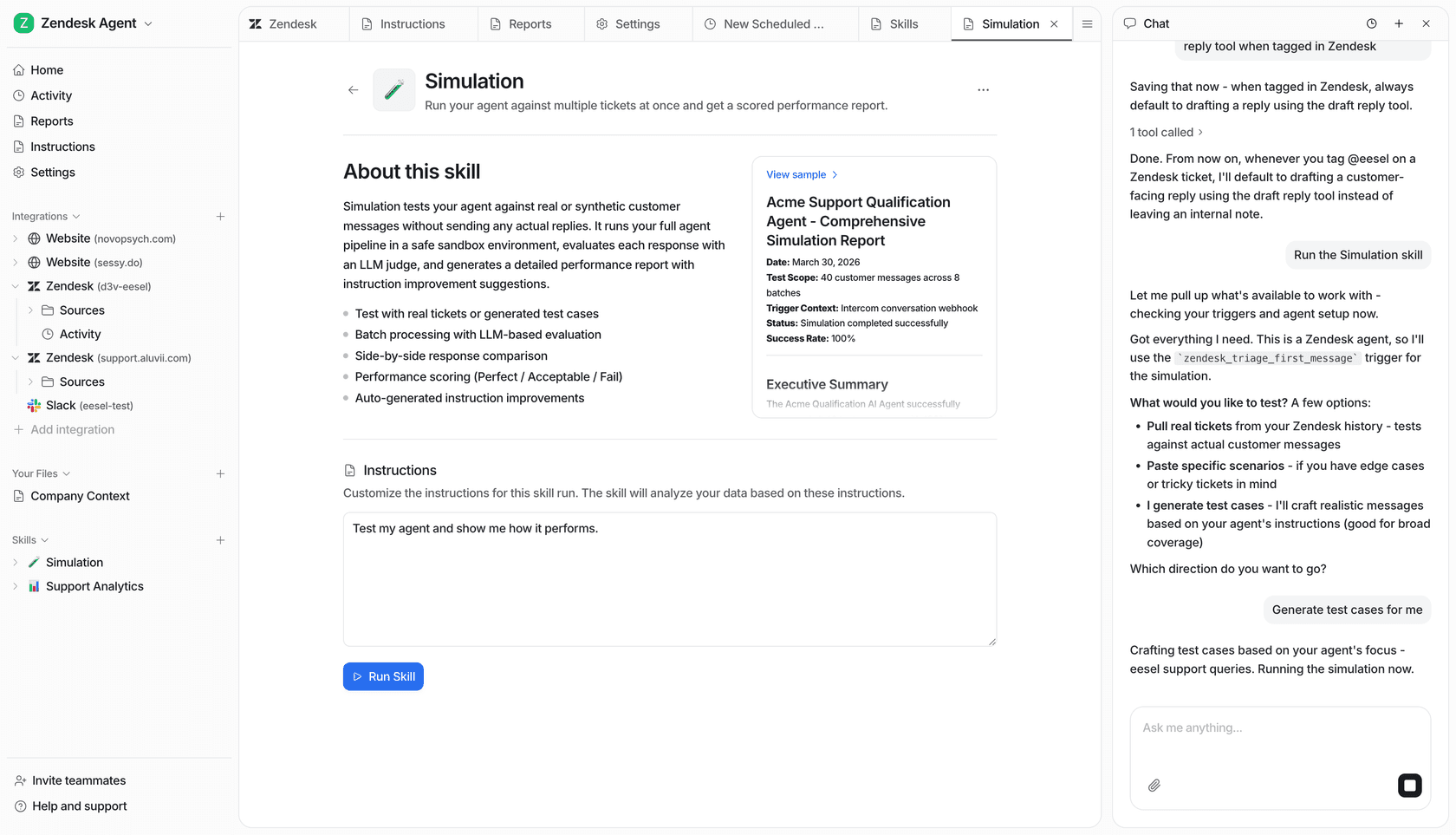
Confidence: Instead of building something and just hoping it works, eesel AI’s simulation mode lets you test your AI on thousands of your own past tickets. You get accurate, data-backed predictions on how many issues it will resolve before you ever turn it on for live customers.
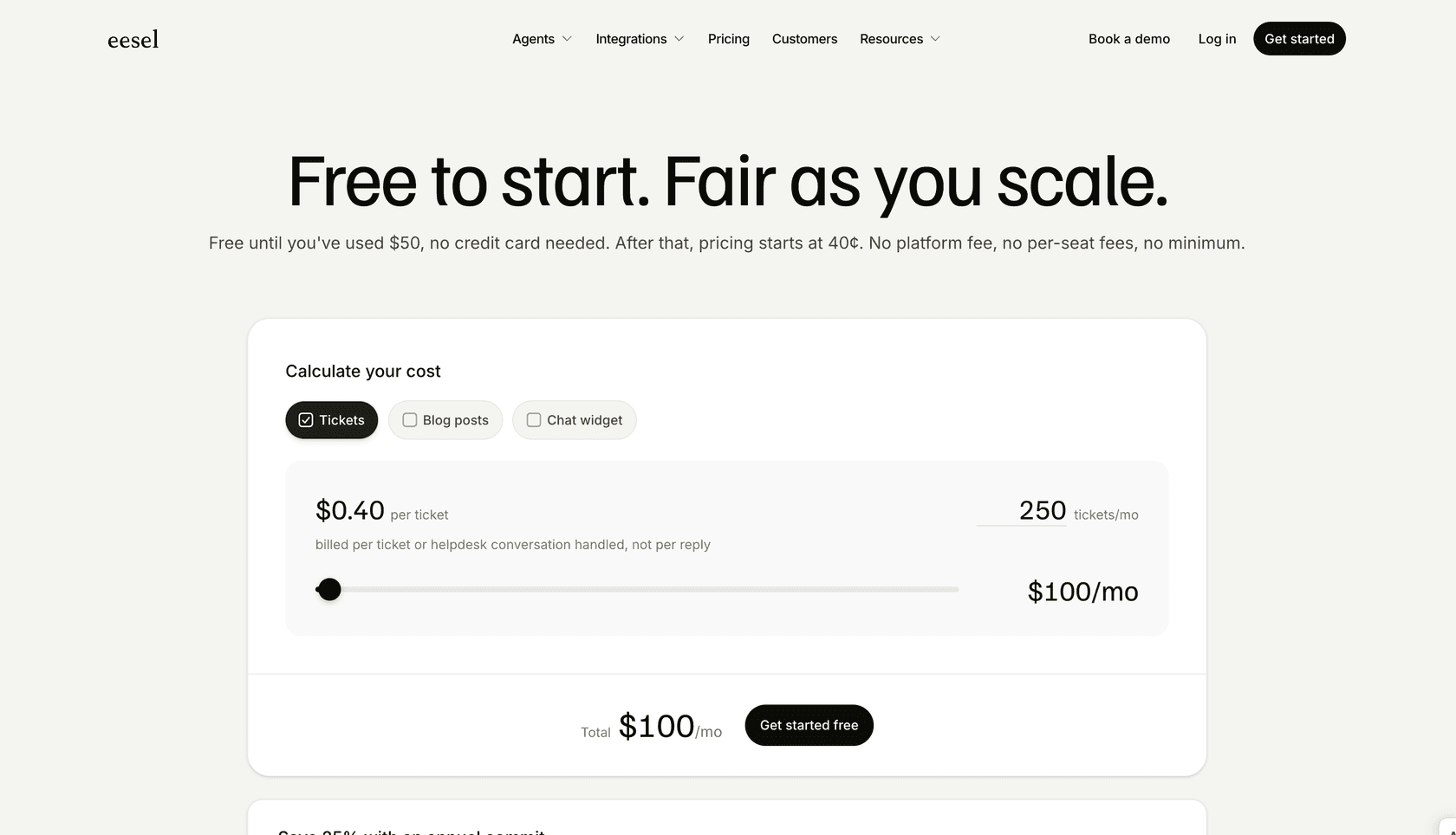
- Cost-Effectiveness: You avoid the black hole of surprise infrastructure and development costs. eesel AI has transparent, predictable pricing with no sneaky per-resolution fees. This means your costs stay flat, even during your busiest months, so you're not penalized for growing your support volume.
The bottom line for RAG vs vector database vs hybrid search for support AI: Focus on relevance, not retrieval methods
In the nuanced world of customer support, where a single question can involve broad concepts and hyper-specific details, hybrid search is the most effective way to find the right information. It gives you the best of both worlds: the contextual understanding of vector search and the precision of keyword search.
But getting stuck in a debate over which retrieval method to use misses the bigger point. The real challenge isn't picking the right tech; it's getting a high-performing system up and running reliably and efficiently.
Building your own RAG system is a complicated, expensive, and slow project that pulls focus away from your main mission of helping customers. A managed solution like eesel AI takes care of all the technical heavy lifting for you. It gives you the power of a sophisticated hybrid search engine that's ready to go in minutes, so you can focus on what actually matters: delivering an amazing customer experience.
Try eesel AI for free and see for yourself how a state-of-the-art RAG system performs on your own data.
Frequently asked questions

Share this article

Article by
Kenneth Pangan
Writer and marketer for over ten years, Kenneth Pangan splits his time between history, politics, and art with plenty of interruptions from his dogs demanding attention.