Yuma AI pricing: what it really costs in 2026


Last edited June 24, 2026

Table of Contents
What Yuma AI actually costs (the short answer)
I'll be upfront about where I'm sitting: I work on eesel, and we compete with Yuma. So I went looking for reasons it's overpriced and didn't really find them. Yuma is a genuinely well-built product. We've lost deals to it. One DTC brand on Gorgias doing around 7,000 tickets a month picked Yuma over us and called it "really well built", and they weren't wrong. So this is a fair-value read, not a hit piece.
Here's the honest summary of Yuma's pricing as it stands in 2026:
- No public rate card. The pricing page is a demo-request form. You get a custom quote scoped to your ticket volume, channels, and how much implementation work your team needs.
- The Shopify App Store does publish plans. The listing reads "From $850/month", with a Small Merchant plan at $850/mo and a Medium Merchant plan at $1,200/mo. Each is a monthly base fee that bundles a ticket package, with usage-based overage charged on top. Anything bigger than "Medium" is sales-led and off-listing.
- The per-ticket rate is ~$0.65-0.74. Yuma states this itself, but only on its competitor comparison pages, footnoted as an estimate rather than a published rate.
- Billing is outcome-based. "No value, no charge" is the literal headline. You pay for tickets the AI fully resolves, not for ones it escalates to a human.
- There's a 30-day free trial on real tickets, with setup handled by a dedicated account manager at no extra cost.
So the real answer to "how much does Yuma AI cost" is: plan on at least $850/month, climbing with your ticket volume at roughly $0.74 per resolved ticket.
How Yuma's pricing model works
The thing to understand before you model any numbers is the billing unit. Yuma doesn't charge per agent seat (the old helpdesk model) and it doesn't charge a flat SaaS subscription. It charges per ticket its AI resolves end-to-end, in your brand voice, by taking real actions like issuing refunds, editing subscriptions, or pulling live tracking.
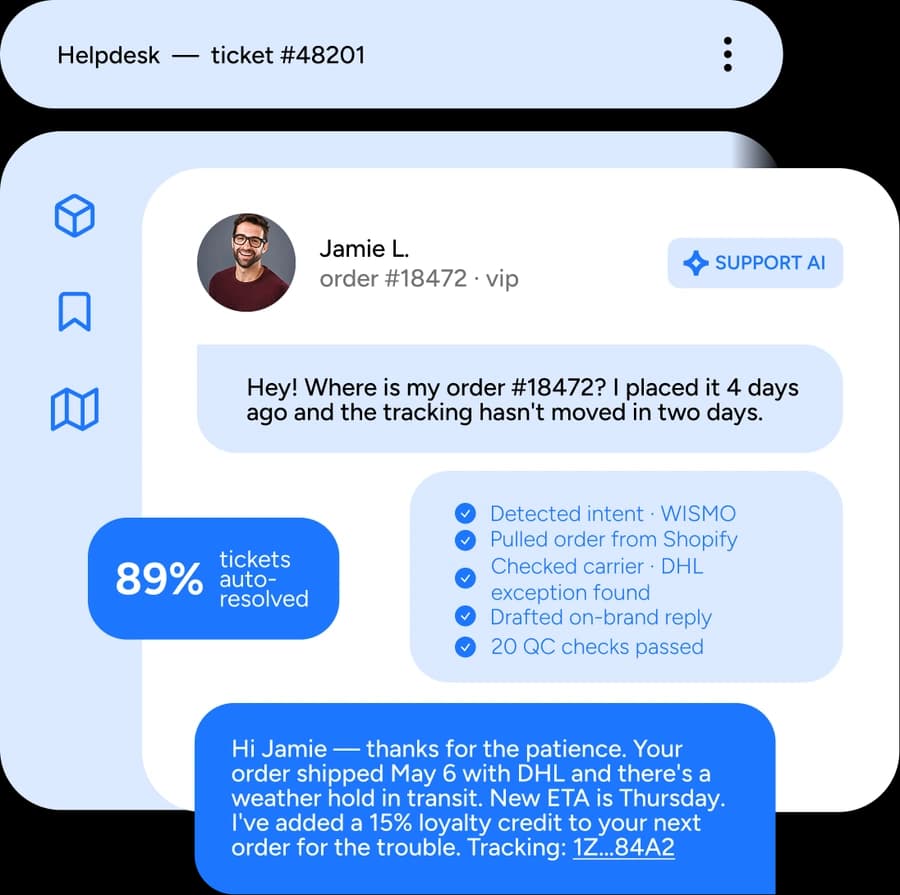
That "fully resolved" qualifier is doing a lot of work, and it's actually the most buyer-friendly part of the model. If Yuma drafts a reply but a human has to step in, you're not billed for it. The flip side: a "resolution" is whatever Yuma's system counts as one after running each reply through 15 to 20 quality-control checks across multiple models. Worth pinning that definition down in your contract.
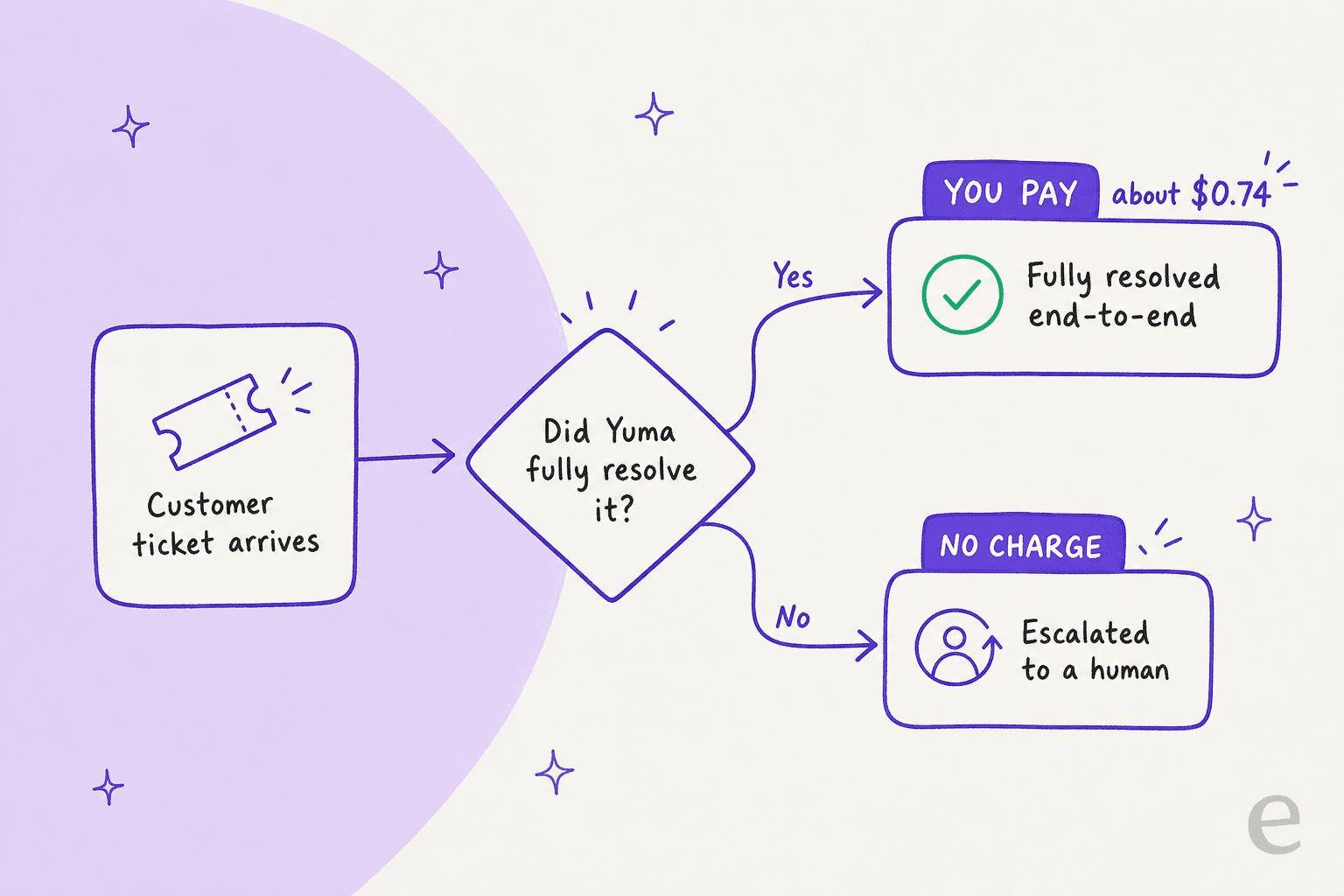
This is the same family as conversation- or outcome-based AI pricing you'll see across the category, and on paper it aligns the vendor's incentives with yours. The friction shows up in the details, which is where the rest of this post lives.
The full Yuma AI pricing picture
Here's everything I could verify, pulled together. The Shopify plans are firm public facts; the per-ticket rate is Yuma's own stated estimate.
| Plan / lever | Price | What it covers |
|---|---|---|
| Small Merchant (Shopify listing) | $850/mo | Monthly base fee bundling a package of automated tickets, overage applies, 14-day trial |
| Medium Merchant (Shopify listing) | $1,200/mo | Larger bundled ticket package, overage applies, 14-day trial |
| Enterprise / high volume | Custom (talk to us) | Sales-led, off-listing; scoped to volume, channels, implementation depth |
| Per fully resolved ticket | ~$0.65-0.74 | Yuma's own stated estimate (comparison pages), billed on resolutions only |
| Free trial | 30 days | On your live tickets, with white-glove setup included |
| Included at no extra cost | $0 | Enterprise-grade security (SOC 2 Type II), 75+ actions, dedicated human support |
A few things to flag. First, the $850 and $1,200 plans are the only published numbers, and they cap at "Medium" - if you're a high-volume brand, your real price is whatever the sales conversation produces. Second, the overage is the part that scales: those base fees bundle a ticket package, and once you blow past it you're paying the per-resolution rate on top. Third, the 30-day trial is "typically kicked off with an agreed potential automation rate", so both sides have a number to hit before money changes hands. That's a fair way to run it.
Estimate your own monthly cost
Pricing pages with no numbers are annoying precisely because the answer depends entirely on your volume. So here's a quick estimator. Punch in your monthly ticket count and a realistic automation rate, and it'll show roughly what Yuma would bill (at $0.74 per resolved ticket, with the $850 floor) next to a usage-based alternative.
Slide it down to a few hundred tickets a month and you'll see the problem small stores hit: Yuma sits pinned at the $850 floor while the usage-based line keeps falling. Slide it up past several thousand and the per-resolution model starts looking reasonable.
What you get for the price
Yuma isn't charging $850-plus for a chatbot. The reason the price is defensible at volume is that it's a fairly deep piece of customer service software, organized as four customer-facing agents plus a control layer:
- Support AI is the core: post-purchase ticket resolution (WISMO, returns, refunds, cancellations, subscription and address changes) with 100+ ready-to-use actions.
- Sales AI is a pre-purchase widget answering sizing and compatibility questions, A/B tested at up to 18% higher revenue per visitor.
- Social AI handles Instagram and Facebook comments and DMs.
- Chat AI is a live-chat widget on the same engine.
- Ask Yuma is the layer the team is proudest of: a conversational console that builds automations, diagnoses mishandled tickets, and reports, all from plain English.
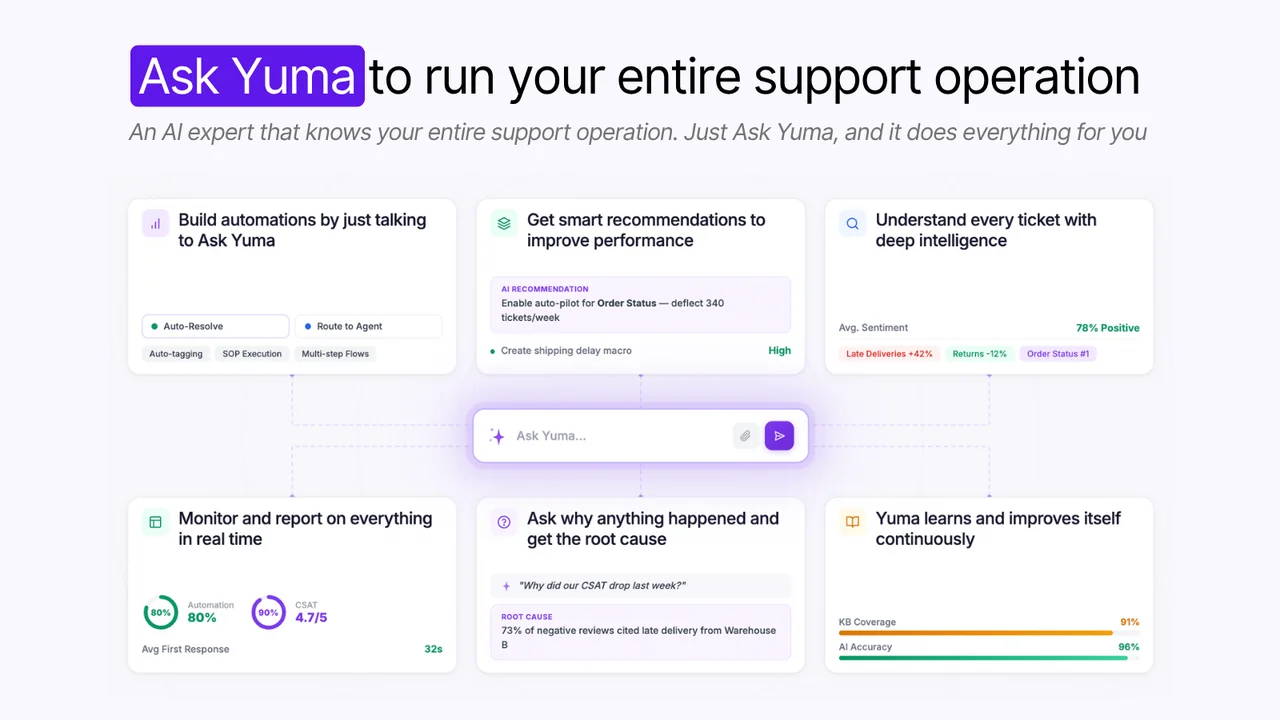
It also plugs into the stack a real Shopify brand runs, Gorgias, Zendesk, Kustomer, Recharge, Klaviyo, without forcing a helpdesk migration. That breadth is part of what you're paying for, and it's the honest reason the per-resolution rate sits where it does.
The catch: the model rewards volume, not small stores
This is the part I'd want a friend to tell me before I signed. Yuma's pricing is built for brands with serious ticket volume, and it can quietly punish everyone else. The clearest evidence is a Yuma customer's own words, in a 4.5-star G2 review:
"The pricing model is rather strict. You need a significant volume of tickets to make it truly cost-effective, or at least be in a strong growth trajectory so that it becomes profitable over time... it's not the most suitable solution if you're just starting out or handling low volumes."
Verified User in Retail, G2

Two forces are at play. First, the $850 monthly floor: below a few thousand resolved tickets, you're paying the minimum whether you use it or not. Second, the automation rate that drives your bill is lower in practice than the headline.
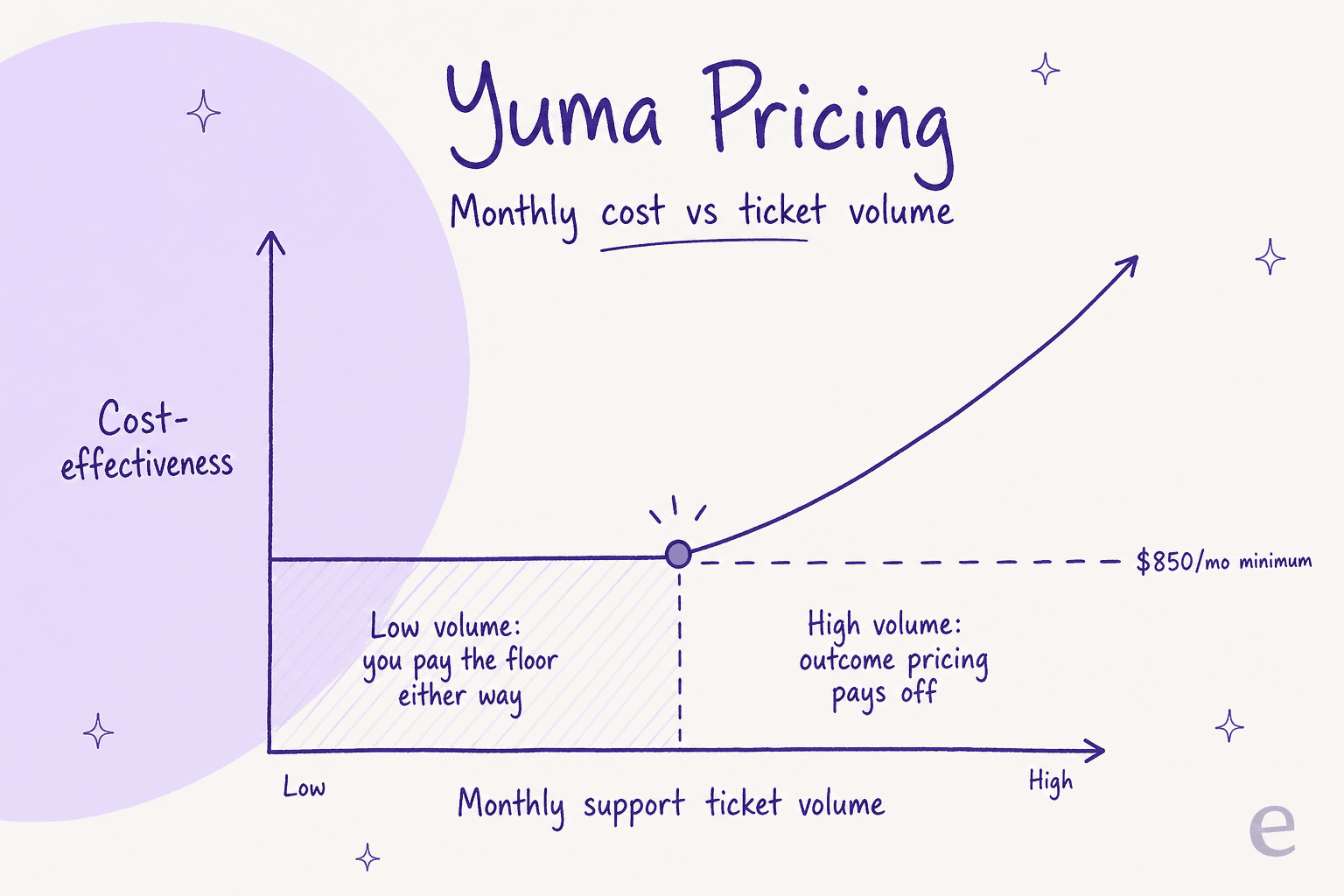
About that rate. Yuma markets up to 89% automation, and to be fair, that's a real figure from flagship case studies like EvryJewels (89% automation, 150K+ tickets). But the operators reviewing Yuma on G2 report something more grounded: "nearly 40% full automation... ~75% of tickets" from one jewelry brand, "30% of our tickets" from a mid-market reviewer, "more than 50%" from an eight-figure brand's co-founder. Most land in the 30-50% fully automated range after real setup work. Your per-resolved-ticket bill scales with that real automation rate, not the marketing one.

None of this makes Yuma a bad deal. It makes it a volume deal. If you're processing thousands of tickets a month and growing, the math works. If you're a smaller store testing the water, the floor will sting.
Setup is included, but time is the hidden cost
One genuinely good thing: Yuma's setup is white-glove and free. A dedicated account manager connects your helpdesk, writes the automation processes, and configures the agents, with zero engineering work from your side. Rollout is gradual (Yuma describes it as 0% → 1% → 10% → 30% → 50% → 100%), with around 25 human reviews before full autonomy.
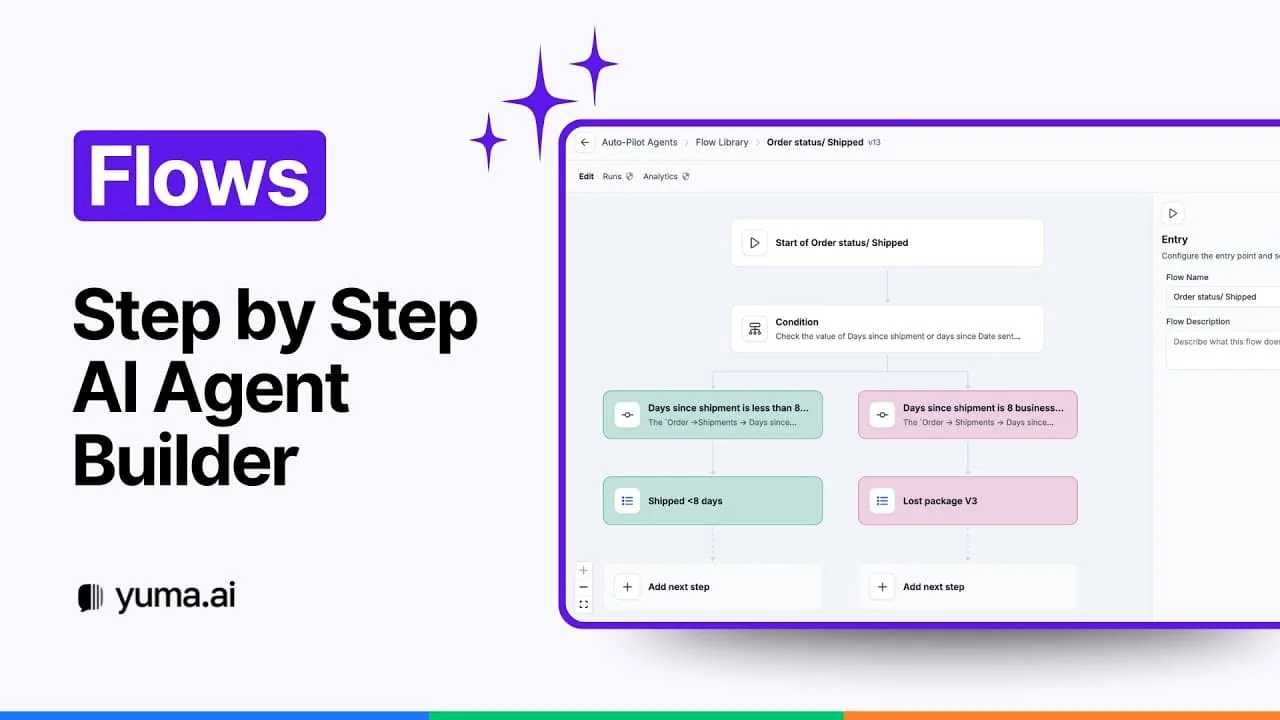
The hidden cost isn't dollars, it's calendar. Reviewers say so plainly: one eight-figure brand's co-founder wrote that "companies telling you that automating customer service with AI in one or a few hours are just trying to sell you something." Expect weeks of ramp before the automation rate (and the savings) land. That's not unique to Yuma, it's the honest reality of any AI agent on a live support queue, but it's worth budgeting for.
Yuma vs the alternatives on price
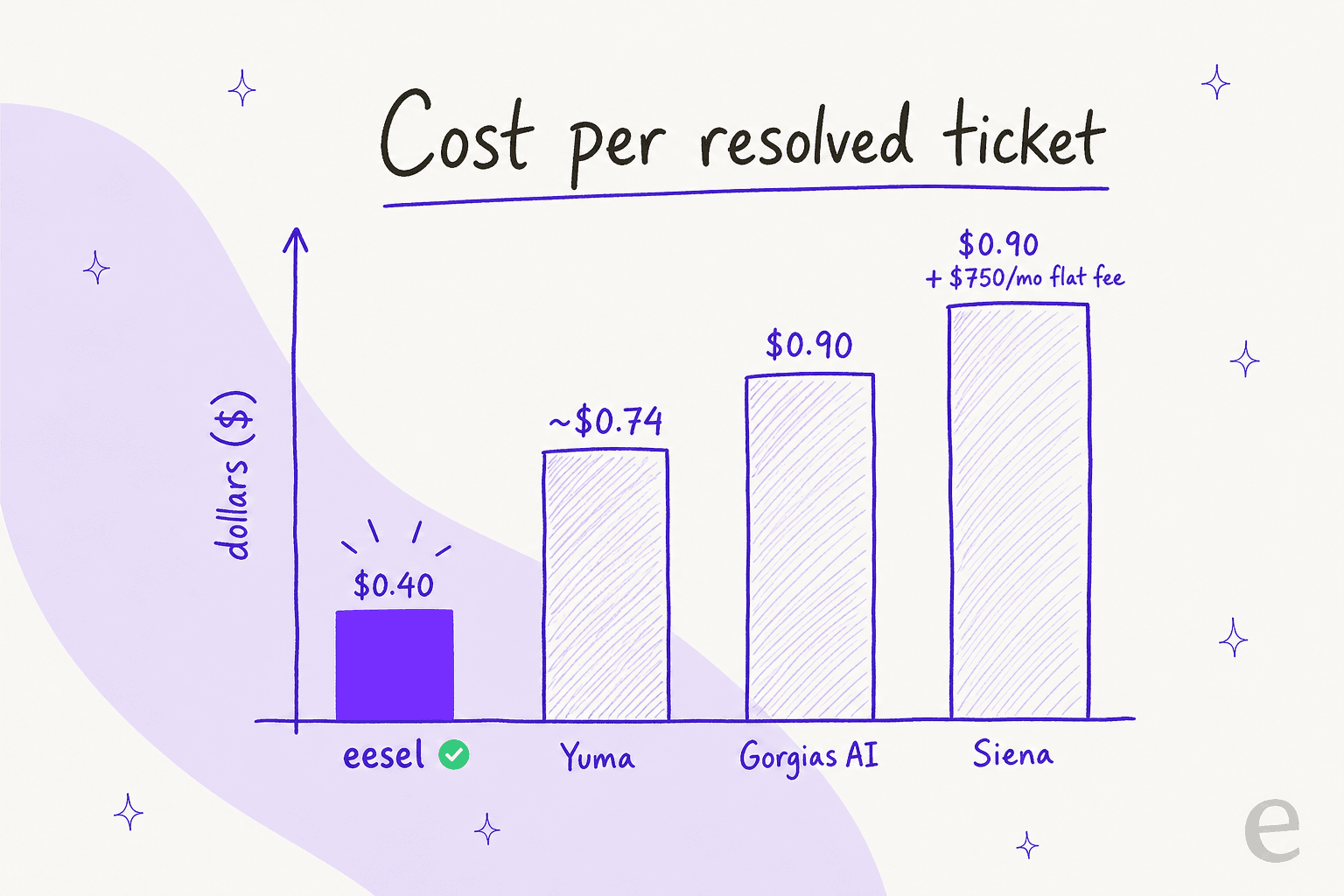
Here's how Yuma's per-ticket economics stack up against the closest ecommerce-focused options, using each tool's own stated numbers (Yuma's figures for Gorgias AI and Siena come from its comparison pages; I've kept eesel's straight from our pricing page).
| Tool | Headline rate | Billing unit | Monthly minimum |
|---|---|---|---|
| Yuma AI | ~$0.74 / resolved ticket | Fully resolved tickets only | ~$850/mo (Shopify listing) |
| Gorgias AI | $0.90 / resolved ticket | AI-resolved tickets (on top of helpdesk seats) | Helpdesk plan + AI |
| Siena | $0.90 / conversation | Per automated conversation, resolved or not | ~$750/mo flat platform fee |
| eesel AI | $0.40 / ticket | Per ticket handled | None |
Two honest observations. Yuma is cheaper per resolution than its direct ecommerce rivals (Gorgias AI and Siena both list $0.90), and its "only pay for fully resolved" model is friendlier than Siena charging per conversation whether it resolves or not. Where it loses on pure price is against usage-based tools with no floor: at $0.40 per ticket and no minimum, eesel comes out cheaper per unit and far cheaper for low-volume stores. The trade-off is that Yuma is more of an ecommerce-specialist out of the box; the right pick depends on your volume and how much hand-holding you want.
Is Yuma AI worth it?
If I'm being straight: yes, for the right store. Yuma is a well-built, ecommerce-native product with a fair, outcome-aligned model and a support team reviewers rave about. If you're a Shopify or Gorgias brand doing thousands of tickets a month, the $850-plus and the per-resolution rate will likely pay for themselves, and the white-glove setup removes the usual friction.
It's the wrong fit if you're a smaller store, if you need transparent pricing you can model without a sales call, or if you want to self-serve a trial today rather than wait on an account manager. The $850 floor and the "talk to us" rate card are real barriers for teams that just want to switch on automation and see what it does.
Try eesel
If the floor and the sales call are what's giving you pause, that's the gap eesel AI was built for. eesel is an AI helpdesk agent that plugs into the helpdesk you already run (Gorgias, Zendesk, Freshdesk, Shopify) and resolves tier-1 tickets, the same job Yuma does, but at $0.40 per ticket with no per-seat fees and no monthly minimum.

The part I'd point a Yuma shopper to: before you go live, eesel lets you simulate the AI on your own historical tickets and see the exact resolution rate (and therefore the exact cost) you'd get, no demo required. You can start a free trial and run that simulation yourself in an afternoon. Try eesel and see your real number before you pay a cent.
Frequently Asked Questions

Share this article