|
VOOZH | about |
|
VOOZH | about |
A number series is an ordered sequence of numbers arranged according to a specific mathematical rule or pattern. Each number in the series relates to the others through consistent operations like addition, subtraction, multiplication, division, exponents, or more complex relationships.
Number Series is a widely asked topic in the Logical Reasoning section of competitive examinations. There are two main types of questions asked,
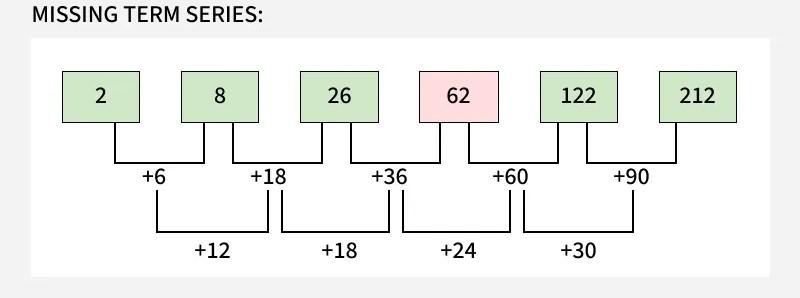
1. Missing Term Series: A sequence is given with one or more missing numbers, and you must find the correct number that fits the pattern.
2. Wrong Term Series: A complete sequence is given, but one number is incorrect, and you must identify the wrong term and sometimes correct it.
Number series can be categorized based on their underlying patterns. Here are the most common types:
Rule: Each term increases or decreases by a fixed difference (common difference).
Example:
- 5, 9, 13, 17, ... (Here number is increased by +4)
- 20, 17, 14, 11, ... (Here number is decreased by −3)
Rule: Each term is multiplied/divided by a fixed ratio (common ratio).
Example:
- 3, 6, 12, 24, ... (Here number is multiply ×2)
- 81, 27, 9, 3, ... (Here number is divided by 3)
3. Square Series
Rule: Terms are squares of natural numbers().
Example:
1, 4, 9, 16, 25, ... (1², 2², 3², ...)
4. Cube Series
Rule: Terms are cubes of natural numbers ).
Example:
1, 8, 27, 64, 125, ... (1³, 2³, 3³, ...)
5. Fibonacci Series
Rule: Each term is the sum of the two preceding terms.
Example:
0, 1, 1, 2, 3, 5, 8, 13, ...
Rule: Consists of prime numbers (divisible only by 1 and themselves).
Example:
2, 3, 5, 7, 11, 13, 17, ...
Rule: Combines two or more different operations alternately.
Examples:
- 1, 4, 3, 6, 5, 8, ... (Alternate between +3 and −1)
- 2, 6, 12, 20, 30, ... (1×2, 2×3, 3×4, 4×5, ...)
Rule: Terms are factorials ().
Example:
1, 2, 6, 24, 120, ... (1!, 2!, 3!, 4!, ...)
Rule: Combines multiple arithmetic/geometric/other operations.
Examples:
- 2, 5, 10, 17, 26, ... (n² + 1: 1²+1=2, 2²+1=5, etc.)
- 1, 3, 7, 15, 31, ... (×2 +1: 1×2+1=3, 3×2+1=7, etc.)
Rule: Terms involve exponents or power functions.
Examples:
2, 4, 16, 256, ... (Each term is the square of the previous one: 2²=4, 4²=16, etc.)
3, 9, 81, 6561, ... (3¹, 3², 3⁴, 3⁸, ... exponents double each time)
➣ Number Series Solved Question- Refer Here!
➣ Test your knowledge- Quiz!