|
VOOZH | about |
|
VOOZH | about |
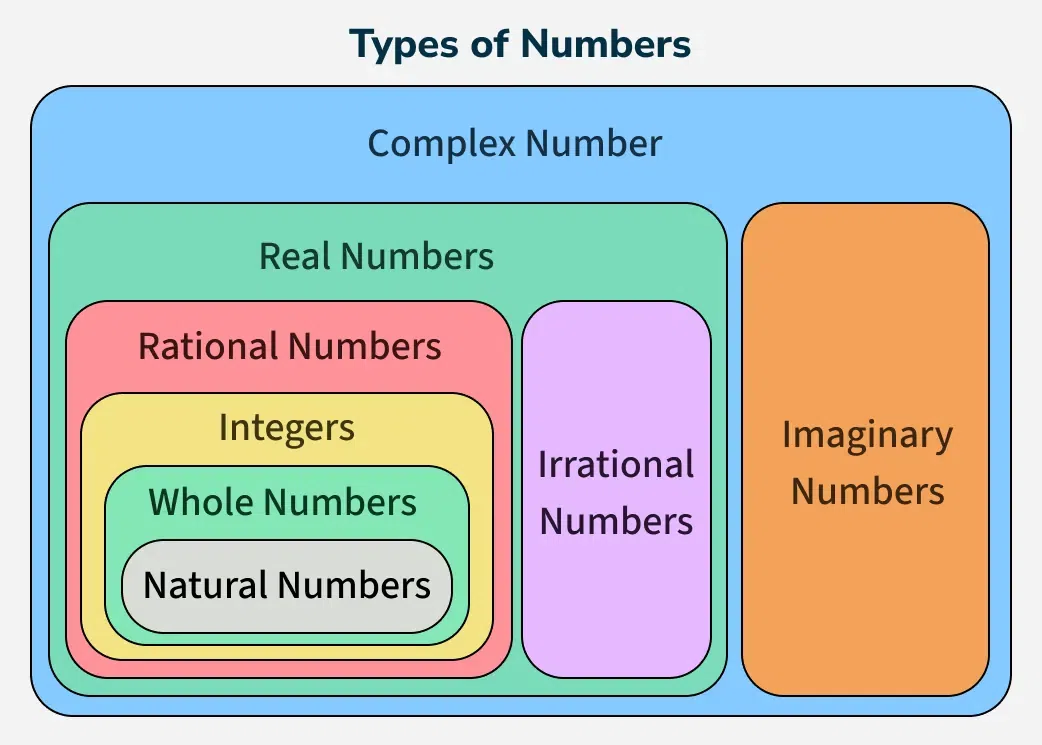
Numbers are the fundamental units of mathematics. In this article, we will discuss numbers, their types, important facts, divisibility rules, and other important points about numbers for aptitude preparation.
Here's a table summarizing the divisibility rule of common numbers:
Divisibility by Number | Rule | Example |
|---|---|---|
The last digit should be even. | 124 last digit is 4( even), so it is divisible by 2. | |
The sum of its digits should be divisible by 3. | 12321 divisible by 3 because 1 + 2 + 3 + 2 + 1 = 9 and 9 is divisible by 3. | |
The last two digits should be divisible by 4. | 1232 is divisible by 4 as the last two digits 32 are divisible by 4. | |
The last digit is either 0 or 5. | 85 last digit is 5, so 85 is divisible by 5. | |
The number should be divisible by both 2 and 3. | 114 is divisible by 6 as it is divisible by both 2 and 3:
| |
Remove last digit from the number then Double the last digit, subtract it from the rest of the number, and if the result is divisible by 7, the number is divisible by 7. | 196 is divisible by 7
| |
The last three digits should be divisible by 8. | 1232 is divisible by 8 as the last three digits 232 is divisible by 8. | |
The sum of its digits is divisible by 9. | 12321 is divisible by 9 because 1 + 2 + 3 + 2 + 1 = 9 and 9 is divisible by 9. | |
The difference between the sum of numbers at even positions and odd positions is either 0 or a multiple of 11. | 121 is divisible by 11 as
Find the difference 2 - 2 = 0. which is divisible by 11. |
Other Useful Rules
Note : If 'p' and 'q' are co-primes and we have a number 'n' that is divisible by both 'p' and 'q', 'n' will be divisible by p x q.
For example, 48 is divisible by both 3 and 8 and also by 3 x 8 = 24.
But, if 'p' and 'q' are NOT co-prime, then the fact that 'n' would be divisible by p x q given that 'n' is divisible by both 'p' and 'q' is not necessary. For example, 144 is divisible by both 8 and 12 (not co-prime), but it is not divisible by 8 x 12 = 96.
The table summarizes the remainder rules for different divisors, providing a quick and easy way to determine the remainder without performing full division. Each rule is accompanied by an example for clarity.
Remainder | Rule | Example |
|---|---|---|
| 37 → the last digit is 7 (odd), so remainder = 1 when divided by 2. | |
Sum the digits of the number. Find the remainder of this sum when divided by 3. | 23 → Sum of digits 2 + 3 = 5. 5 ÷ 3 = 2. So, remainder = 2. | |
Take the last two digits of the number, divide them by 4, and the remainder is the remainder of the original number. | 123 → Take the last two digits 23. 23 ÷ 4 = 5 with remainder 3. So, remainder = 3. | |
Divide the last digit of the number by 5 to get the remainder. | 32 → The last digit is 2. 2 ÷ 5 = 0.4 with remainder = 2. So, remainder = 2. | |
Apply both the remainder rules for 2 and 3.
| 35 → Remainder when divided by 2 is 1 (odd number), and remainder when divided by 3 is 2. So, the remainder is 5 when divided by 6. | |
For larger numbers:
| 198 → 1*10^2+ 9*10^1+8*10^0 1*2+9*3+8*1 =37 37÷7=5 with remainder = 2. | |
Take the last three digits, divide by 8, and the remainder is the remainder of the original number. | 1,476 → Take the last three digits 476. 476 ÷ 8 gives the remainder 4. So, remainder = 4. | |
Sum the digits of the number. The remainder when this sum is divided by 9 is the remainder of the original number. | 1234 → Sum of digits 1 + 2 + 3 + 4 = 10. 10 ÷ 9 = 1 remainder. So, remainder = 1. |
Dividend = (Divisor x Quotient) + Remainder
1. (xn - an) is divisible by (x - a) for all values of n.
For example:
- For n = 2, x2 - a2 = (x - a) (x + a), which is divisible by (x - a).
- Similarly, for n = 3, x3 - a3 = (x - a) (x2 + a2 + xa), which is divisible by (x - a).
2. (xn - an) is divisible by (x + a) for all even values of n.
For example:
- For n = 2, x2 - a2 = (x - a) (x + a), which is divisible by (x + a).
- Similarly, for n = 3, x3 - a3 = (x - a) (x2 + a2 + xa), which is not divisible by (x + a).
3. (xn + an) is divisible by (x + a) for all odd values of n.
For example:
For n = 3, x3 + a3 = (x + a) (x2 + a2 - xa), which is divisible by (x + a).
The cyclicity of any number is mainly focused on its unit digit. Every unit digit has its own repetitive pattern when raised to any power.
Examples:
1. 52 = 25: Unit digit is 5
2. 16 = 1: Unit digit is 1
3. 04 = 0: Unit digit is 0
4. 63 = 216: Unit digit is 6
Examples:
42 = 16: Unit digit is 6.
43 = 64: Unit digit is 4.
92 = 81: Unit digit is 1.
93 = 729: Unit digit is 9.
Question 1: When a number is successively divided by 35, 45, and 55, we get 18, 28, and 38 as the remainder, respectively. What is the smallest such number?
Solution:
Take lcm of divisior 35, 45, 55, we get 3465
Then find common remainder:
35-18 = 17
45-28 = 17
55-38 = 17Common remainder is 17.
Now, lcm - common remainder => 3465-17= 3448.
Thus, 3448 is the required answer.
Question 2: How many four-digit numbers are divisible by 7?
Solution:
- Smallest four-digit number = 1000.
Divide: 1000 ÷ 7 ≈ 142.857
Next integer = 143, so first multiple = 143 × 7 = 1001
- Largest four-digit number = 9999.
Divide: 9999 ÷ 7 ≈ 1428.428
Integer part = 1428, so last multiple = 1428 × 7 = 9996So the sequence is: 1001, 1008, 1015, …, 9996
Sequence properties
- First term a1 = 1001
- Last term an = 9996
- Common difference d = 7
Find the number of terms using the formula: an = a1 + (n − 1)d
- 9996 = 1001 + (n − 1)⋅7
- 9996 − 1001 = (n − 1)⋅7
- 8995 = (n − 1)⋅7
- n−1 = 8995/7 = 1285
- n = 1286
The number of four-digit numbers divisible by 7 is 1286
Question 3: What would be the maximum value of 'B' in the following equation :
1 2 B
+ B 4 C
+ C 6 7
--------
1035
--------
Solution:
Only the leftmost part of the number can be of two or more digits. So, we split the answer as :
1 2 B
+ B 4 C
+ C 6 7
--------
10 3 5
--------Now, from column 1, we can easily infer that B + C = 8.
First, let us consider B + C = 18. This is the case possible if and only if B = C = 9. So, the equation would be 129 + 949 + 967 = 2045, but we need 1035 as the answer. Thus, this is not the required case.
So, B + C = 8. For maximum 'B', we put C = 0. Therefore, B = 8.
Now, to verify our answer, we put B = 8 and C = 0 in the given equation.1 2 8
+ 8 4 0
+ 0 6 7
--------
10 3 5
--------Therefore, our answer B = 8 is correct.
Question 4: Which of the following are prime numbers?
(i) 247
(ii) 397
(iii) 423
Solution:
(i) 162 = 256 > 247. Prime numbers less than 16 are 2, 3, 5, 7, 11, 13 and 247 is divisible by 13. Therefore, 247 is not a prime number. It is a composite number.
(ii) 202 = 400 > 397. Prime numbers less than 20 are 2, 3, 5, 7, 11, 13, 17, 19 but 397 is not divisible by any of these. Therefore, 397 is a prime number.
(iii) 212 = 441 > 423. Prime numbers less than 21 are 2, 3, 5, 7, 11, 13, 17, 19 and 423 is divisible by 3. Therefore, 423 is not a prime number. It is a composite number.
Question 5: Find the unit's digit in the product (17)153 x (31)62.
Solution:
The unit's digit of the given equation would be the same as the unit's digit of the equation 7153 x 162.
Now, we need to find a pattern in the unit's digit when we gradually increase the powers of 7. 71 gives 7, 72 gives 9, 73 gives 3, 74 gives 1. So, at the fourth power, we get the unit's digit as 1. Therefore, to make our work easy, we need to write the original power (153) in multiples of 4 to the closest extent possible. We multiply this power (4) by a number such that we get nearest to 153. So, 4 x 38 = 152 and 7152 also has 1 in the unit's place.
Now, (17)153 has 7 at unit's place and (31)62 has 1 at the unit's place.
Therefore, the problem simply reduces to 7 x 1 = 7.
Hence, the unit's digit is 7.
Quiz: Practice Quiz on Numbers
Numbers Solved Questions: [Read Here!]