|
VOOZH | about |
|
VOOZH | about |
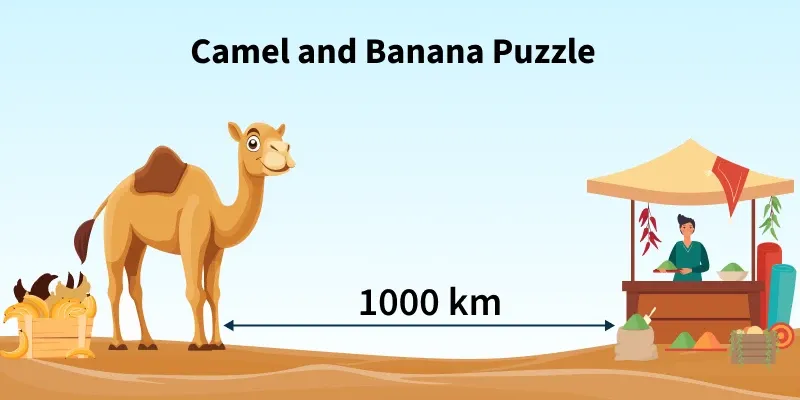
A person owns a banana plantation and needs to transport 3000 bananas to a market located 1000 km away. The only available means of transportation is a camel.
The camel has the following limitations:
The camel may make multiple trips and can store bananas at intermediate points.
Determine the maximum number of bananas that can be delivered to the market.
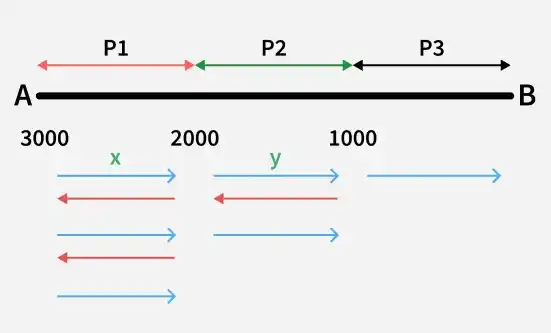
To minimise the loss of bananas, the journey is divided into three stages: P1, P2, and P3. At each stage, bananas are transported in parts, and the number of trips determines how many bananas are consumed per kilometre.
The diagram above shows how the number of bananas reduces from 3000 to 2000 to 1000 across the three stages before reaching the destination.
Step 1: From 3000 to 2000 Bananas
The camel must transport 3000 bananas, but it can carry only 1000 at a time. Therefore, 3 trips are required.
For each kilometre:
Total consumption = 5 bananas per kilometer
3000 − 5x = 2000
x = 200 km
After this stage:
Step 2: From 2000 to 1000 Bananas
Now, 2 trips are required.
For each kilometre:
Total consumption = 3 bananas per kilometer
2000 − 3y = 1000
y = 333.33 km
After this stage:
Step 3: Final Stage
At this stage, the camel carries 1000 bananas in a single trip.
Remaining distance:
1000 − 533.33 = 466.67 kmBananas consumed:
466.67Bananas remaining at destination:
1000 − 466.67 = 533.33
The maximum number of bananas that can reach the destination is approximately 533 bananas.