|
VOOZH | about |
|
VOOZH | about |
NCERT CBSE Class 12th Science Notes Chapter 9 Biotechnology: Principles and Processes: Biotechnology Principles and Processes is an important part of Class 12 Science Notes for quick revision. They will benefit from having challenging study material to use in preparing for the exam. Students can get CBSE Class 12th Science Notes Chapter 9 Biotechnology: Principles and Processes, Biotechnology, the principle of biotechnology, Recombinant DNA Technology, Separation and Isolation of DNA Fragments, Tools of Recombinant DNA Technology.
The branch of biology known as biotechnology is where technology is used to improve human health. Biotechnology is the production, development, and modification of useful products to satisfy the needs of all living things.
The name "biotechnology" comes from the Greek words "bios," which means "life," "techno," which means "technology," and "logos," which means "language," or "proof." Biotechnology is the technical use of living organisms for a variety of purposes, including food, medicine, medicines, and recycling. Biotechnology is the combination of biology and technology for human benefit and sustainable development. Biotechnology is a technology that uses biological systems, living organisms, or parts of them, to produce or create various products.
The Benefits of biotechnology help in overcoming numerous problems across several industries. While the most common applications of biotechnology are in the fields of medicine, the environment, marine biology, and industry, there are other applications as well. Biotechnology provides farmers now have access to technologies with tools that can reduce production costs and improve management. For instance, some biotechnology crops can be modified to withstand particular herbicides, simplifying and improving weed control. According to legend, the term "biotechnology", sometimes referred to as "biotech", was first used in 1919 by the Hungarian engineer Karl Erecki. Biotechnology is a fast-growing career option with emerging demand in fields such as pharmaceuticals, animal husbandry, agriculture, health care, medicine, genetic engineering, etc. We are studying Genetic Engineering, Bioinformatics, and Bioprocess Engineering under Modern Biotechnology.
Genetic engineering is the procedure of altering an organism's genetic composition. A cloning vector is typically used to insert a desired gene, such as pest-resistant or antibiotic-resistant genes, into a host. It integrates the desired gene into the host genome, and transformation can be seen in the host phenotype.
Through bioprocess engineering, the production of many products can be accelerated and carried out on a large scale, including enzymes, antibodies, organic acids, vaccines, etc. The desired microorganisms are developed under controlled, sterile, and appropriate conditions for this purpose.
In bioinformatics, biological data such as genome and protein sequences are stored, preserved, and retrieved for many different purposes.
Among many, the two fundamental techniques that contributed to the development of modern biotechnology are :
The following are the main methods used in genetic engineering:
This restriction is overridden by genetic engineering techniques such as recombinant DNA production, gene cloning, and gene transfer, which enable us to extract and introduce only one or a small number of desired genes without introducing unwanted genes into the desired organism.
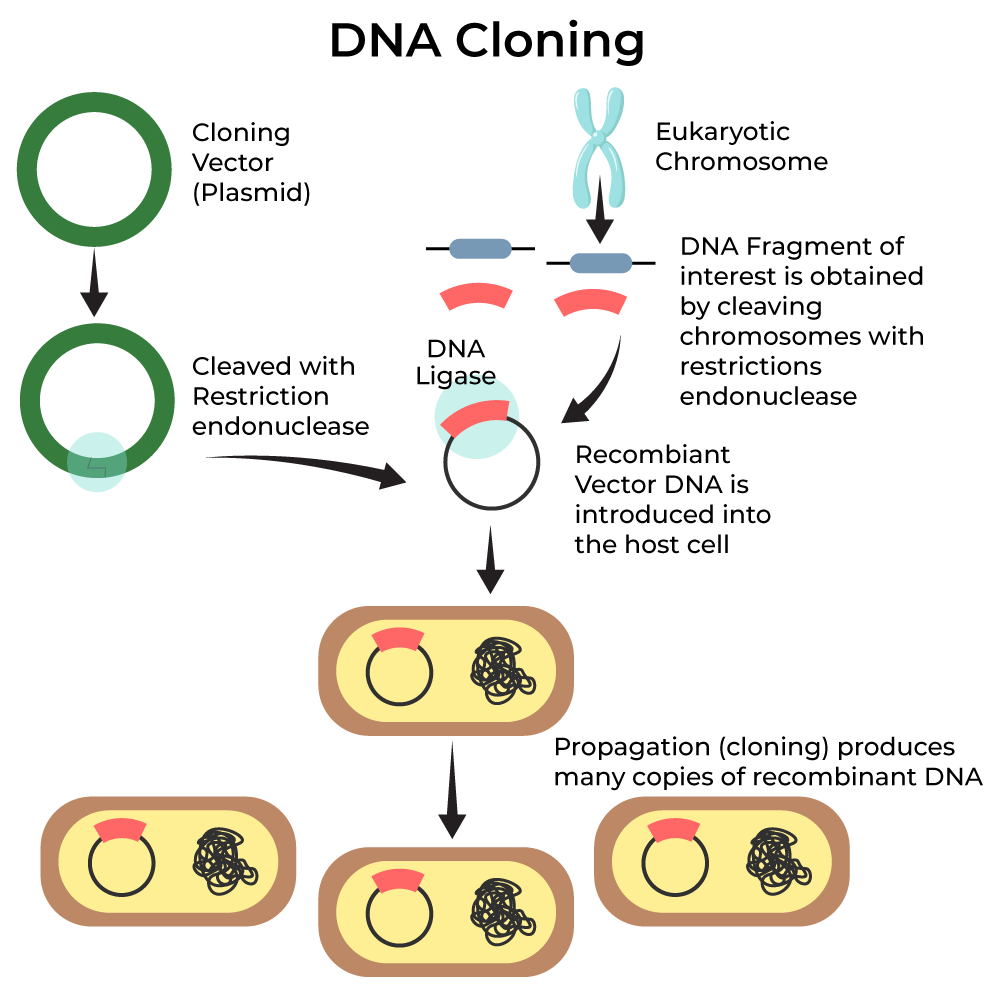
DNA cloning is the procedure of comprising multiple identical copies of a portion of DNA. This procedure necessitates the use of cloning vectors with the following characteristics:
The origin of replication is a specific DNA sequence in the chromosome that is responsible for initiating replication. Consequently, for any foreign piece of DNA to multiply in an organism, it must be a component of a chromosome(s) with a certain specific sequence referred to as the 'origin of replication'.The genomic regions where DNA replication begins are commonly referred to as DNA replication origins. However, they do have at least two distinct elements: the DNA region that will form the pre-replication complex and that will be recognized and bound by specialized proteins.
Plasmids are small, circular DNA molecules that can reproduce autonomously, as they do not depend on an organism's chromosomal DNA for replication. As a result, plasmids are often referred to as extrachromosomal DNA. Plasmids are important genetic engineering tools as they help in gene cloning and gene therapy.
Plasmids are present in bacteria and some eukaryotes. A plasmid can range in size from 1 to 200 kb and produces enzymes that can break down antibiotics or heavy metals. Plasmids are classified into five types: fertility F-plasmids, resistance plasmids, virulence plasmids, degradation plasmids, and Col plasmids.
Recombinant DNA technology modifies the phenotype of an organism (the host) by using a genetically modified vector. This cloning vector is injected and incorporated into the organism's genome.
So, basically, this process involves essentially entails inserting a foreign portion of DNA into the genome that consists of our genes of interest. The gene which is included is the recombinant gene and the technique is referred to as the recombinant DNA technology. Here we will learn about the major tools of recombinant DNA technology.
The following is a discussion of the various tools used for various purposes. The above explanation has shown us that key tools such as restriction enzymes, polymerase enzymes, ligases, vectors, and host organisms are essential for genetic engineering or recombinant DNA technology to be successful.
The position at which the desired gene is inserted into the vector genome is greatly influenced by the restriction enzymes utilized in recombinant DNA technology. E-coli was the first restriction enzyme to be isolated in 1963 from the development of bacteriophage in the laboratory.
This enzyme was able to cleave DNA but not the precise side of DNA cleavage. In 1970 Hemeltan Smith and his co-worker isolate the restriction enzyme activity from the bacterium Haemophilus influenzae strain Rd, showing it was able to cleave DNA at a specific site that is referred to as Hind II recognized six double Standard DNA Sequence that is GI, PY, PU, AC.
In addition to Hind II, there are approximately 900 restriction enzymes known, each of which recognizes a different recognition sequence. These enzymes were isolated from over 230 bacterial strains.
Restriction enzymes are part of a larger class of enzymes referred to as nucleases. Nucleases degrade the DNA Molecules by breaking the phosphodiesterase bond that is one molecule nucleotide the next in the DNA strength. Exonucleases and endonucleases are two different types of nucleases. Exonucleases remove nucleotides one at a time from the ends of the DNA whereas, endonucleases comprised cuts at specific positions within the DNA. The DNA is cut at specified locations by restriction endonucleases, which are sequence-specific and typically palindrome sequences.
For example, E-coli enzyme Exonucleases degrade just one end of the double standard molecules and leave single standard DNA as a product. Sequences read identically in a 5' à 3' direction on both strands. This is also accurate when measured from 3' to 5'..
5' —— GAATTC —— 3'
3' —— CTTAAG —— 5'
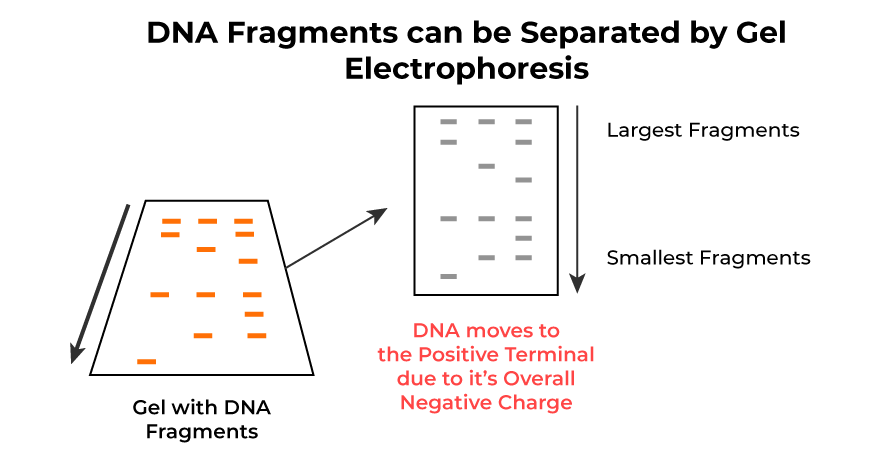
The cutting of DNA by restriction endonucleases results in fragments of DNA. These fragments can be separated by a technique referred to as gel electrophoresis. the component of each reaction take separated to determine the length of each strand. It consists of a thin layer of gel made of polyacrylamide and 5 ml of DNA placed onto the gel strand. Because DNA fragments are negatively charged molecules, they can be separated by forcing them to move toward the anode during a medium/matrix. Agarose is one of the components of Agar that is a mixture of polyacrylamide isolated from certain seaweeds. The DNA fragments separate (resolve) as per their size during the sieving effect provided by the agarose gel. The separated DNA fragments can be exposed only after staining the DNA with a compound referred to as ethidium bromide dye followed by highlighting to UV radiation. In a UV-exposed ethidium bromide-stained gel, bright orange bands of DNA can be seen. The separated DNA bands are sliced off of the agarose gel and removed from the gel component. This process is called elution. The purified DNA fragments are utilized to create recombinant DNA by combining them with cloning vectors.
The vectors support carrying and inserting the desired gene. These are a very important part of the tools of recombinant DNA technology as they are the final vehicles that carry the desired gene further into the host organism. The two most popular types of vectors used in recombinant DNA technology are bacteriophages and plasmids.
👁 Types of VectorsA vector is a DNA molecule used to introduce foreign DNA into a host cell. It is capable to self-replicate and integrating into the host cell. These vectors have aided in the analysis of the molecular structure of DNA.
Vectors can be a plasmid from the bacterium, a cell from a higher organism, or DNA from a virus. The target DNA is integrated into the particular sites of the vector and ligated by DNA ligase. The host cell is subsequently modified to receive the vector, allowing replication.
A DNA molecule which when a foreign DNA is inserted has the ability to replicate it autonomously to give birth to multiple clones of recombinant DNA is referred to as a cloning vector. Plasmids and phages are cloning vectors.
Some of these basic characteristics are extremely required for their functions. This involves the presence of a suitable cloning site as well as selectable markers. Some other characteristics can be accessible but their functionality is limited. The cloning process is usually performed using E. coli and therefore cloning vectors usually contain systems to permit maintenance and function in E. coli. Sometimes, there are other characteristics that allow them to persist in organisms other than E. coli.
This involves isolating the gene from the donor cell, integrating it into a small carrier molecule (also called a vector), and then replicating it into the host cell. A few steps in this process are mentioned below.
Recombinant DNA technology consists of selecting the appropriate gene for administration into the host, after this, the correct vector is selected with which the gene is to be integrated and hence the recombinant DNA is formed. This recombinant DNA is then to be introduced into the host. Finally, it must be preserved in the host and passed on to the progeny.
Isolating DNA is difficult because it consists of nucleic acid that is contained within the nucleus. Cells from plants or animals are treated with specific enzymes during the enzymatically controlled process of DNA isolation. Pure DNA is isolated from the cells using enzymes like cellulose (for plant cells), lysozyme (for bacteria),, and chitinase (for fungi).
The isolated and extracted DNA is treated with restriction endonucleases which snip the DNA into fragments. Restriction enzymes using recombinant DNA technology are important for locating the site at which the desired gene is integrated into the vector genome.
The restriction endonucleases are specific sequences, usually palindrome sequences, and snip the DNA at certain points. They inspect the length of DNA and cut it at specific sites referred to as the restriction site. same restriction enzymes snip the targeted genes and the vectors to obtain the complementary sticky ends. This makes it easier for ligases to link the necessary gene to the vector.
Polymerase chain reaction (PCR) is a technique for amplifying a gene when the appropriate gene of interest is cut out using restriction enzymes. Multiple copies of the desired gene can be generated through this technique. Denaturation, annealing, and extension are the three phases of the PCR Technique.
The host is the ultimate tool of rDNA technology, which absorbs the vector engineered with the desired DNA with the help of enzymes. There are several techniques to introduce the desired recombinant DNA into the host organism. some important techniques such as Microinjection, different heating and cooling methods, use of the gene cannon, biolistics, etc.
In recombinant technologies, the desired gene is selected, followed by a selection of an ideal vector in which the specific gene is integrated, and then the gene of interest is fused with the vector to form recombinant DNA. Once this foreign DNA is integrated, the host multiplies and eventually produces the desired protein. The rDNA must be retained in the host and passed on to the progeny. In order for the desired protein to be produced, the gene that encodes for it needs to be expressed. It occurs only under optimized conditions. Not only the target protein has to be expressed but it has to be produced on a large scale.
Recombinant cells can be multiplied extensively using a continuous culture system. Here the cells are cultured in a sizable vessel and the medium is refreshed at regular changes to maintain optimum conditions. This aid to culture a large quantity of the desired protein. This can be achieved by utilizing a bioreactor.
A bioreactor supports to the production of a large quantity of culture. A bioreactor is a large vessel where various cells, including human or plant, or animal cells, can be cultured to produce new biological products. It provides appropriate conditions such as temperature, pH, substrate, oxygen, and so on that are necessary for the culturing of cells to develop desired products. The two types of bioreactors utilized for this purpose are simple stirred-tank bioreactors and sparged stirred-tank bioreactors.
Downstream processing is a sequential phase in which the final products are isolated, purified, and preserved before they are marketed. In this phase, the final product is developed with additives such as preservatives, pigments, and so on.