|
VOOZH | about |
|
VOOZH | about |
Inheritance is the term given to the process by which characters are passed from parents to offspring which forms the basis of heredity. Heredity is the process of passing down genetic traits from parents to offspring. The degree of difference in characters between a parent and offspring is called variation. All these are studied under genetics which deals with the study of inheritance and variation of characters passed from parents to offspring. The first proper documented study of this inheritance and variation was done by G.J. Mendel which is why he is considered the father of genetics.
In a living cell, the chromosomes of a particular gene are present in a diploid manner and each one is called an allele. Genotype is the genetic make-up of an organism i.e. the TT or tt. Whereas phenotype is the external morphological appearance or expression of the genotype i.e. TT phenotype will be tall and for tt phenotype will be dwarf.
Table of Content
Mendel used garden peas (Pisum sativum) to perform his hybridization experiment to study genetics for seven years i.e. from 1856 to 1863 which led him to propose the laws of inheritance. He first prepared self-pollination of the pea lines to obtain true breeds of particular characters and then performed cross-pollination/artificial pollination of those pea lines having contrasting characters. He selected seven pairs of contrasting characters i.e. 14-true breeding pea plant varieties. The contrasting pairs of characters are listed below;
Also Read: Mendels Law of Inheritance
👁 Characterstics of Mendel ExperimentMendel crossed tall and dwarf pea plants collected their seeds, and grew them to produce the first hybrid generation called the first filial progeny or F1 generation. Then he crosses the seeds to obtain the second filial progeny or F2 generation. Similarly, he crossed other contrasting characters containing plants to obtain F1 and F2 generations. After these crossings, he concluded that;
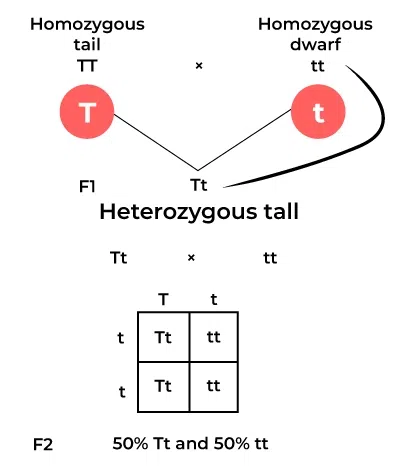
The above type of crossing that Mendel performed with only true-breeding pea line studying only one particular character is called monohybrid cross i.e. crossing of only one selected character. E.g. Homozygous tall (TT) crossed with homozygous dwarf (tt).
👁 Monohybrid CrossBased on this monohybrid cross he proposed two out of three laws from laws of inheritance. The two laws were;
Also Read: Law of Segregation And Law of Dominance
The law of segregation is universal whereas there are certain exceptions to the law of dominance. These exceptions are explained by the law of incomplete dominance as dicussed below:
It states that in some cases there is no dominant or recessive gene present i.e. both the parent will be expressed in the offspring but in an intermediate or mixed manner. E.g. snapdragon or dog flower (Antirrhinum sp.) where the red flower is dominant over white. When expressed as a heterozygous condition an intermediate expression occurs.
👁 Incomplete DominanceHere, in incomplete dominance, the phenotypic ratio changes from 3:1 to 1:2:1.
It states that in some cases there is no dominant gene or recessive gene, both genes act dominant and express themselves simultaneously in heterozygous conditions. E.g. ABO blood grouping in humans. It is controlled by the I-gene and has three types of alleles; IA, IB, i. IA and IB are dominant whereas i is recessive. When IA and IB are present together they are both expressed.
Blood Group (Phenotype) | Genotypes |
A | IAIA, IAi |
B | IBIB, IBi |
AB | IAIB |
O | ii |
Also Read: Co-Dominance
British geneticist R.C. Punnett developed a graphical representation called Punnett square to calculate the possibility of all possible genotypes of offspring in a genetic cross. E.g. the cross between TT(tall) and tt (dwarf) can be represented as;
The back cross is the cross in which the offspring from F1 progeny is crossed with either one of its parents.
👁 Back Cross
A test cross is the crossing of the F1 progeny with its recessive parent only to determine the unknown genotype of the individual.
Mendel also worked and crossed pea plants that differed into two characters and got a typical phenotypic ratio of 9 : 3 : 3: 1 and genotype ratio 1: 2: 2: 4: 1: 2: 1: 2: 1.
For example; let’s see the cross between homozygous round and yellow pea with homozygous wrinkled and green pea.
👁 Dihybrid CrossHere, the Phenotypic ratio = 9:3:3:1 and the Genotypic ratio = 1:2:1:2:4:2:1:2:1
Based on the dihybrid cross Mendel proposed the third law from the three laws of inheritance;
It states that “in the combination of two pairs of traits in a hybrid, segregation of one pair of characters is independent of the other pair of characters”.
Also Read: Difference between Monohybrid and Dihybrid cross
Mendel’s work was not accepted at that time because due to a lack of communication between the scientific communities, the use of maths in his work was not acceptable to some biologists, lack of physical proof of his work on the genes, etc. reasons. Then after years of his death, his work was rediscovered by three scientists namely Carl Correns, Hugo De Vries, and Von Tschermrk independently. They were able to do so due to the development of a microscope so that cell division and its chromosomes were observable.
Based on the work done by the above three scientists to rediscover Mendel’s work Walter Sutton and Theodore Boveri noted that the behavior of chromosomes was parallel to the behavior of genes and they used chromosome movement to explain Mendel's Laws. Based on this development they proposed the Chromosomal Theory of Inheritance. The salient features of this theory were;
Experimental verification of this theory was done by T.H. Morgan, who worked with fruit flies (Drosophila melanogaster). He chose fruit flies because;
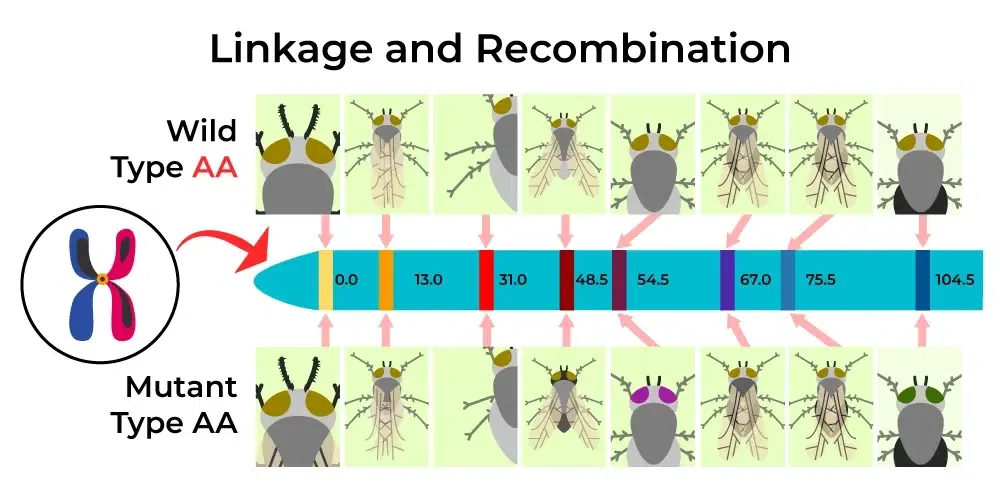
The term linkage and crossing over is introduced by TH Morgan. The physical association of parental genes in a chromosome is called linkage, such genes are called Linked genes and recombination is used to describe non-parental gene combinations. When two genes in a dihybrid cross were situated on the same chromosome, the proportions of parental gene combinations were much higher than in the non-parental type. Linked genes are exceptions to the law of independent assortment (3rd law).
Later Morgan's student Alfred Sturtevant used the frequency of recombination between genes on the same chromosome as a measure of distance between genes and mapped their position on chromosomes. Genetic maps are used in human genome projects (HGP).
👁 Linkage and RecombinationBoth these phenomena are exceptions to Mendel’s laws of Inheritance. In pleiotropy, a single gene can exhibit multiple phenotypic expressions. It is the effect of a gene on metabolic pathways which contributes to different phenotypes. E.g. White-eye mutation in Drosophila results in changes in body color, and starch grain size in pea seed and seed size where a single gene control both starch grain size and seed shape.
Whereas polygenic inheritance is the condition in which a character’s expression is controlled by the number of genes. E.g. height of a human, human skin color which is controlled by three genes A, B, and C where AABBCC leads to the darkest skin color, AaBbCc leads to intermediate skin color, and aabbcc leads to the lightest skin color or albino condition.
The chromosome involved in sex determination is called the sex chromosome (Allosome). Whereas the chromosome in an organism other than the sex chromosome is called somatic chromosomes (Autosomes). Henking (1891) studied spermatogenesis in some insects in which he observed that 50% of sperm received a nuclear structure after spermatogenesis, other 50% of sperm did not receive it, he named them as ‘X-body’ is now called X-chromosome. There are various mechanisms of sex determination, these are;
The mutation is a sudden heritable change in DNA sequences resulting in changes in the genotype (and sometimes phenotype) of an organism. It is the alteration in chromosomes that result in abnormalities or aberrations that can be easily observed in cancer cells. The substance that causes mutations are called Mutagens and these are of two types;
Mutations are of two types;
👁 Types of MutationThe analysis of a trait or traits in several generations of a family is called pedigree analysis. It is represented in the form of a hierarchical chart that is called the pedigree tree. It helps to trace the inheritance of a specific trait or abnormality or disease.
👁 Pedigree AnalysisThe disorders that occur due to defect in the genetic structure of a person is called a genetic disorder. These disorders can get transmitted from one generation to another. There are mainly 2 types of genetic disorders Mendelian disorders and Chromosomal disorders.
It occurs due to mutation or alteration in a single gene. These are transmitted to the offspring and can be traced in a family using pedigree analysis.
They are caused due to absence or excess or abnormal arrangement of one or more chromosomes that results due to the failure of segregation of chromatids during the cell-division cycle resulting in the gain or loss of a chromosome(s), which is called Aneuploidy.
Learn from CBSE Previous Year Question Papers to boost your understanding and excel in your studies.
CBSE Class 12 Previous Year Question Paper for Biology (2022) | |
Previous Year Question Paper for CBSE Class 12 Biology – 2020 |
Also Read: